
Quick Answer
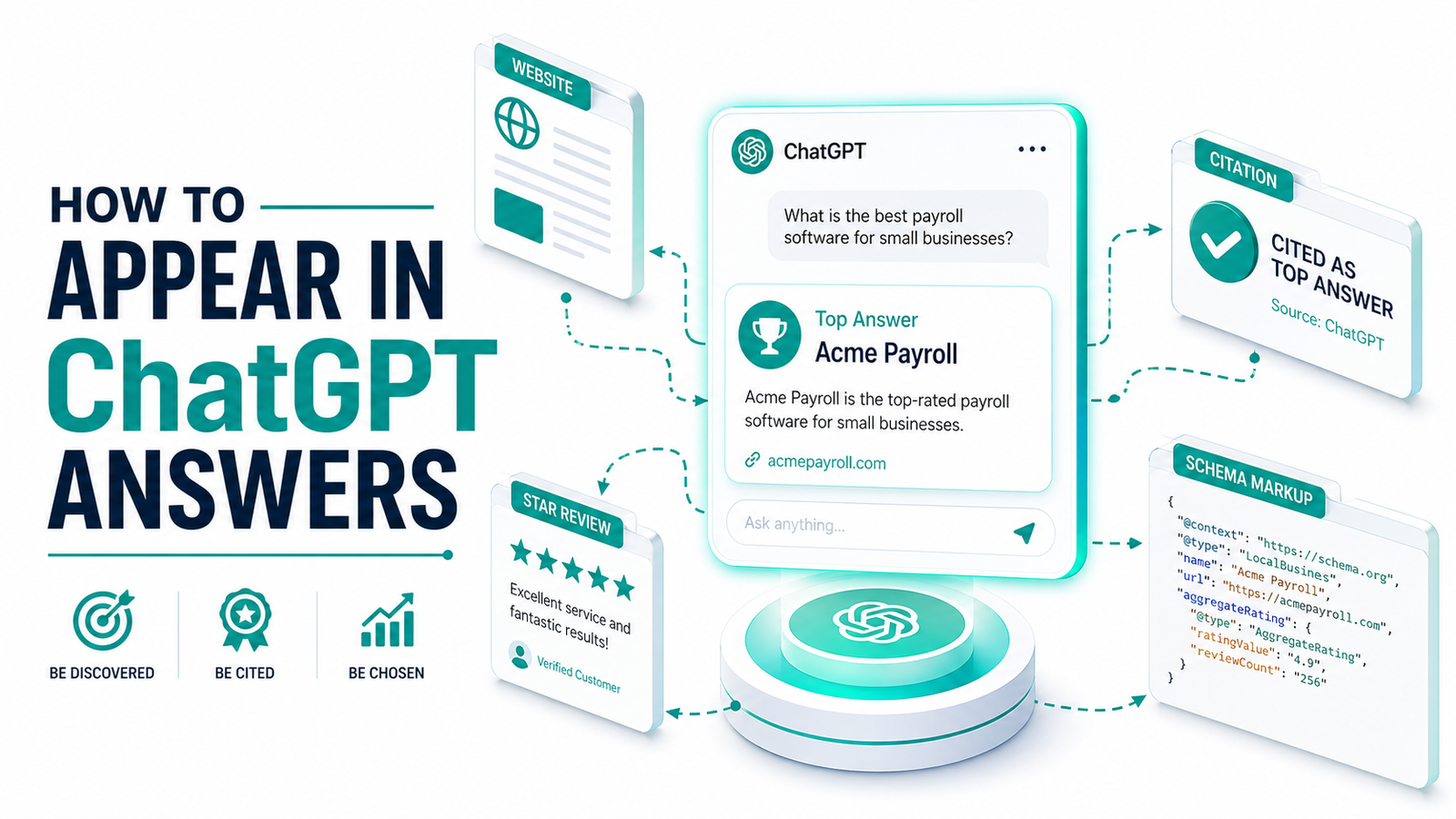
To appear in ChatGPT answers, you need three things working together: structured, answer-first content that directly addresses questions your customers ask; entity authority signals that confirm your business is real, established and credible across multiple platforms; and schema markup and technical access that allows AI crawlers to read and understand your pages. None of these alone is sufficient. All three together create a compounding citation advantage that grows over time. This guide walks through each in detail with the exact implementation steps.
Why Appearing in ChatGPT Answers Matters More Than Ever
The Business CaseThe numbers are no longer arguable. ChatGPT Search handles over 1.8 billion monthly queries, growing at 340 percent year on year. 64 percent of consumers now use AI tools to discover new products and brands. Among frequent online shoppers, 34 percent turn to ChatGPT first when researching a purchase. This is not a niche behaviour. It is mainstream commercial search behaviour affecting every industry, every geography and every business size.
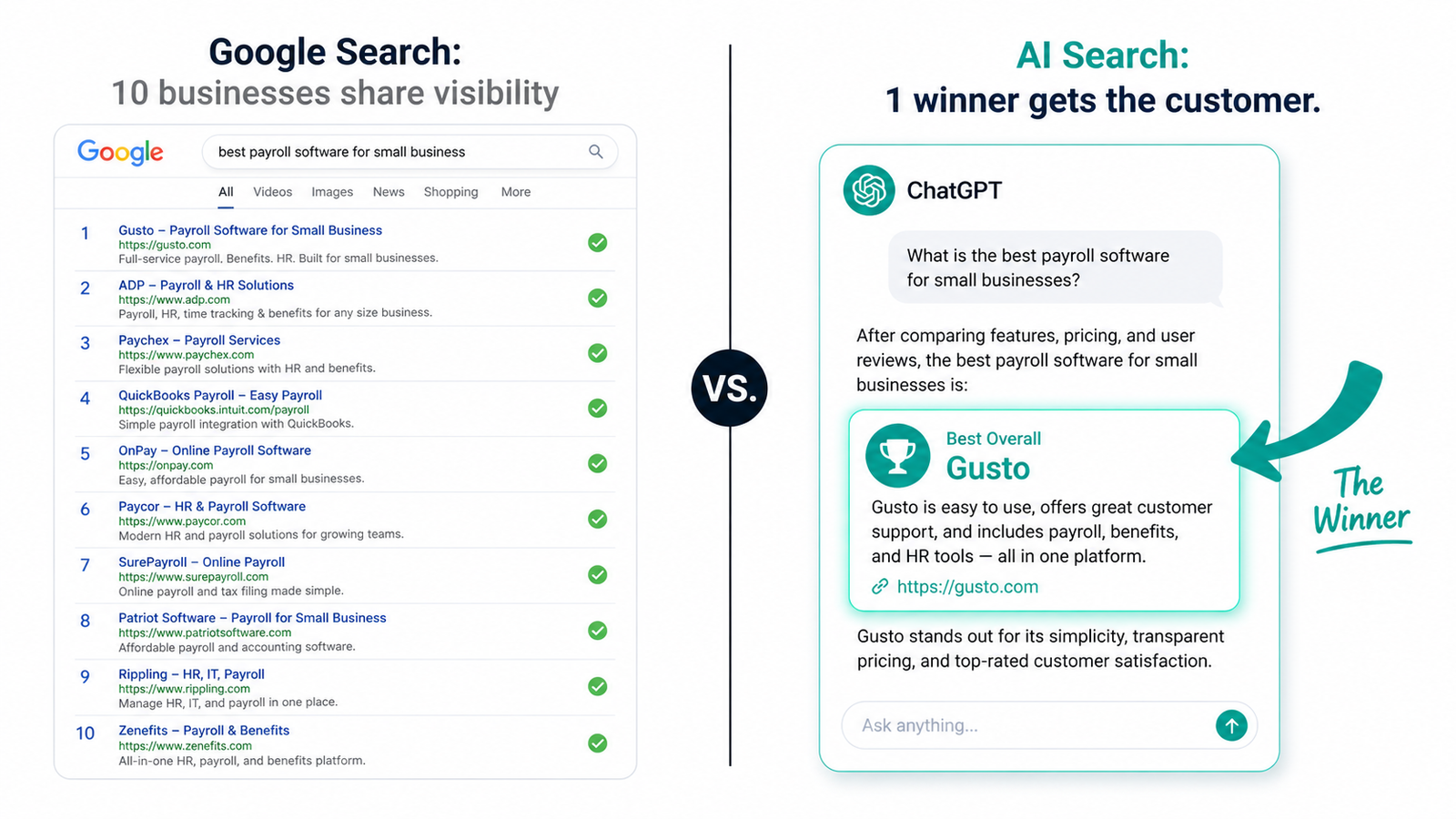
The fundamental difference between traditional search and AI search is binary. On Google, ten businesses can appear on page one and all receive traffic. When a user asks ChatGPT "what is the best digital marketing agency for small businesses?", ChatGPT presents one or two answers. Your business either appears in that answer or it does not exist to that user at that moment.
The risk of inaction: A Similarweb 2026 study tracking 113 brands across ChatGPT, Gemini and Perplexity found dramatic swings in AI visibility over just nine months. Early movers that established citation authority maintained it. Late entrants found competitors already occupying the citation positions for their category. The cost of waiting increases every month.
How ChatGPT Actually Decides What to Cite
Technical ExplainerBefore you can optimise for ChatGPT, you need to understand exactly how it selects the sources it includes in its answers. This is different from how Google ranks pages, and confusing the two leads to wasted effort.
Stage 1: Training Data (Base Knowledge)
The core ChatGPT model was trained on a massive dataset of text from the internet, books, research papers and other sources up to a knowledge cutoff date. This training process does not store individual pages. Instead, it learns patterns, facts, associations and reputations. To influence what ChatGPT knows about your brand from its base training, your business needs consistent, credible mentions across multiple independent sources — not just your own website.
A 2025 University of Toronto study found that ChatGPT cited third party earned sources 93.5 percent of the time for well known brands and 95.1 percent of the time for niche brands. Your own website content is one signal. What other credible sources say about you is the dominant driver of ChatGPT's training data representation.
Stage 2: Live Search and Retrieval Augmented Generation
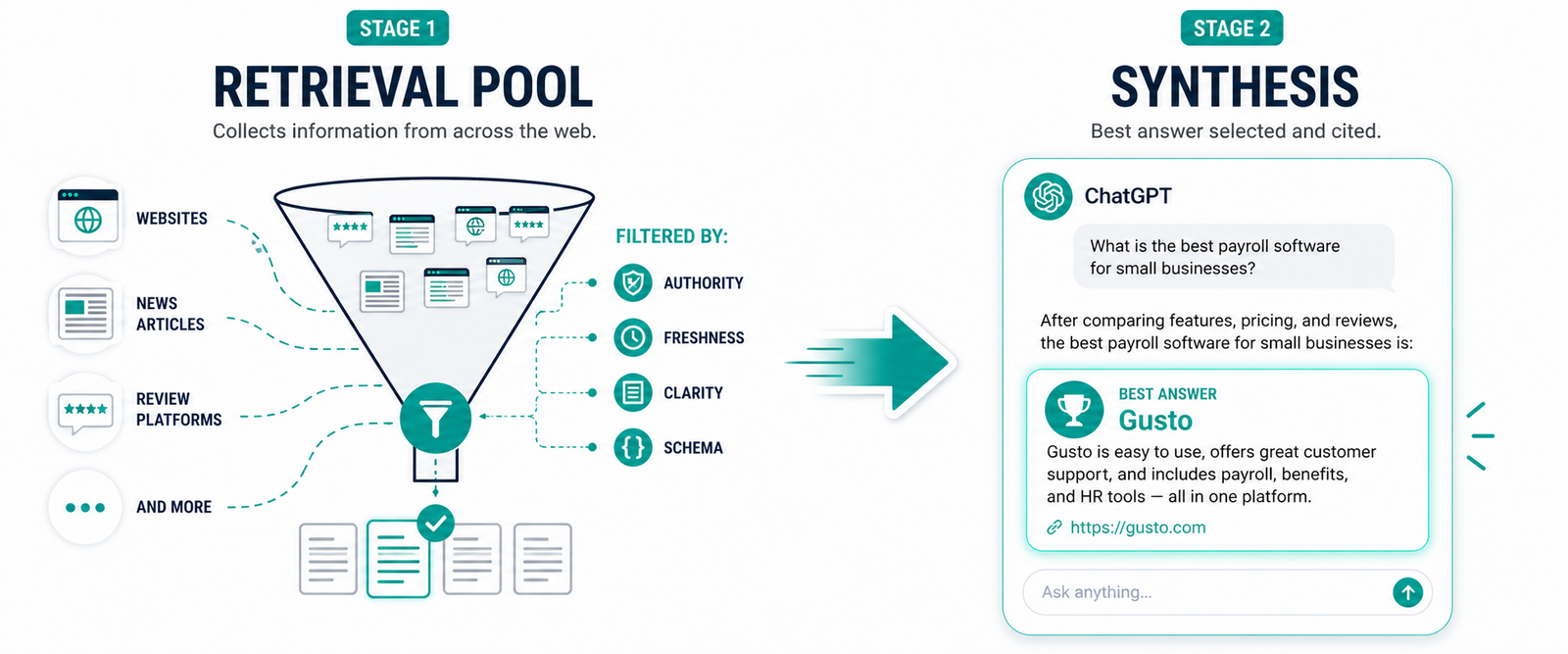
When ChatGPT's browsing mode is active, or when a user uses ChatGPT Search, the system performs real time web retrieval at query time. This is Retrieval Augmented Generation (RAG) — it searches the live web, retrieves relevant sources, and synthesises them into an answer with citations. For this stage, traditional SEO signals (domain authority, page speed, crawlability, structured content) combine with content clarity and schema markup to determine whether your page enters the retrieval pool.
Research from Ahrefs found that 71.7 percent of ChatGPT citations come from pages with organic search presence. Seer Interactive analysed over 300,000 keywords and found a 0.65 correlation between ranking on Google page one and being cited by ChatGPT. Strong AI SEO foundations are prerequisites for reliable ChatGPT citation.
What Determines Training Data Representation
- Volume of credible third party mentions of your brand
- Consistency of brand identity across the web
- Presence on authoritative review and directory platforms
- Quality and authority of sites that reference you
- Clarity and specificity of how your brand is described
- How narrowly your brand is focused on a specific category
What Determines Live Retrieval Citation
- Page authority and domain trust (traditional SEO)
- Content structure: answer-first, clear headings, short paragraphs
- Schema markup present and accurate
- AI crawler access not blocked in robots.txt
- Page speed and Core Web Vitals pass
- Content freshness and recency signals
The practical implication: You need two parallel strategies. For training data visibility (ChatGPT base model), focus on entity building and external brand mentions over 3 to 6 months. For live retrieval visibility (ChatGPT Search, Perplexity, Google AI Overviews), focus on content structure, schema and technical SEO — results appear within 4 to 8 weeks. Our GEO Optimization service runs both simultaneously.
The 3 Pillars of AI Citation Success
Core FrameworkEvery strategy in this guide falls under one of three pillars. Understanding the framework helps you prioritise correctly and avoid spending effort on tactics that cannot work without the right foundations in place.
Pillar 1: Content That AI Can Cite
Your content must be structured in a way that AI systems can extract and present a clear, direct answer. This means answer-first writing, question based headings, specific data points and FAQ sections. Without citable content, no amount of entity building or technical work will generate consistent citations.
- Answer-first paragraph structure
- Question based H2 and H3 headings
- Specific statistics with cited sources
- FAQ sections on every key page
- Expert perspective and first hand experience
Pillar 2: Entity Authority
Your business must exist as a recognisable, trustworthy entity across multiple independent platforms. AI systems want corroboration before they recommend a brand. If your website is the only place that says you are credible, AI systems treat you as an unknown. External validation from credible third parties is the dominant citation driver.
- Consistent NAP across all platforms
- Google Business Profile verified
- Clutch, GoodFirms, directory listings
- Founder LinkedIn with credentials
- Client reviews on multiple platforms
Pillar 3: Technical and Schema
AI crawlers need to be able to access, read and understand your content. Technical issues that block access or slow page loading directly reduce citation probability. Schema markup in JSON-LD format provides machine readable context that increases citation precision and reliability across all AI platforms.
- AI crawlers allowed in robots.txt
- Page speed under 3 seconds
- FAQPage schema on all FAQ sections
- Article schema on all blog content
- LocalBusiness or Organization schema on homepage
The Content Strategy That Gets You Cited
Content GuideContent is where most businesses fail at AI citation — not because they produce too little, but because they produce the wrong kind. Here is exactly what the research shows about which content characteristics drive AI citation, and how to apply them.
Write Answer-First Content for Every Page
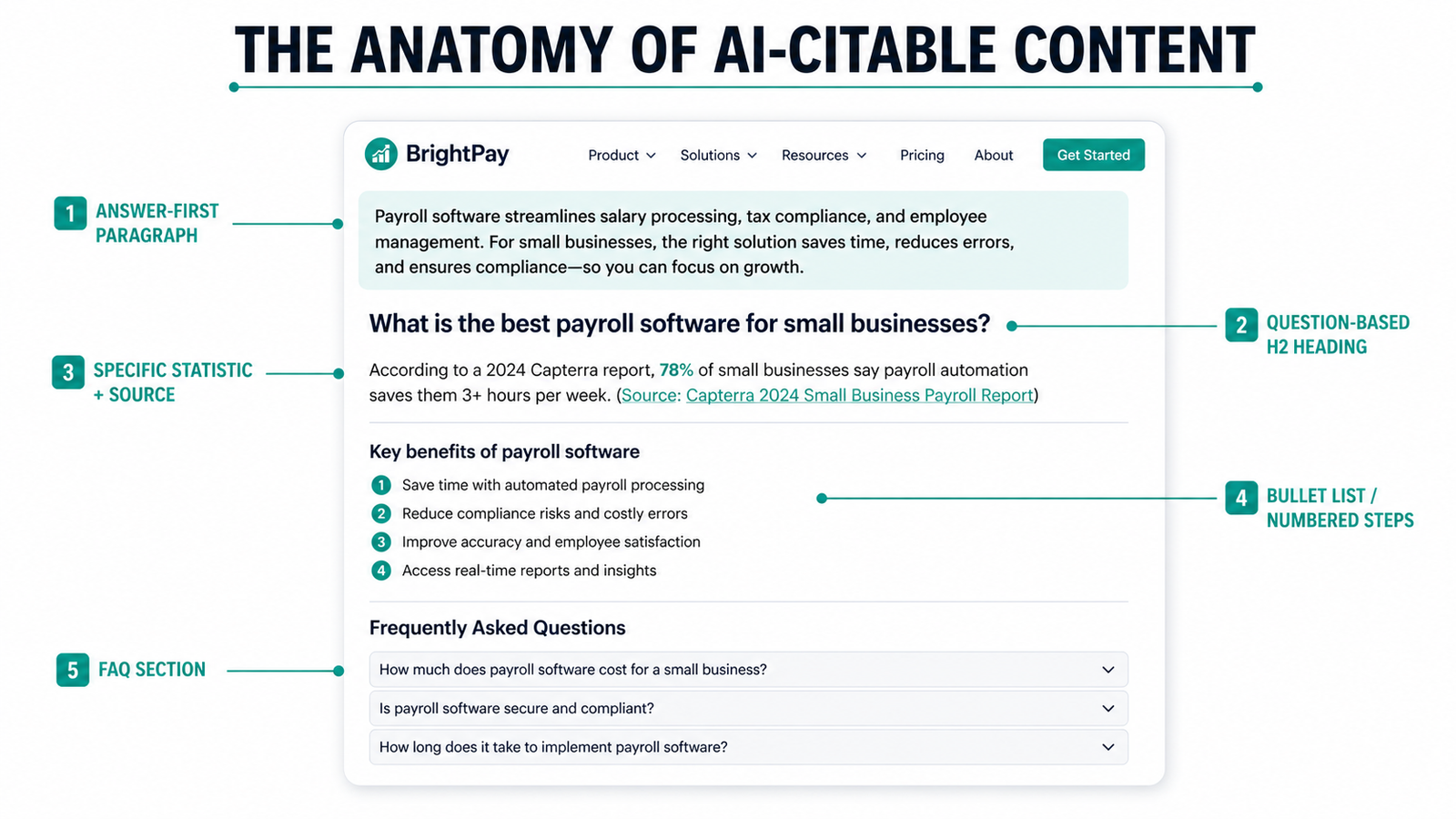
The single most important content change you can make is to rewrite the opening paragraph of every service page, product page and blog post to lead with a direct, specific answer to the most likely question a visitor has. AI systems extract the clearest answer from within a page — and the first paragraph is weighted most heavily. Instead of "At GrowingAI we have been helping businesses grow since…" your opening should be "GEO Optimization is the process of structuring your website content and brand signals so that AI systems like ChatGPT and Perplexity cite your business in their answers." Every page. Every time. No exceptions.
Rewrite All Headings as Questions Your Customers Actually Ask
AI systems are optimised to match questions to answers. When your heading is "Our Services", AI systems cannot connect it to a user query. When your heading is "What Does a GEO Optimization Agency Do?", it matches directly to that query and your content beneath it becomes a candidate answer. Use tools like AnswerThePublic, AlsoAsked and Google's People Also Ask box to identify the exact question phrasings your customers use. Rewrite every H2 and H3 on every key page. A Princeton GEO study found that pages using question-based headings received up to 38 percent more AI citations than the same content with descriptive headings.
Include Specific, Cited Statistics on Every Page
AI systems strongly prefer content that contains specific data points, percentages and research citations over content that makes general claims. "Many businesses struggle with AI visibility" is not citable. "A 2025 BrightEdge study found that only 3 percent of businesses have implemented any GEO optimisation strategy despite 64 percent of consumers using AI tools to discover brands" is citable. Add at least two to four specific statistics per major page, citing the source in the text. This signals to AI systems that your content is authoritative, current and trustworthy — the same attributes that drive citation selection.
Build Comprehensive FAQ Sections on Every Key Page
FAQ sections are the single highest-performing content format for AI citation. They are structured as question-answer pairs — exactly how AI systems retrieve and present information. Every service page, product page and cornerstone blog post should have a dedicated FAQ section with a minimum of six to eight questions. Questions should include the full conversational phrasing a user might type into ChatGPT ("How long does it take to appear in ChatGPT answers?" not "Timeline"). Answers should be two to four sentences, direct and specific. These FAQ sections should then have FAQPage schema markup applied — covered in Section 6 of this guide.
Demonstrate First-Hand Experience and Expert Perspective
Google's EEAT framework (Experience, Expertise, Authoritativeness, Trustworthiness) directly influences which sources AI systems treat as credible enough to cite. Content that demonstrates genuine first-hand experience with the topic consistently outperforms generic explanations. Include specific client results with numbers ("We increased a UK-based e-commerce client's AI citation rate by 340 percent in 90 days"). Name the author and include a bio. Describe proprietary processes and frameworks. Share specific tools and workflows you actually use. AI systems are trained to favour content from people who have clearly done the thing they are writing about. Generic "here is how SEO works" content from anonymous authors performs poorly. See our guide on what GEO optimization actually involves for a real-world example of this approach.
Write One Comprehensive Cornerstone Page Per Topic Cluster
AI systems, particularly for complex topics, favour the single most comprehensive, authoritative source over multiple partial sources. For your primary service or product categories, create one 3,000 to 5,000 word cornerstone page that covers the topic more completely than any competitor. This page should answer every major question on the topic, link to supporting content, include statistics, FAQs, step-by-step guidance and examples. Then build a cluster of shorter supporting pages that link to this cornerstone. This hub and spoke content architecture is one of the most reliably effective GEO strategies, particularly for B2B service businesses. Our GEO service builds this architecture for every client from day one.
Content audit first: Before creating new content, audit existing pages for these characteristics. In most cases, rewriting existing service pages to be answer-first with question headings and FAQ sections delivers faster citation results than publishing new content — because existing pages already have some authority and index history.
Entity Building and Brand Authority Signals
Trust and CredibilityEntity building is the process of establishing your business as a recognised, trusted entity in AI knowledge systems. It is the most underestimated and most impactful long-term strategy for ChatGPT visibility. University of Toronto research confirms that third-party sources drive 93.5 percent of ChatGPT citations — meaning what the rest of the internet says about you matters far more than what your own website says.
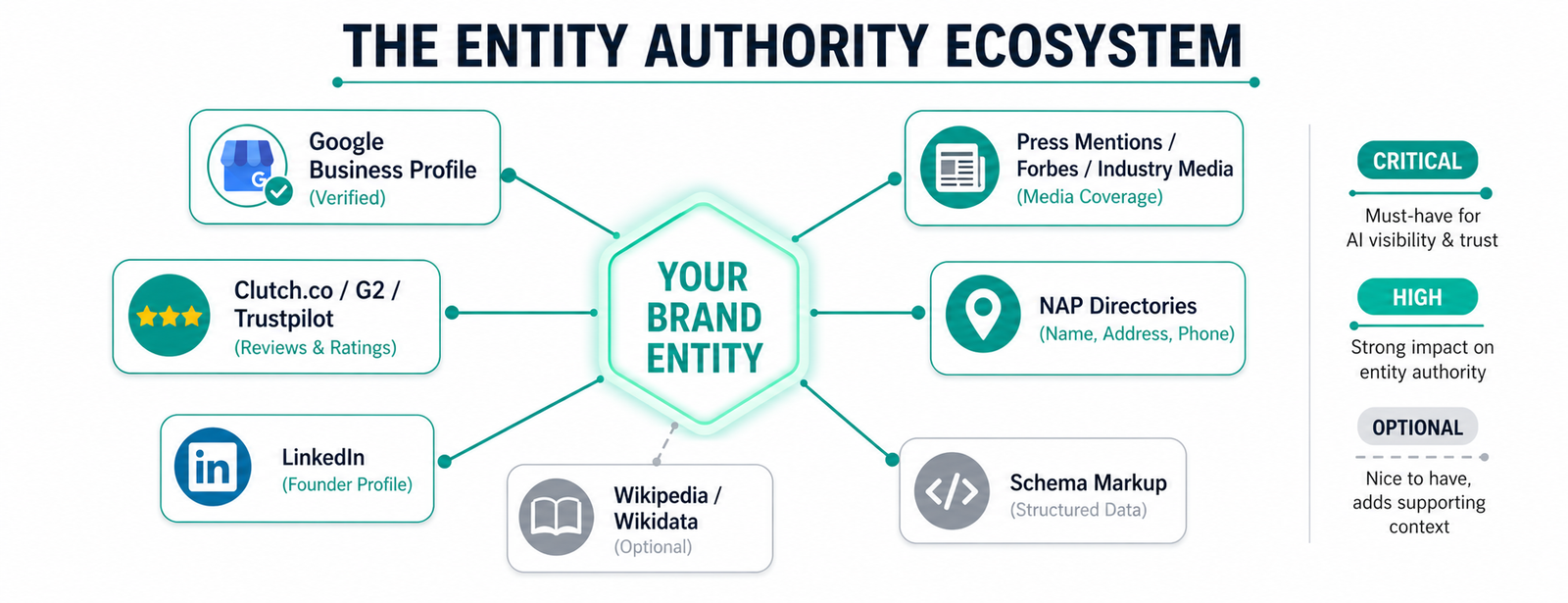
Step 1: Lock Your NAP Consistency
NAP stands for Name, Address, Phone number. Every single platform where your business is listed — Google Business Profile, Yelp, LinkedIn, Clutch, Trustpilot, Apple Maps, Bing Places, industry directories, your website footer, your email signature — must show the exact same business name, address and phone number. Even minor variations ("GrowingAI Ltd" vs "Growing AI Limited" vs "GrowingAI") fragment your entity signal and reduce AI systems' confidence in your business's identity. Audit every listing using a tool like Moz Local or BrightLocal and correct all discrepancies before doing anything else.
Step 2: Build Reviews Across Multiple Platforms
Reviews are among the strongest third-party credibility signals for AI citation. ChatGPT and Perplexity frequently cite Clutch, G2, Trustpilot, Google Business Profile and Capterra reviews when recommending service providers. You need a minimum of 15 to 20 verified reviews across at least three platforms. Actively request reviews from clients by sending a direct link to your review page. For service businesses, Clutch.co is particularly powerful because it is one of the platforms AI systems are trained to treat as authoritative for agency and consultant recommendations. Our team can advise on a review acquisition strategy appropriate for your industry and region.
Step 3: Earn Press Mentions and Backlinks from Authoritative Sources
The most powerful entity signals are editorial mentions from high-authority publications. A feature in Forbes, Entrepreneur, Search Engine Journal, or a top-tier industry publication tells AI systems that your brand is credible enough for a major outlet to cover. You do not need dozens of these — three to five high-quality press mentions on genuinely authoritative sites outperform fifty mentions on low-authority directories. Strategies for earning press coverage include: contributing expert quotes to journalists via HARO (Help a Reporter Out) or Qwoted; submitting original research or data studies to industry publications; writing guest opinion articles for relevant trade publications; and winning or being listed in industry awards. A single Forbes mention can meaningfully shift your AI citation frequency within weeks of publication.
Step 4: Build Founder and Team Authority on LinkedIn
AI systems increasingly treat founder and leadership LinkedIn profiles as credibility signals for businesses. A fully built-out founder LinkedIn profile with detailed experience, published articles, a professional headshot and a following of 500+ connections tells AI systems the business is led by a real, credible expert. Publish LinkedIn articles monthly on your area of expertise. Comment with substance on industry conversations. Connect your LinkedIn profile explicitly to your company page. This is particularly impactful for B2B service businesses where the founder's reputation is intrinsically linked to the business's credibility.
| Platform / Signal | AI Citation Impact | Priority | Time to Complete |
|---|---|---|---|
| Google Business Profile (verified) | Very High — directly indexed by all AI search | CRITICAL | 1–2 days |
| Clutch.co profile with 5+ reviews | Very High — primary B2B citation source | CRITICAL | 2–4 weeks |
| Consistent NAP across 30+ directories | High — foundational entity signal | HIGH | 1 week |
| LinkedIn Company + Founder profile | High — B2B credibility anchor | HIGH | 2–3 days |
| Trustpilot / G2 reviews | High — third-party trust signal | HIGH | 2–6 weeks |
| Wikipedia / Wikidata entry | Very High if achievable — strongest possible entity signal | MEDIUM | 4–8 weeks |
| Press mention in DA 70+ publication | Very High — strongest training data influence | MEDIUM | 4–12 weeks |
| Industry awards and listings | Medium — supplementary corroboration | MEDIUM | Varies |
| Podcast appearances | Medium — expertise and third-party association signal | LOWER | Ongoing |
What not to do: Avoid purchasing fake reviews, submitting to hundreds of low-quality directories simultaneously, or using AI-generated press release content on newswires like PRWeb. These approaches do not build genuine entity authority and may actively damage your credibility signals. AI systems are trained on human-evaluated content from credible sources — only genuine third-party validation counts.
Schema Markup and Technical Setup for AI Crawlers
Technical GuideSchema markup is structured data in JSON-LD format that you add to your web pages to give AI systems and search engines machine-readable context about your content. It does not change how your page looks to visitors. It changes how AI systems understand what your page is about, who created it and what questions it answers. Implementing schema correctly is one of the highest return-on-time investments in GEO optimization — particularly FAQPage schema, which directly surfaces your Q&A content for AI retrieval.
The 5 Schema Types Every Business Needs
1. FAQPage Schema
Apply to every page with a FAQ section. This is the most directly impactful schema type for AI citation — it explicitly marks your Q&A pairs as machine-readable FAQs that AI systems can extract for conversational responses. Place on service pages, product pages and blog posts. Each FAQ item should include the full question text and a complete, standalone answer.
2. Article Schema
Apply to all blog posts and long-form guides. Include datePublished, dateModified, author (with name and URL), publisher (with name and logo) and headline. The dateModified field is particularly important — AI systems factor in content freshness when selecting citations for time-sensitive queries. Update this field every time you make meaningful edits to a page.
3. Organization / LocalBusiness Schema
Apply to your homepage and About page. Include name, url, logo, description, foundingDate, areaServed, contactPoint and sameAs (linking to all your social profiles, Google Business Profile and directory listings). The sameAs array is particularly powerful — it explicitly tells AI systems that all your external profiles are the same entity as your website, consolidating your authority signals.
4. HowTo Schema
Apply to any page that walks through a process step by step. The HowTo schema type with individual HowToStep items is favoured by AI systems for instructional queries — exactly the kind of "how do I" questions most businesses want to be cited for. Each step should include a name, text and optionally an image. Applied to your service delivery or process pages, HowTo schema significantly increases citation probability for process-related queries.
5. Review and AggregateRating Schema
Apply to service pages and product pages where you have collected customer reviews. Include the aggregate rating (e.g. 4.8 out of 5 from 47 reviews) in machine-readable format. AI systems use this data to assess whether to recommend your business for comparison queries like "which is the best SEO agency for small businesses" — where rating signals influence citation selection.
Bonus: Person Schema
Apply to author bio pages and the About page section for your founder and key team members. Include name, jobTitle, worksFor, sameAs (LinkedIn URL, Twitter URL) and description. This links your team's expertise to your business entity and is particularly effective for B2B service businesses where personal authority drives citation credibility.
Technical Access: Make Sure AI Crawlers Can Reach You
Schema markup is useless if AI crawlers cannot access your pages. Check your robots.txt file for rules that block major AI crawlers. The following crawlers need to be explicitly allowed (or at minimum, not blocked): GPTBot (OpenAI/ChatGPT), PerplexityBot, Google-Extended, Anthropic-AI, ClaudeBot, FacebookBot, and Bytespider. A misconfigured robots.txt that blocks GPTBot will prevent ChatGPT Search from ever indexing your content for live retrieval — no matter how good your content is.
robots.txt check: Visit your yourdomain.com/robots.txt and look for any User-agent: GPTBot or User-agent: * followed by Disallow: /. If GPTBot is disallowed, add User-agent: GPTBot followed by Allow: / above the conflicting rule. Do the same for PerplexityBot, Google-Extended and ClaudeBot.
Beyond crawler access, ensure your pages load in under three seconds (test with Google PageSpeed Insights), pass Core Web Vitals, use HTTPS across the entire domain, and have no significant crawl errors in Google Search Console. These are not optional — they are table stakes for AI citation eligibility in the live retrieval stage.
Platform by Platform Strategies
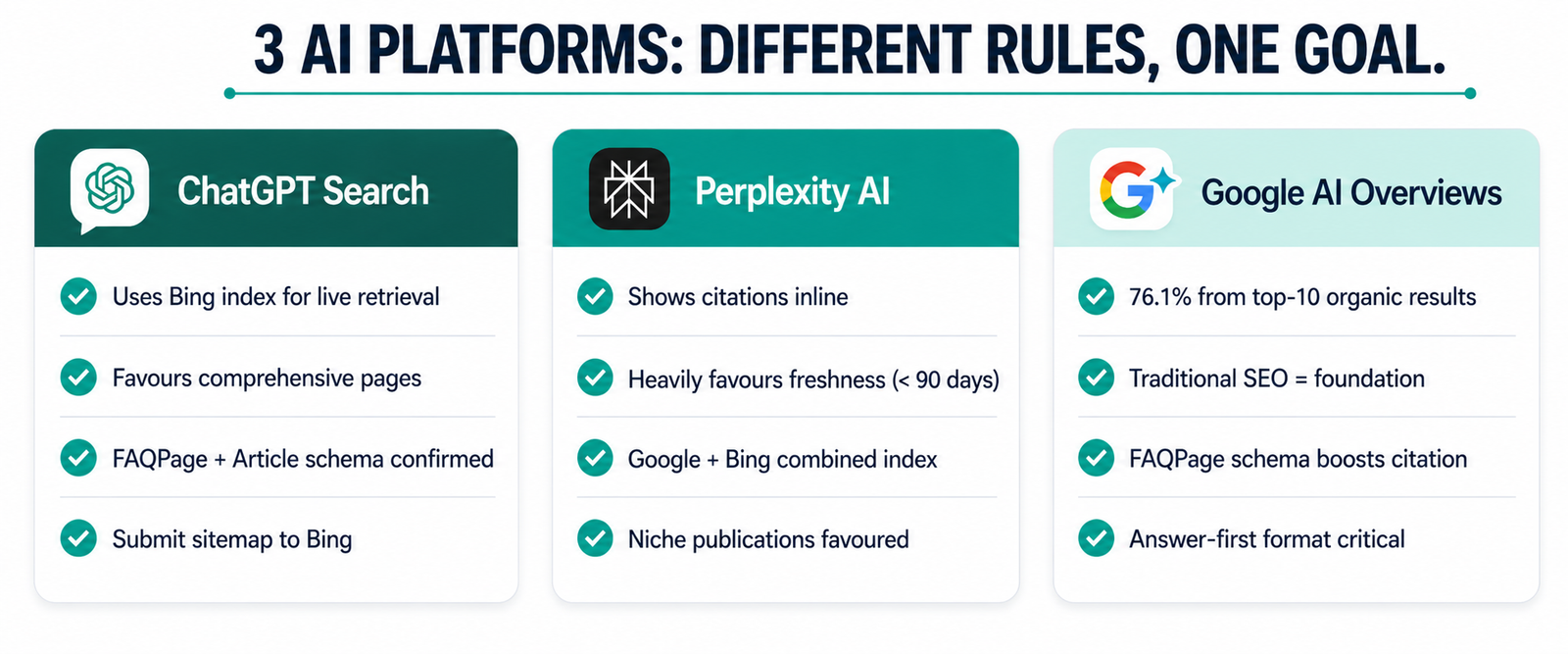
Platform GuideChatGPT, Perplexity and Google AI Overviews each have different citation mechanics. The core content and entity strategies in this guide work across all three, but each platform has nuances worth optimising for separately.
ChatGPT Search
ChatGPT Search combines live Bing web retrieval with OpenAI's base model knowledge. Pages in Bing's index are prioritised — so submitting your sitemap to Bing Webmaster Tools is essential. ChatGPT tends to cite well-structured, comprehensive pages over short thin content. FAQPage and Article schema are confirmed to influence citation selection. ChatGPT Search is more conversational and often synthesises multiple sources, so being the most complete answer on a topic increases citation probability even when you are not the single top ranking result.
- Submit sitemap to Bing Webmaster Tools
- Allow GPTBot in robots.txt
- FAQPage and Article schema on all key pages
- Aim for comprehensive, 1500+ word cornerstone pages
- Target question-format headings throughout
Perplexity AI
Perplexity is a search-native AI platform — it retrieves live web results for every query and synthesises them with citations shown inline. This makes Perplexity more transparent about its source selection than ChatGPT. Perplexity heavily favours pages that rank well on Google (it uses a combination of Google and Bing indices) and strongly prioritises freshness — pages updated within the past 30 to 90 days are cited significantly more often than stale content. Perplexity also features high-authority niche publications and industry-specific sites, making niche directory and trade publication mentions particularly valuable here.
- Update key pages regularly (at least quarterly)
- Allow PerplexityBot in robots.txt
- Build listings in industry-specific directories
- Include specific data and research citations
- Target industry publications for guest content
Google AI Overviews
Google AI Overviews appear directly in Google search results for commercial and informational queries. A Seer Interactive study found that 76.1 percent of AI Overview citations come from pages already in the top 10 organic results for that query — making traditional Google SEO performance the single strongest predictor of AI Overview visibility. However, pages with structured markup, FAQ sections and clear answer-first formatting are cited at significantly higher rates than top-10 pages without these features. The combination of strong organic rank plus GEO-optimised structure is the winning formula for Google AI Overviews.
- Rank in top 10 for target keywords (traditional SEO)
- Allow Google-Extended in robots.txt
- FAQPage schema on all FAQ sections
- Answer-first opening paragraphs
- Submit updated sitemap to Google Search Console
Realistic Timeline and Expectations
What to ExpectOne of the most common questions businesses ask us is: how long does it take to appear in ChatGPT answers? The honest answer is that it depends on two variables — your current baseline (existing authority, content quality, technical setup) and which AI platform you are targeting. Here is what our client data and published research show for a typical new GEO optimization programme.
Technical Foundation and Content Audit
Fix robots.txt to allow all major AI crawlers. Implement Organization schema on homepage. Audit all existing pages for answer-first structure and question headings. Identify top five pages for immediate content restructuring. Submit sitemap to Google Search Console and Bing Webmaster Tools. No visible citation changes yet — this is the foundation phase.
Content Restructure and Schema Implementation
Rewrite top five service pages with answer-first openings and question-based headings. Add FAQ sections with six to eight questions per page. Implement FAQPage schema on all FAQ sections. Add Article schema to all blog posts. Begin entity building: verify Google Business Profile, create or update Clutch profile, begin requesting reviews. First Perplexity citations may appear for long-tail queries with low existing competition.
Citations Begin — Live Retrieval Platforms
Google AI Overviews and Perplexity citations typically begin appearing for target queries at this stage, assuming the content changes and schema are in place. ChatGPT Search citations for live retrieval queries start emerging. NAP consistency corrections and directory listings take effect. Client review accumulation on Clutch and Trustpilot begins building visible third-party authority. Monitor using the tools described in Section 9.
Brand Training Data Influence Begins
Entity signals accumulated over months 1 through 3 begin influencing ChatGPT's base model responses for brand-specific queries. Press mentions and high-authority backlinks earned in months 2 and 3 start feeding into training data representation at the next model update cycle. Citation frequency increases across all platforms as authority compounds. This is where GEO optimization's long-term ROI becomes visible — earlier movers compound significantly faster than latecomers.
Compounding Authority and Category Dominance
Businesses that have maintained consistent GEO optimization for six months or more typically hold dominant citation positions in their category across all three major AI platforms. At this stage, the strategy shifts from building to defending and expanding — targeting new query clusters, expanding into adjacent service areas and monitoring competitor citation activity. The citation gap between early movers and latecomers is typically 3x to 5x by the 12-month mark.
Free and Paid Tools for Monitoring AI Citation
Monitoring StackYou cannot manage what you cannot measure. The good news is that the tooling for monitoring AI citation has improved dramatically in 2025 and 2026. Here are the tools we recommend for tracking your visibility across ChatGPT, Perplexity and Google AI Overviews — from free manual methods to enterprise platforms.
The most basic monitoring method: ask ChatGPT directly "What is the best [your service] in [your city/industry]?" and variants. Do this weekly for 10 to 15 core queries. Log results in a spreadsheet. Free, but time-consuming at scale. Best for businesses just starting out.
Enterprise-grade AI search tracking across ChatGPT, Perplexity and Google AI Overviews at scale. Tracks citation frequency, brand mention sentiment and competitive benchmarking across thousands of queries. Best for agencies and large businesses tracking 100+ queries.
Semrush now includes AI Overview tracking directly in its keyword reporting dashboard. Ideal for businesses already using Semrush for traditional SEO — adds AI visibility data without a separate tool. Tracks which of your pages are being cited in Google AI Overviews and which keywords trigger them.
Test your citation presence on Perplexity directly — it shows sources inline, making it easy to see whether your site is being cited and which competitor is being favoured instead. Free account limits daily queries; Pro account ($20/month) removes limits. Highly recommended for weekly monitoring.
Google Search Console now includes a filter for AI Overview impressions and clicks in the Performance report. This is the most reliable free data source for Google AI Overview visibility — it shows exactly which queries are triggering AI Overviews that include your pages. Available in all GSC accounts.
Purpose-built for tracking brand mentions across AI search platforms including ChatGPT, Perplexity, Gemini and Claude. Scores your brand's AI visibility and provides competitive benchmarking. Particularly useful for tracking sentiment — not just whether you are mentioned, but how positively you are described.
Recommended monitoring cadence: Weekly manual testing of 10 core queries across ChatGPT and Perplexity. Monthly review of Google Search Console AI Overview data. Quarterly competitive audit — test which competitors are being cited for your target queries and compare their content structure, entity signals and schema against yours. If you work with our GEO Optimization service, we provide monthly citation tracking reports as standard.
9 Mistakes That Are Killing Your AI Visibility
What to AvoidAfter auditing hundreds of business websites for AI citation readiness, we see the same mistakes repeated across every industry and geography. Avoiding these will immediately improve your citation eligibility without any additional content creation.
Blocking AI Crawlers in robots.txt
Approximately 28 percent of businesses have robots.txt rules that inadvertently block GPTBot, PerplexityBot or Google-Extended — often because they copied a broad disallow rule without realising AI crawlers were included. If ChatGPT's crawler cannot access your pages, it cannot cite them. Check yourdomain.com/robots.txt today and correct any conflicting rules for AI crawlers.
Writing for Humans But Not for AI Extraction
Content written entirely as flowing narrative — with no question-based headings, no answer-first opening, no FAQ section — is difficult for AI systems to extract a clean, citable answer from. AI systems need a clear signal: "here is the answer to this specific question." Beautiful prose without extractable structure rarely gets cited. Add structural signposts: question headings, bold key definitions, numbered processes and FAQ pairs.
Inconsistent Business Name Across Platforms
NAP inconsistency is one of the most common entity authority killers. "GrowingAI", "Growing AI", "GrowingAI Ltd" and "Growing AI Limited" are all different entities from an AI knowledge system's perspective. This fragmentation reduces the confidence AI systems have in your entity and directly lowers citation probability. Audit every listing and standardise your business name exactly — including punctuation, spacing and legal suffix — across every platform before doing anything else in your GEO strategy.
Relying Only on Your Own Website as a Credibility Source
If the only source saying your business is credible is your own website, AI systems treat you as an unknown quantity. The University of Toronto study showing 93.5 percent of ChatGPT citations come from third-party sources is a direct message: you need external validation. A business with ten credible third-party mentions outperforms a business with a perfectly optimised website and zero external mentions every time. External authority building is not optional — it is the primary lever.
Treating AI Search as the Same as Google SEO
Many businesses apply exactly the same approach to AI search as they do to Google SEO — targeting keyword density, building link volume, optimising title tags. While some SEO foundations carry over (domain authority, page speed, crawlability), AI search prioritises content structure, entity authority and answer clarity in ways that traditional SEO does not fully address. Read our AI SEO vs traditional SEO comparison for the full breakdown of where the strategies diverge.
Publishing Content Without Schema Markup
Schema markup is the machine-readable layer that tells AI systems what type of content a page contains, what questions it answers and who created it. Publishing content without schema is like submitting a CV in a language the hiring manager cannot read — the content might be excellent, but the message cannot be properly decoded. FAQPage schema on FAQ sections, Article schema on blog posts and Organization schema on the homepage are non-negotiable baseline implementations for any GEO strategy.
Setting Up GEO Once and Never Updating
AI search citation is not a "set and forget" strategy. AI platforms update their retrieval systems regularly. Query patterns shift. Competitors improve their strategies. Content freshness is a live retrieval signal — pages not updated in over 90 days are deprioritised by Perplexity and partially by ChatGPT Search. Build a quarterly content refresh schedule that updates statistics, adds new FAQ pairs and revises any outdated information on your key pages. Treat AI visibility like any other channel that requires ongoing maintenance.
Targeting Only Your Homepage for AI Optimization
Many businesses optimise their homepage for AI citation and ignore all other pages. In practice, AI citation happens at the page level — the specific page that best answers the specific query gets cited. A service page, a blog post, a case study or an FAQ hub can all be cited independently of your homepage. Every major page on your website that addresses a question your target customers ask should be individually optimised with answer-first content, question headings and schema markup.
Not Measuring AI Citation Performance
You cannot improve what you do not measure. The businesses making the fastest GEO progress are those tracking citation frequency weekly across ChatGPT and Perplexity, monitoring Google Search Console for AI Overview data monthly, and auditing competitor citation positions quarterly. Without measurement, you are guessing. The tools in Section 9 of this guide give you a free-to-affordable monitoring stack that covers all three major platforms. Start with manual testing this week and add paid tools as your programme scales.
Your 30 Day AI Citation Action Plan
Implementation GuideHere is your prioritised, week-by-week action plan to go from zero to actively generating AI citations within 30 days. Each task is sequenced so that earlier actions unlock the value of later ones. Work through these in order.
Want us to do all of this for you? Our GEO Optimization service executes the full 30-day plan and continues into months 2 through 6 with entity building, content expansion, press outreach and monthly citation tracking reports. Book a free AI visibility audit to see where your business stands today.
Frequently Asked Questions
FAQ
How long does it take to appear in ChatGPT answers?
For live retrieval platforms like ChatGPT Search, Perplexity and Google AI Overviews, the first citations typically appear within 4 to 8 weeks of implementing content structure changes, schema markup and technical fixes. For ChatGPT's base model knowledge (which reflects training data), influencing your representation takes 3 to 6 months of consistent entity building. Businesses with existing domain authority often see faster results — sometimes within 2 to 3 weeks for Perplexity.
Does traditional SEO help with appearing in ChatGPT answers?
Yes — significantly. Research from Ahrefs and Seer Interactive confirms that 71.7 percent of ChatGPT citations come from pages with organic search presence, and there is a 0.65 correlation between Google page one rankings and ChatGPT citation. Strong traditional SEO (domain authority, page speed, backlink profile, crawlability) is a prerequisite for reliable live retrieval citation. However, traditional SEO alone is not sufficient — GEO-specific optimisations like answer-first content structure, FAQPage schema and entity building provide additional citation uplift beyond what SEO alone delivers. The two strategies are complementary, not competing. Read our full AI SEO vs traditional SEO comparison for a detailed breakdown.
Can I pay to appear in ChatGPT answers?
As of April 2026, there is no paid placement system for organic ChatGPT, Perplexity or Google AI Overview answers. These AI systems cite sources based on relevance, authority and content quality — not advertising spend. OpenAI and Google have introduced separate advertising products (ChatGPT sponsored results and Google AI Max), but these are distinct from organic citations and clearly marked as ads. The strategies in this guide are entirely organic — based on legitimately improving your content, authority and technical setup to earn AI citations on merit.
What is GEO Optimization and how is it different from SEO?
GEO stands for Generative Engine Optimization — the practice of structuring your content, brand signals and technical setup so that AI-powered answer engines like ChatGPT, Perplexity and Google AI Overviews cite your business in their responses. It differs from traditional SEO in that it focuses on AI citation rather than search ranking positions, prioritises content extractability and entity authority over keyword density and link volume, and requires a different technical layer (schema markup for AI systems and crawler access management). Read our complete GEO optimization explainer for a full guide.
Does my business size matter for AI citation?
Business size matters less than most people assume — and in some cases, smaller specialist businesses outperform larger generalist competitors in AI citation. AI systems favour topical authority and content clarity. A small agency that is the most clear, specific and comprehensive source on a narrow topic can consistently outperform a large agency with a vague, generic presence across many topics. The GEO optimization strategies in this guide work for businesses of all sizes. The key variable is not size — it is the specificity of your expertise and the quality of your content structure.
Does this work for businesses outside the US and UK?
Yes — the strategies in this guide work for businesses worldwide. ChatGPT and Perplexity are global platforms and handle queries in all major languages and geographies. The core principles of answer-first content, entity building and schema markup apply universally. For non-English markets, additional localisation considerations apply: ensure your content is written in the language your customers search in, build entity signals on region-specific platforms (e.g. Indian business directories for India, UAE-specific platforms for the Gulf), and target local query phrasing rather than directly translating English keyword lists. Our GEO service works with clients across India, the UAE, Australia, Canada and Europe.
How do I know if ChatGPT is citing my business?
The most direct method is manual testing — ask ChatGPT, Perplexity and Google the exact queries your customers use to find your business and see whether your business is cited. For Perplexity, citations are shown inline with every answer, making it easy to verify. For ChatGPT, enable web search mode and look for your domain in the cited sources. For scale monitoring, tools like Profound, BrightEdge Generative Parser and Semrush's AI Toolkit track citations automatically across thousands of queries. Google Search Console shows AI Overview appearances and clicks in its Performance report under the AI Overview filter.
Is a Wikipedia page necessary for ChatGPT citation?
No — a Wikipedia page is not required, but it is one of the most powerful entity signals available if your business qualifies. Wikipedia pages are weighted very heavily in AI training data because Wikipedia has exceptional editorial standards and is treated as a primary reference source. However, most businesses do not meet Wikipedia's notability standards, and creating a non-qualifying page will be deleted. For most businesses, the entity signals in this guide (Google Business Profile, Clutch, press mentions, review platforms, consistent NAP) are sufficient to build strong AI citation authority without a Wikipedia page. Focus on these first; consider Wikipedia only if your business has received significant press coverage that would justify a notability claim.