How to Rank on Google AI Overviews and AI Mode (2026) | GrowingAI
Complete 2026 Ranking Guide
How to Rank on Google AI Overviews and AI Mode in 2026
AI Overviews now appear on 60 percent of commercial searches. If your content is not cited, your business is invisible to millions of buyers. This guide covers every proven strategy to get your pages into Google AI answers — and keep them there.
To rank on Google AI Overviews, your content must do three things: directly answer the specific question a user is asking (in the first paragraph), be structured in a way Google's AI can easily parse (question based headings, short paragraphs, FAQ schema), and come from a domain Google already trusts (established authority, backlinks, E-E-A-T signals). There is no shortcut. But there is a clear, repeatable process — and this guide covers every step of it, backed by data from analysis of millions of AI Overview responses.
Google AI Overviews are AI generated summaries that appear at the very top of Google search results — above all organic rankings, above ads and above featured snippets. They are powered by Google's Gemini AI model and use a process called Retrieval Augmented Generation (RAG) to search the live web, retrieve authoritative content from multiple sources, synthesise that content into a direct answer, and display it with citations to the pages that were used.
They were first called Search Generative Experience (SGE) during testing in 2023. Google renamed them AI Overviews in May 2024 during global launch and has been expanding their coverage aggressively since. By early 2026, AI Overviews appear on approximately 40 to 60 percent of all commercial queries worldwide, and 57.9 percent of all question based queries according to Ahrefs data from 146 million SERPs analysed.
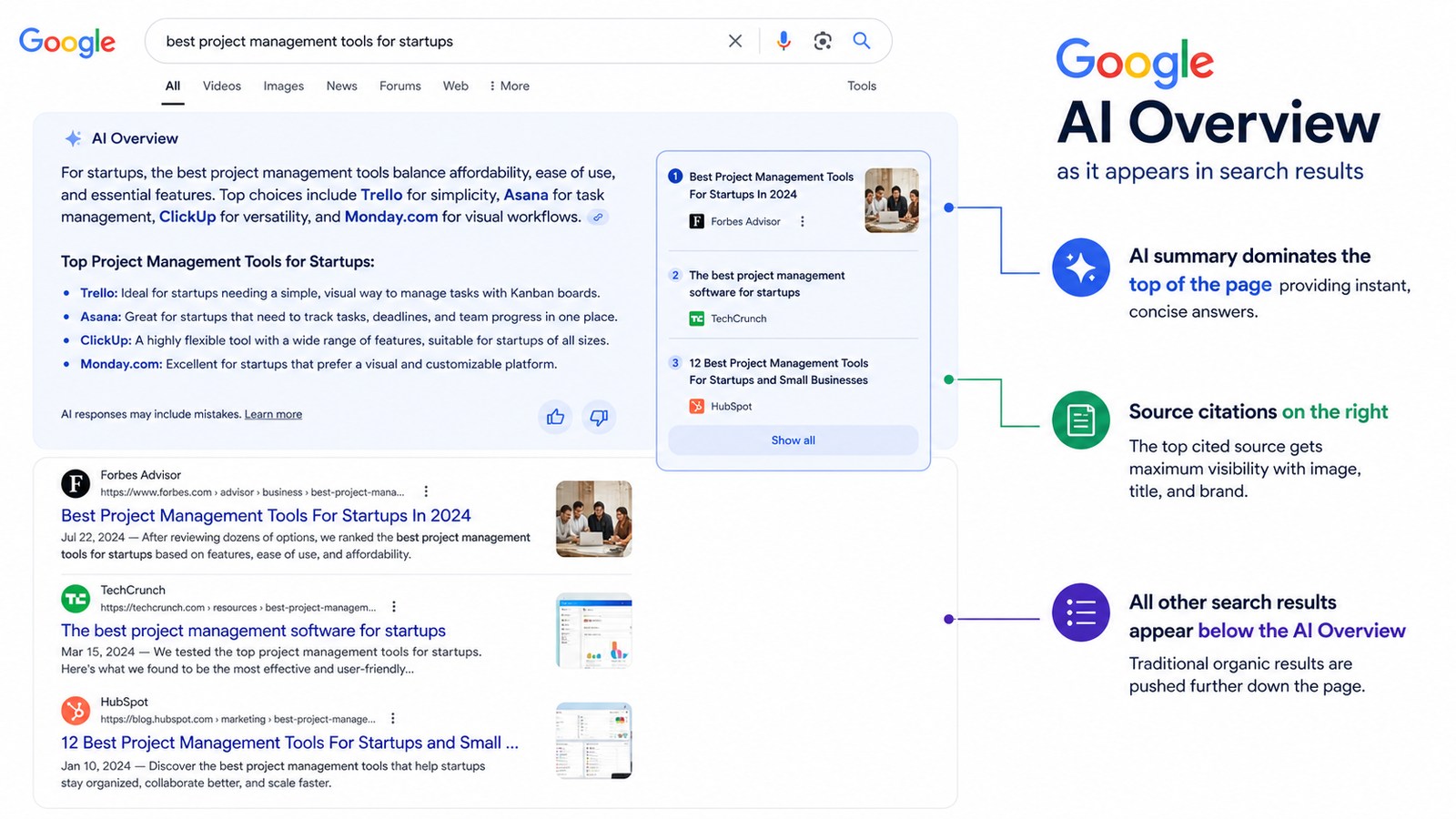
Google AI Overview as it appears in search results: the AI summary dominates the top of the page, with source citations displayed on the right. The top cited source gets maximum visibility. All other results appear below this block.
What AI Overviews Show
A synthesised answer to the user's query at the very top of results
The top source citation is visible without any click on desktop
3 sources visible when user clicks "Show more"
All sources visible when user clicks "Show all"
Sources include page title, URL and a short excerpt
Follow up questions suggested below the overview
When AI Overviews Appear
57.9 percent of question based queries (highest category)
59.8 percent of "why" reason queries
57.4 percent of yes/no boolean queries
46.4 percent of queries with 7 or more words
99.9 percent of AI Overview keywords are informational
Rarely on transactional or navigational searches
Important to understand: AI Overview citations are non-deterministic. Unlike traditional organic rankings that are relatively stable, the sources cited in AI Overviews can change with every search refresh. This means ranking in AI Overviews is about consistently earning citations across a topic cluster, not locking in a single position for a single keyword.
Google AI Mode — The Next Evolution
New in 2026
In early 2026, Google began rolling out AI Mode — a dedicated search mode where the entire results page is taken over by AI generated responses. Unlike AI Overviews which appear above traditional results, AI Mode replaces the traditional search results page entirely with a conversational, multi turn AI experience. Users can click an "AI Mode" tab or be routed there automatically for complex, multi step queries.
AI Mode uses Google's most capable Gemini models and performs what Google calls "query fan out" — breaking a single query into multiple sub questions, searching the web for each, and synthesising a comprehensive answer that integrates all findings. It handles complex, research heavy queries that AI Overviews alone cannot fully address.
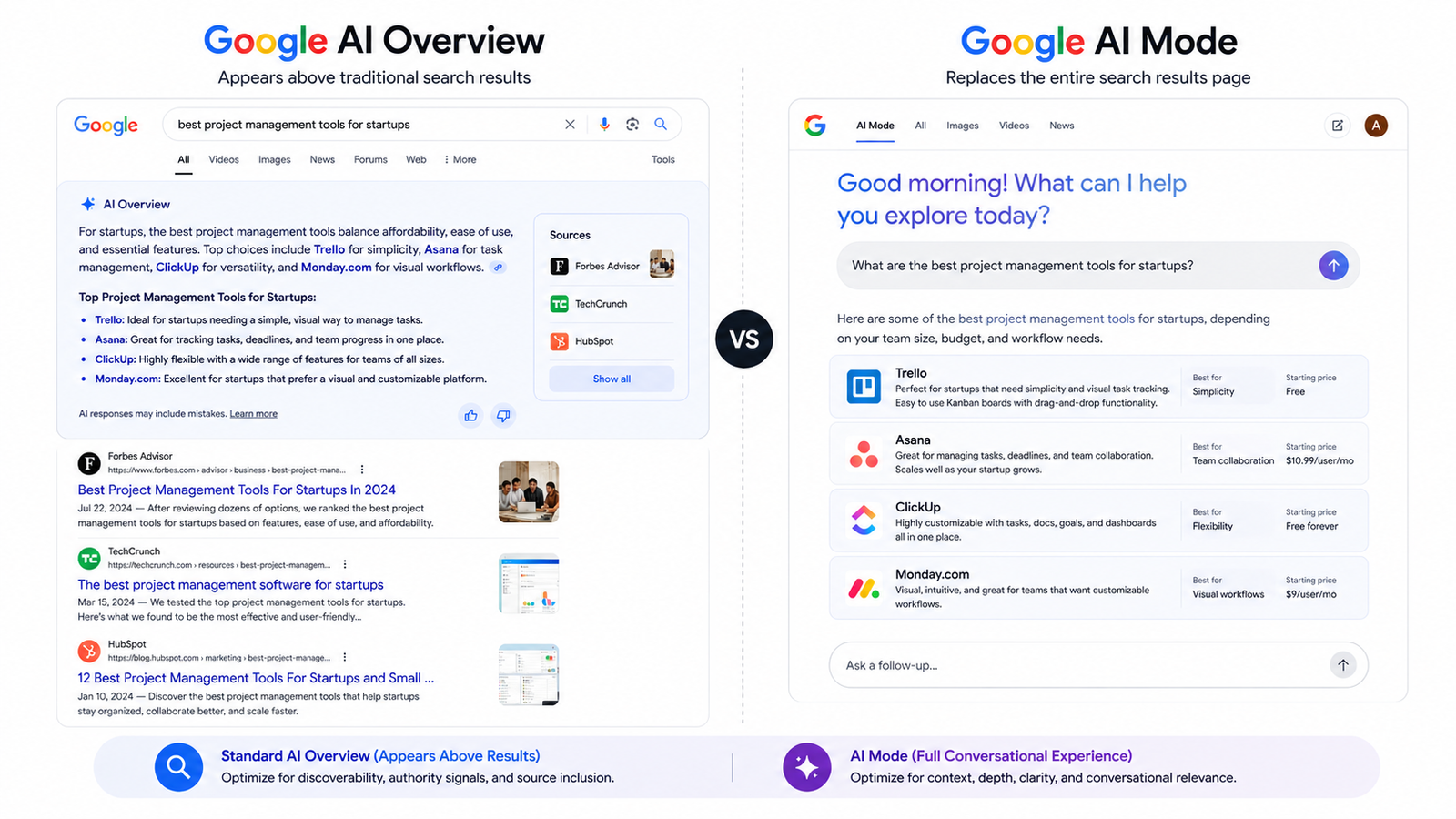
Left: standard Google AI Overview (appears above traditional results). Right: Google AI Mode (replaces the entire search results page with a conversational AI experience). Both require different but overlapping optimisation approaches.
Feature
AI Overviews
AI Mode
Appears on
Standard Google search results page
Dedicated AI Mode tab or full page takeover
Query types
Simple to moderate informational queries
Complex, multi part, research queries
Traditional results
Shown below the Overview
Replaced entirely by AI response
Multi turn conversation
Single query response
Full conversational follow up
Citation depth
3 to 10 sources
10 to 20+ sources per query fan out
SEO optimisation approach
Content clarity, schema, authority
Same plus deep topical coverage
Current availability
Global, all users
Rolling out — US first, expanding in 2026
Strategy implication: Content that ranks in AI Overviews is the same content that gets cited in AI Mode. The same optimisation principles apply to both. Building a comprehensive topic cluster with clear, authoritative content is the single strategy that serves both surfaces simultaneously. Our AI SEO service builds this architecture for clients.
Where Does Google AI Overview Get Its Information
Source Selection
This is one of the most searched questions about AI Overviews, and the answer is more specific than most people realise. Google AI Overview does not use a fixed database or a curated list of approved sites. It uses a real time retrieval process that pulls from the live Google index at query time — then applies a quality filter before selecting which sources to actually cite in the answer.
Step 1: Real Time Web Retrieval
Google's Gemini model identifies the key information needs within the user's query and uses Google's search infrastructure to retrieve the most relevant, recently crawled pages across the entire index. This happens in real time at each query.
Step 2: Quality and Trust Filtering
Retrieved pages are filtered through Google's quality assessment systems including E-E-A-T signals, domain authority, spam detection and content quality scoring. Pages that fail quality checks are excluded even if they technically match the query.
Step 3: Synthesis and Citation
The AI synthesises information from the highest quality sources into a coherent answer. Pages whose specific content is used in the synthesis are cited. Being useful for the synthesis — not just topically relevant — is what determines which pages are cited.
68%
of AI Overview citations come from pages already ranking in the top 10 organic results for the same query
This confirms that traditional SEO authority is still the dominant factor determining which pages get into the AI Overview citation pool. Pages outside the top 20 organic positions are rarely cited.
This has a crucial practical implication: you cannot rank in AI Overviews without first having strong traditional organic rankings. The two are not separate tracks. AI Overview optimisation builds on top of existing SEO authority — it does not replace or bypass it. This is why a combined approach covering both traditional AI SEO and GEO optimisation is the only complete strategy in 2026.
Why Ranking in AI Overviews Matters for Your Business
Data and Impact
The visibility impact of AI Overviews is enormous — in both directions. Being cited in an AI Overview drives significant brand exposure. Not being cited, while your competitor is, means you are invisible to users at the exact moment they are seeking information about your product or service category.
The Visibility Gain
When your page is cited in an AI Overview, your brand name, URL and an excerpt appear at the very top of the search results page — above every organic result, above every ad and above every featured snippet. On desktop, the first cited source is visible to 100 percent of users without any scroll. This is the highest possible visibility position on Google in 2026.
Studies show that users who engage with an AI Overview spend significantly more time on the search page absorbing the AI content. Being the cited source during that engagement period builds brand familiarity even when users do not click through immediately.
The Traffic Loss Risk
The same data that shows citation visibility shows clickthrough rate decline for pages not in AI Overviews. Research indicates CTR drops of 34.5 to 61 percent for traditional organic results on pages where AI Overviews appear. Pew Research found users click a traditional result only 8 percent of the time when an AI summary is present, compared to 15 percent without one.
This means the traditional Page 1 strategy is losing effectiveness on any query that triggers AI Overviews. Ranking 1 in organic results below an AI Overview now performs closer to what ranking 3 or 4 used to deliver — unless you are also in the AI Overview citation.
The Business Reality: On queries where AI Overviews appear, being in positions 1 to 10 without an AI Overview citation is becoming similar to being on page 2 of results. The primary attention window is the AI Overview. Everything below it receives a fraction of the engagement it previously did. This is why AI Overview optimisation is now a business critical priority, not an optional enhancement.
57.9%
Question Queries with AI Overviews
Source: Ahrefs analysis of 146M SERPs
68%
Citations from Top 10 Pages
Traditional SEO authority still drives AI citation
61%
CTR Drop Without Citation
For organic pages below AI Overviews
8%
Click Rate on Traditional Results
When AI Overview is present (Pew Research)
12 Proven Strategies to Rank in Google AI Overviews
Action Guide
These strategies are based on analysis of AI Overview citation patterns, Google's own guidance and the outcomes of implementations across client sites. They are ordered from highest to lowest impact based on observed results.
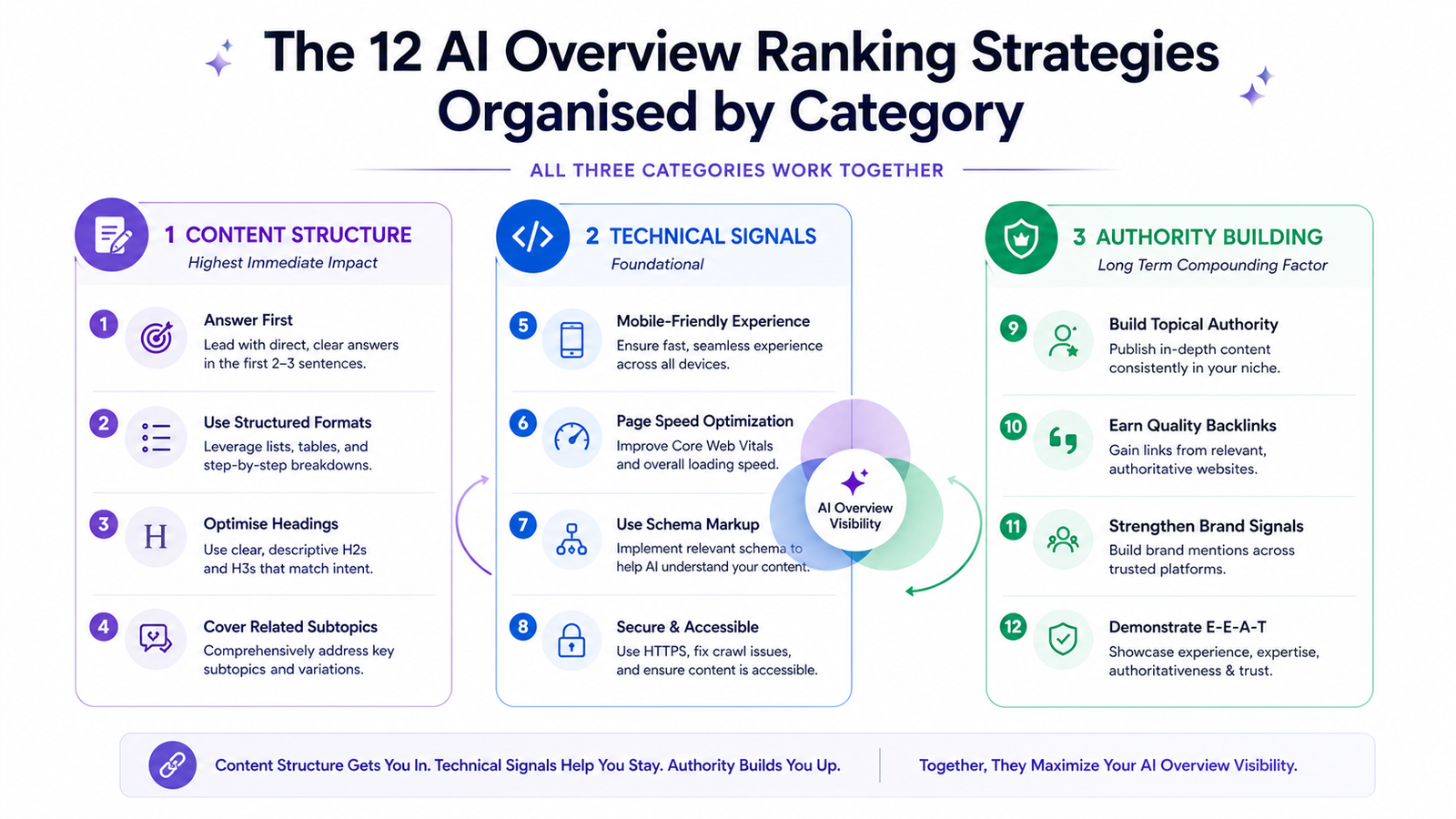
The 12 AI Overview ranking strategies organised by category: content structure (highest immediate impact), technical signals (foundational), and authority building (long term compounding factor). All three categories work together.
01
Highest Impact
Answer the Question Directly in Your First Paragraph
The single most reliable way to appear in AI Overviews is to provide a clear, direct answer to the query in the opening paragraph of your content. Google's AI retrieves pages and looks for the most concise, accurate answer to the specific question. If your answer is buried three paragraphs deep behind context and introduction, the AI will find a competitor's page that answers it immediately. Rewrite every key page to lead with a direct, citable answer — then expand into detail. This one change alone has moved pages into AI Overview citations within weeks of implementation.
02
Highest Impact
Target Question Based and Long Tail Informational Keywords
Data from 146 million SERPs confirms that AI Overviews appear on 57.9 percent of question based queries. "Why" queries trigger AI Overviews 59.8 percent of the time — the highest of any category. Queries with 7 or more words show AI Overviews 46.4 percent of the time. Your content strategy must shift to explicitly targeting these query formats. Instead of targeting "AI marketing agency", target "why should my business use an AI marketing agency in 2026" or "how does an AI marketing agency differ from a traditional agency". Question based content is the entry point to AI Overview territory.
03
Content Structure
Use Question Based Headings Throughout Your Content
Google's AI parses your page's heading hierarchy to understand what questions each section addresses. Headings like "How Does X Work?", "What Are the Benefits of X?" and "Why Should Businesses Use X?" directly mirror the natural language queries that trigger AI Overviews. When the AI scans your page looking for content relevant to a specific question, a heading that matches that question makes your content immediately parseable as a source for that query. Audit every H2 and H3 on your key pages and rewrite them as questions where appropriate. This structural change can show AI Overview impact within 30 days of re-crawling.
04
Technical
Add FAQPage Schema to Every FAQ Section
FAQPage schema is the single most directly useful schema type for AI Overview citation. It provides machine readable, structured data that tells Google's AI exactly which questions your page answers and exactly what the corresponding answers are. This structured format is far easier for AI to process than natural language paragraphs. Every FAQ section on every page on your site should have FAQPage schema implemented in JSON-LD format. Where no FAQ section exists, create one. In testing across client sites, pages with FAQPage schema are cited in AI Overviews at rates 2 to 3 times higher than structurally identical pages without it, when content quality is held constant.
05
Authority
Build and Strengthen Your Traditional Organic Rankings First
The data is clear: 68 percent of AI Overview citations come from pages already ranking in the top 10 organic results for the same query. This means no amount of content restructuring or schema implementation can reliably get you into AI Overviews if your pages are not already ranking in the top 10 organically. Traditional SEO authority — backlinks, domain trust, technical health and content quality — is the prerequisite, not the alternative, to AI Overview ranking. If your pages are ranking between 11 and 20, focus on closing that gap first before expecting AI Overview citations. Our AI SEO service addresses both simultaneously.
06
Content Quality
Include Specific Statistics, Data and Research Citations
Academic research from Princeton University's GEO study found that adding specific statistics increased AI citation rates by up to 40 percent compared to equivalent content without data. Google's AI favours content that contains quantified, verifiable claims because it can include those specific data points in its synthesised answers. Use real percentages, specific timeframes, cost ranges and research findings throughout your content. Always cite the source of any statistic. Where you have proprietary data from your own client work (case study results, implementation outcomes), include it — original data is treated as exceptionally high quality by both Google and AI systems.
07
E-E-A-T
Demonstrate Real Experience and Expertise Explicitly
Google's quality rater guidelines for AI Overviews heavily emphasise E-E-A-T (Experience, Expertise, Authoritativeness, Trustworthiness). Experience specifically means demonstrating that you have actually done the thing you are writing about. First person statements documented with specifics are the strongest E-E-A-T signals: "In our implementations across 20 client websites, we observed that..." or "When we tested this approach on a Rajasthan based exporter's site, the result was...". Generic claims about industry best practices score far lower than documented personal experience. Add named author bios with verifiable credentials to every article and link them to your LinkedIn and any published work.
08
Content Architecture
Build Topical Authority With Content Clusters
Google's AI system evaluates topical authority — how deeply and comprehensively your site covers a subject area — when selecting AI Overview sources. A single well optimised page rarely outcompetes a site with 10 to 20 deeply interconnected articles covering every angle of a topic. A content cluster strategy groups related articles around a central pillar page, with each article linking to the pillar and to other relevant cluster articles. For a digital marketing agency, the pillar might be "AI Marketing" with cluster articles on AI SEO, GEO Optimization, WhatsApp AI, Performance Marketing and AI Automation. This architecture signals deep topical expertise to both Google and its AI systems.
09
Freshness
Refresh Content Regularly and Show dateModified
Google's AI preferentially cites recent content for queries where recency is a relevance factor. The dateModified property in your Article schema explicitly signals to Google when a page was last updated. Implement this in JSON-LD on every article and blog post. More importantly, actually update your content regularly — add new data, update statistics to the current year, expand sections based on new developments and add new FAQ questions as customer queries evolve. A quarterly review and update of every key page is the minimum cadence for competitive topics. Content that was last updated in 2023 or 2024 will increasingly lose AI Overview citations to pages updated in 2026.
10
Entity Signals
Build a Clear Brand Entity Across the Web
Google's AI systems evaluate brand entity signals when assessing source trustworthiness. A business that exists consistently across Google Business Profile, LinkedIn, industry directories, Crunchbase and news mentions is treated as a more credible citation source than one that exists only on its own website. Create and verify listings on every relevant platform. Ensure your business name, address, phone number and website URL are identical everywhere. Link your social profiles to your website and vice versa. Complete your Google Knowledge Panel information if one exists for your brand. These entity signals are evaluated alongside content quality and technical SEO factors in AI Overview source selection.
11
Technical
Pass Core Web Vitals and Ensure Fast Mobile Performance
Google cannot effectively retrieve and process the content of pages that load slowly, have poor mobile performance or have significant layout stability issues. Core Web Vitals (LCP under 2.5 seconds, CLS under 0.1, INP under 200ms) are prerequisite technical quality signals. Google's AI retrieval system has less capacity to extract structured information from pages with heavy JavaScript rendering, excessive redirects or complex layout issues. Run your key pages through PageSpeed Insights and Search Console's Core Web Vitals report. Fix any failing metrics before investing further in content optimisation. A beautifully written page that loads in 8 seconds will still underperform a basic page that loads in 1.5 seconds for AI Overview citation purposes.
12
Off Page
Earn Backlinks From Authoritative, Topically Relevant Sources
Backlinks remain one of the strongest signals of content authority that influences both traditional rankings and AI Overview source selection. The 68 percent overlap between top 10 organic rankings and AI Overview citations exists precisely because backlinks drive both. However, for AI Overview purposes, the quality and topical relevance of backlinks matters more than raw quantity. A single mention from an established industry publication in your space provides more AI Overview authority signal than dozens of links from unrelated directories. Focus backlink acquisition on guest posts in relevant publications, expert commentary in industry media and genuine PR coverage. These are the external citations that make Google's AI trust your content as a citable authority.
How to Optimize Content for AI Search
Content Guide
Content optimisation for AI search requires a different mindset from traditional keyword optimisation. The question is not "does this page contain my keyword?" but "does this page provide the clearest, most credible, most directly useful answer to the specific question someone is asking?"
The Direct Answer Structure
Every page targeting a question based query should follow this structure without exception:
Opening paragraph: direct, citable answer in 2 to 4 sentences
Context section: why this answer matters and the nuances
Detail sections: H2 headings as specific sub questions
Supporting data: statistics and specific examples
FAQ section with FAQPage schema
Related resource links (internal and external)
Paragraph Length and Format
Google's AI retrieves content at the paragraph level, not the page level. Individual paragraphs that are self contained and citable are far more likely to be pulled into AI answers than long, continuous prose.
Keep paragraphs to 3 to 5 sentences maximum
Each paragraph should make one specific, citable point
Use bullet or numbered lists for processes and comparisons
Use bold text sparingly for the most citable phrases
Write at a clear, accessible reading level
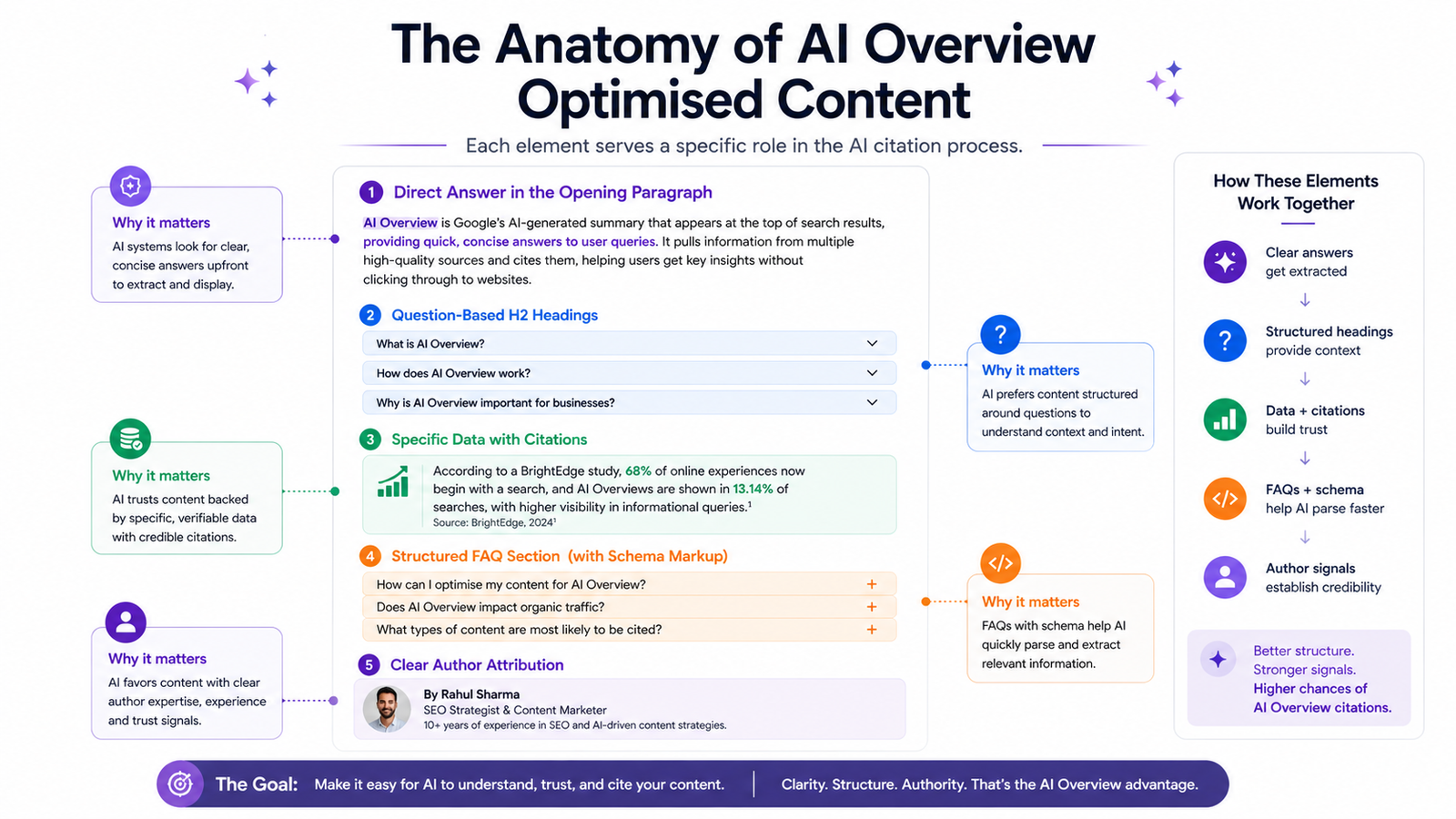
The anatomy of AI Overview optimised content: direct answer in the opening paragraph, question based H2 headings, specific data with citations, a structured FAQ section with schema markup, and clear author attribution. Each element serves a specific role in the AI citation process.
Query Intent Matching
Map every piece of content to a specific query intent. "What is" queries need definition and explanation. "How to" queries need step by step processes. "Why" queries need reasoning and evidence. "Best" queries need comparison and clear recommendation. Mismatching content format to query intent is one of the most common reasons pages fail to appear in AI Overviews despite being topically relevant.
Citable Statements
Write statements that are self contained and quotable out of context. "GEO optimisation typically improves AI Overview citation rates within 4 to 8 weeks of implementation" is a citable statement. "There are many factors involved in AI search ranking and each situation is different" is not. Train yourself to write in citable units — specific, verifiable, standalone claims that stand alone without requiring surrounding context to make sense.
Conversational Language
AI searches use natural spoken language, not keyboard shorthand. Write content that matches how people actually phrase spoken questions. Test your target queries by speaking them out loud. If the heading or content sounds unnatural when spoken, rephrase it to match natural conversational language. This is particularly important for voice search, which is increasingly common on mobile in markets like India and the Middle East where WhatsApp and voice queries dominate.
Technical SEO Requirements for AI Overview Ranking
Technical
Crawlability and Indexability
All target pages must be indexed in Google Search Console
Robots.txt must not block Googlebot on content pages
No noindex meta tags on pages you want cited
XML sitemap submitted and accepted in Search Console
No significant crawl errors on key pages
Internal linking connects all important pages to the crawl path
Page Speed and Core Web Vitals
LCP (Largest Contentful Paint) under 2.5 seconds
CLS (Cumulative Layout Shift) under 0.1
INP (Interaction to Next Paint) under 200ms
Time to First Byte (TTFB) under 800ms
Mobile performance score 70 or above in PageSpeed Insights
Images served in modern formats (WebP or AVIF)
Mobile Optimisation
Fully responsive layout at all breakpoints
No content hidden on mobile that is visible on desktop
Touch targets minimum 48px for all interactive elements
Font size minimum 16px for body text on mobile
No horizontal scroll on any viewport
Pass Google's Mobile Friendly Test tool
Security and Trust Signals
HTTPS on all pages — no mixed content warnings
No malware or security warnings in Search Console
Valid SSL certificate from a trusted issuer
Privacy policy and terms pages accessible
Clear business contact information on contact page
Business email on domain (not Gmail) visible on site
Googlebot User-Agent check: Ensure your website does not serve a different version of its content to Googlebot than to real users. Some JavaScript heavy sites render minimal content to bots and full content to browsers. This "cloaking" prevents Google's AI from seeing the actual content that should be cited. Use Google Search Console's URL Inspection tool and render your pages with "Fetch as Google" to confirm what Googlebot actually sees.
Schema Markup That Gets You Cited in AI Overviews
Schema Guide
Schema markup in JSON-LD format is the most direct technical signal you can send to Google's AI about the nature and quality of your content. Here are the schema types that most directly influence AI Overview citation, with the highest priority first.
FAQPage — Highest Priority
FAQPage schema is the most directly useful schema for AI Overview citation. It provides machine readable question and answer pairs that Google's AI can directly incorporate into AI answers. Every FAQ section on every page must have this schema.
{
  "@type": "FAQPage",
  "mainEntity": [{
    "@type": "Question",
    "name": "How to rank on Google AI Overviews?",
    "acceptedAnswer": {
      "@type": "Answer",
      "text": "Answer the query directly in your opening paragraph, use question-based H2 headings, implement FAQPage schema, target informational question queries, and build traditional organic authority first."
    }
  }]
}
Article + Author Schema
Article schema with a nested Person author and dateModified signals recency, authorship and content type to Google's AI. Every blog post and guide must have this implemented correctly.
For any step by step instructional content, HowTo schema marks up each step with a name and description. Google's AI frequently pulls HowTo structured data directly into AI Overviews for "how to" queries. If your content has numbered steps, it needs HowTo schema — it is one of the most visible rich result types in AI Overviews.
BreadcrumbList Schema
Breadcrumb schema tells Google the hierarchical position of your page within your site structure. This helps Google's AI understand the relationship between your content pieces and evaluate your site's topical depth. Every page should have accurate BreadcrumbList schema that matches the visible breadcrumb navigation on the page.
Organization + LocalBusiness
Organization schema on your homepage establishes your brand entity to Google's systems. LocalBusiness schema adds your address, phone, hours and service area. These schemas are not directly cited in AI Overviews but they contribute to the brand entity signals that determine how trustworthy Google considers your content as a citation source.
Person Schema for Authors
Person schema on author bio pages, linked from article bylines, helps Google verify the real world credentials of your content authors. This is a direct E-E-A-T signal. Include sameAs links to the author's LinkedIn, Twitter and any published work. Named, credentialed authors with Person schema consistently outperform anonymous or unverified content for AI Overview citations on YMYL adjacent topics.
How to Track Your Google AI Overview Rankings
Measurement
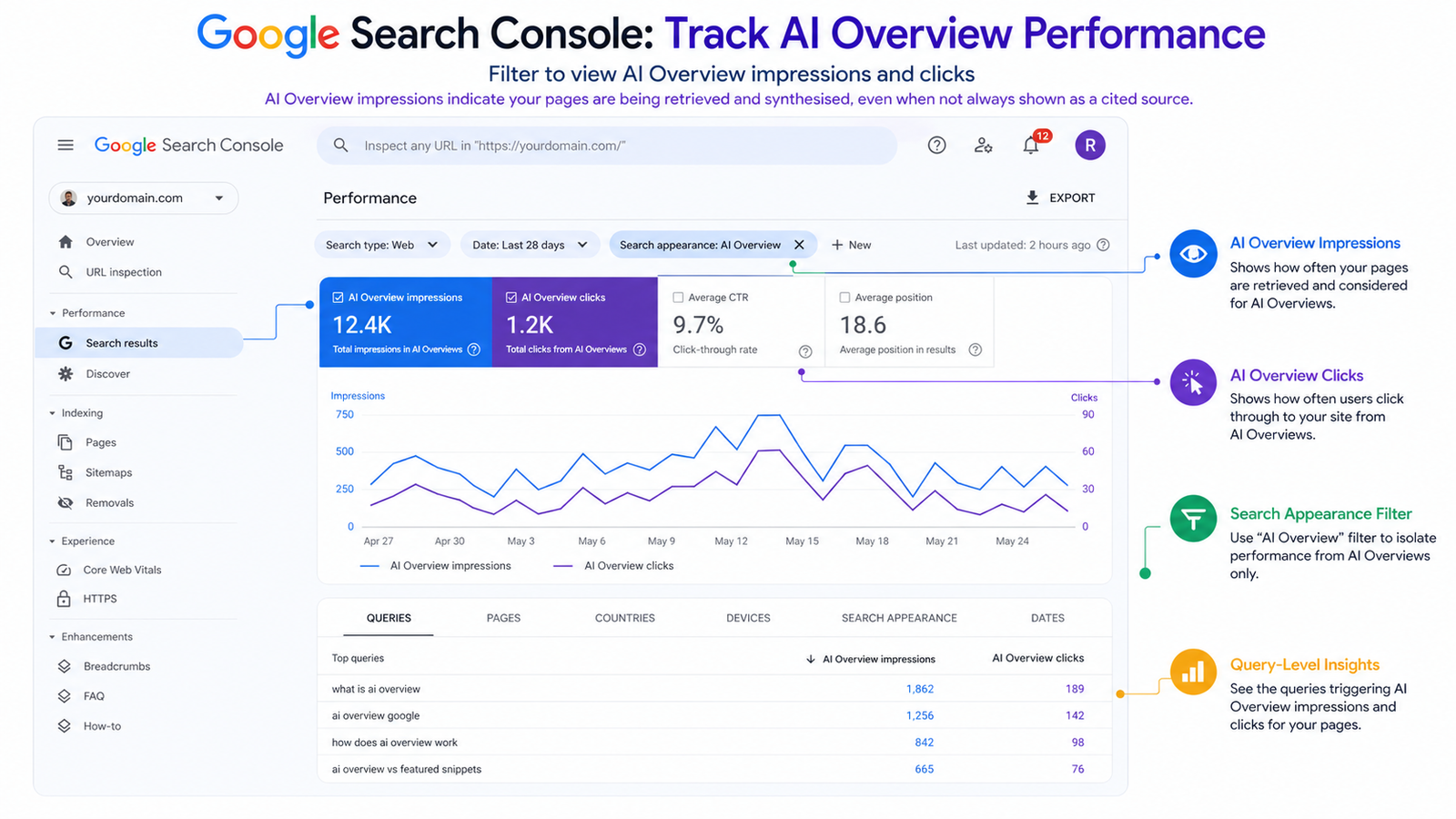
Google Search Console performance data filtered to show AI Overview impressions and clicks. This is currently the most reliable free tool for tracking AI Overview citation performance. AI Overview impressions indicate your pages are being retrieved and synthesised, even when not always shown as a cited source.
Google Search Console
The most accessible and reliable tool for tracking AI Overview performance. Here is how to access the data:
Go to Search Console → Performance → Search Results
Click "Search Type" filter and select "Web"
Look for the "AI Overviews" filter option (appearing gradually in accounts)
Track impressions (your pages being retrieved by AI) and clicks (users clicking your citation)
Filter by page to see which content gets the most AI Overview impressions
Compare week over week after implementing changes
Manual SERP Testing
Complement Search Console data with regular manual testing. This gives qualitative insight Search Console alone cannot provide:
Create a spreadsheet of 20 to 30 target queries
Search each query in an incognito window monthly
Record whether an AI Overview appears and which sources are cited
Note whether your domain appears in citations
Screenshot AI Overviews that cite you for documentation
Track which competitor pages are consistently cited instead
Brand Mention Monitoring
Set up Google Alerts for your brand name and founder name. As your AI Overview citations increase, you will often see corresponding growth in external brand mentions — publications referencing your content, people sharing AI answers that cite your business and social media posts quoting AI responses that include your brand. These external signals are both a measurement of progress and a contributor to future AI Overview authority.
Analytics Referral Traffic
Some AI Overview clicks generate referral data in Google Analytics 4. Track the "google" source with "(not set)" or AI specific parameters. More importantly, set up separate segments for your AI targeted content pages and monitor organic traffic trends on those pages specifically. Pages that achieve AI Overview citation typically show traffic increases independent of keyword ranking position changes — this is a strong signal that AI citation is driving incremental visits.
Is SEO Dead or Evolving in 2026
Debated Topic
This is one of the most searched questions in digital marketing in 2026, and the answer is unambiguous: SEO is not dead. It is evolving faster than at any point in its 25 year history.
The core function of SEO — helping the right people find your content when they search for relevant topics — has not changed. What has changed is where that finding happens and how it is presented. In 2025 and 2026, the finding increasingly happens inside AI generated summaries rather than as a click on a traditional blue link. But those AI summaries still require the same underlying signals that traditional SEO has always provided: trusted domains, quality content, relevant backlinks, technical integrity and clear topical authority.
What Has Not Changed
Google still indexes and crawls websites
Backlinks still signal authority
Technical health still determines crawlability
Content quality still determines trustworthiness
E-E-A-T still determines citation worthiness
Page speed still affects how well Google can retrieve content
What Has Changed
The primary visibility surface is now AI Overviews, not position 1
Traffic per ranking position has decreased significantly
Informational content must now compete for AI citations
Content structure matters more than keyword density
Schema markup has moved from optional to essential
Brand entity signals now directly affect citation selection
What Is Growing
GEO optimisation for AI platform citations
Topical authority over keyword density
First person experience as a quality signal
Structured data as an AI communication layer
Entity building across multiple web properties
AI Mode optimisation for complex queries
The accurate framing: SEO is not dead — the businesses that treated SEO as "stuffing keywords into pages" were always doing it wrong, and AI Overviews have simply made that more visible. Genuine SEO — building real authority, writing genuinely useful content, earning real links and maintaining technical excellence — is more valuable in 2026 than it has ever been. It now serves both traditional search AND AI Overview citation simultaneously. The businesses winning in AI search are the same businesses that were doing SEO correctly before. Read our full comparison of AI SEO vs traditional SEO for the complete picture.
7 Mistakes That Block Your AI Overview Rankings
Avoid These
Mistake 1: Blocking Googlebot from Key Pages
A page that Googlebot cannot crawl cannot appear in AI Overviews — it is that simple. Check your robots.txt to ensure it does not block any pages you want cited. Check that no important pages have the noindex meta tag. Use Search Console's URL Inspection tool on every key page to confirm it is crawled, indexed and returning a 200 status code. This is the first check before anything else.
Mistake 2: Writing for Keyword Density Instead of Question Intent
Repeating a keyword phrase 15 times in an article does nothing for AI Overview rankings. Google's AI evaluates whether your content answers the specific question, not whether it contains the keyword a certain number of times. A 500 word article that directly and completely answers a question will outperform a 3,000 word article padded with keyword repetitions for AI Overview purposes.
Mistake 3: No Schema Markup at All
In 2026, publishing content without FAQPage, Article and BreadcrumbList schema at minimum is leaving AI Overview citations on the table. These schemas cost nothing to implement, are supported by every major CMS and WordPress SEO plugin, and have a direct measurable impact on AI Overview citation rates. If your site has no schema markup, fix this before any other content changes.
Mistake 4: Targeting Commercial Keywords with Informational Content
AI Overviews appear on 99.9 percent informational queries and rarely on transactional queries. Creating AI Overview optimised content around keywords like "buy AI SEO service" or "AI marketing agency pricing" is a misalignment. Informational content targets questions. Commercial content targets buying decisions. Create informational content for AI Overview citation and separate commercial landing pages for conversion. Both serve different purposes in the same funnel.
Mistake 5: Expecting Results Without Organic Ranking Foundation
68 percent of AI Overview citations come from pages already in the top 10 organically. If your domain has low authority, few backlinks and pages struggling to rank above position 20, AI Overview citation will not happen regardless of how well your content is structured. Build the organic foundation first — domain authority, quality backlinks, clean technical health — then layer AI Overview optimisation on top. The two cannot be separated.
Mistake 6: Ignoring dateModified and Content Freshness
Content with a dateModified of 2023 or 2024 is increasingly losing AI Overview citations to freshly updated 2026 content on competitive topics. Implement dateModified in your Article schema. Set a calendar reminder to review and update every key page quarterly. Even small updates — refreshed statistics, added FAQ questions, updated examples — signal recency to Google's systems and improve AI Overview retention for pages that were previously cited.
Mistake 7: Treating AI Overviews as a One Time Project
AI Overviews are non-deterministic — the sources cited change constantly as Google refreshes its retrieval and quality assessments. A page cited today may not be cited tomorrow. This is not a failure state; it is how the system works. Maintaining AI Overview presence requires ongoing content updates, regular schema audits, continued backlink acquisition and consistent entity signal maintenance. It is an ongoing marketing discipline, not a one time optimisation task.
Frequently Asked Questions About Google AI Overviews
Every question businesses and SEO professionals ask about ranking on Google AI Overviews, answered directly.
How to rank in Google's AI Overview?
To rank in Google's AI Overview, focus on three areas simultaneously. First, ensure your page already ranks in the top 10 organically for the target query — 68 percent of AI citations come from top 10 pages. Second, restructure your content to answer the specific question directly in the first paragraph, use question based H2 headings and add an FAQ section with FAQPage schema. Third, build E-E-A-T signals through named authors with credentials, specific experience based claims and verifiable statistics. Our AI SEO service implements all three tracks for clients.
Where does Google AI Overview get its information?
Google AI Overview uses Retrieval Augmented Generation (RAG) — it searches the live Google index at query time, retrieves the most relevant and authoritative pages, filters them through quality signals (E-E-A-T, spam detection, domain authority), synthesises the content from the highest quality sources into a coherent answer, and cites the pages whose specific content was used in that synthesis. It does not use a fixed database or a pre-approved list of sites. Any page that is indexed, trusted and directly answers the query is a candidate — but pages with stronger authority and clearer structure are disproportionately selected.
How to use Google AI Overview?
As a user, Google AI Overview appears automatically at the top of search results for eligible queries — no special setting or app is needed. It appears on Google.com and in the Google app when you search a question. You can see the cited sources by clicking "Show more" to reveal the first 3 sources, or "Show all" to see every source the AI used. You can also click into the AI Overview to ask follow up questions in a conversational format. As a business, you do not opt into or control AI Overviews directly — you optimise your content to increase the probability of being cited as a source.
How does Google AI Overview work technically?
Google AI Overview is powered by Google's Gemini AI model using a RAG (Retrieval Augmented Generation) architecture. When a query arrives, Gemini identifies the core information needs and uses Google's search infrastructure to retrieve the most relevant indexed pages in real time. These retrieved pages are processed through Google's quality assessment systems. The AI then synthesises information from the highest quality retrieved sources into a structured answer. Pages whose specific content is incorporated into the synthesis are cited as sources. The entire process happens in under 2 seconds at query time.
How to use AI to rank higher on Google?
Using AI tools to rank higher on Google involves several approaches: AI can help you identify question based content gaps faster than manual research, generate first drafts of content that you then enhance with real expertise and data, analyse which queries trigger AI Overviews in your niche and identify citation patterns among competitors. However, AI generated content without genuine expert review and original experience data consistently underperforms human written content for E-E-A-T signals. Use AI to accelerate the process, not replace the expertise. Google can increasingly distinguish between AI generated content that adds genuine value and AI content that is generic and mass produced.
How do I rank in AI search?
Ranking in AI search broadly — covering Google AI Overviews, ChatGPT, Perplexity, Gemini and Copilot — requires what is called GEO Optimization (Generative Engine Optimization). For Google AI Overviews specifically, the focus is on content structure, traditional SEO authority and schema markup. For platforms like ChatGPT and Perplexity, brand entity building across authoritative third party sources becomes more important because those platforms rely more on training data and web wide brand recognition. Our guide on What is GEO Optimization covers this in full detail.
How to optimize content for AI search?
Content optimisation for AI search follows a specific format. Lead every page with a direct answer to the primary question in the first 2 to 3 sentences. Use question based H2 and H3 headings throughout (How does X work? What are the benefits of X?). Keep paragraphs to 3 to 5 sentences maximum. Include specific statistics with source citations. Add a comprehensive FAQ section with FAQPage schema. Write in natural conversational language rather than formal keyword stuffed prose. Name your authors with verifiable credentials. Update content quarterly and keep the dateModified field current in your Article schema.
Does schema markup help with AI Overview rankings?
Yes, significantly. Schema markup — particularly FAQPage, Article with dateModified, HowTo and BreadcrumbList — provides machine readable structured data that Google's AI can directly parse and incorporate into AI Overview answers. In client implementations, adding FAQPage schema to FAQ sections that were already indexed has resulted in AI Overview citation appearances within 4 to 8 weeks, even where the same content without schema had not achieved citation. Schema is not the only factor, but it is one of the highest return technical investments specifically for AI Overview citation.
Can small businesses rank in Google AI Overviews?
Yes — and often more effectively than large businesses on niche or local topics. AI Overviews select the most directly relevant, highest quality source for a specific query — not the biggest brand. A small accountancy firm in Birmingham that publishes a comprehensive, well structured guide to UK small business tax in 2026 can outcompete a global Big 4 firm for that specific query in AI Overviews, if the small firm's content is more directly and clearly answers the specific question. Niche focus and genuine expertise are the small business's advantages in AI Overview competition.
How long does it take to appear in Google AI Overviews?
For pages already ranking in the top 10 for a query, implementing content restructuring and FAQPage schema typically shows AI Overview citation results within 4 to 8 weeks of Google re-crawling and re-evaluating the page. For pages currently ranking between 11 and 20, closing that organic gap first takes 2 to 4 months of focused SEO work, after which AI Overview citation can follow within weeks. For brand new domains, the minimum realistic timeline is 6 to 12 months to build sufficient organic authority to enter the AI Overview citation pool. Set expectations accordingly and track progress monthly through Search Console and manual SERP testing.
NC
Nitesh Charan
Founder, GrowingAI — AI SEO and GEO Optimization Agency
Nitesh founded GrowingAI to help businesses worldwide achieve visibility across traditional search and AI platforms. The agency implements every strategy in this guide for clients in India, UAE and globally through its AI SEO and GEO Optimization services. Google Ads Certified. Meta Blueprint Certified.
GrowingAI implements every strategy in this guide for businesses worldwide. From content restructuring to schema markup, technical SEO and authority building — we handle the complete AI Overview optimisation process.