
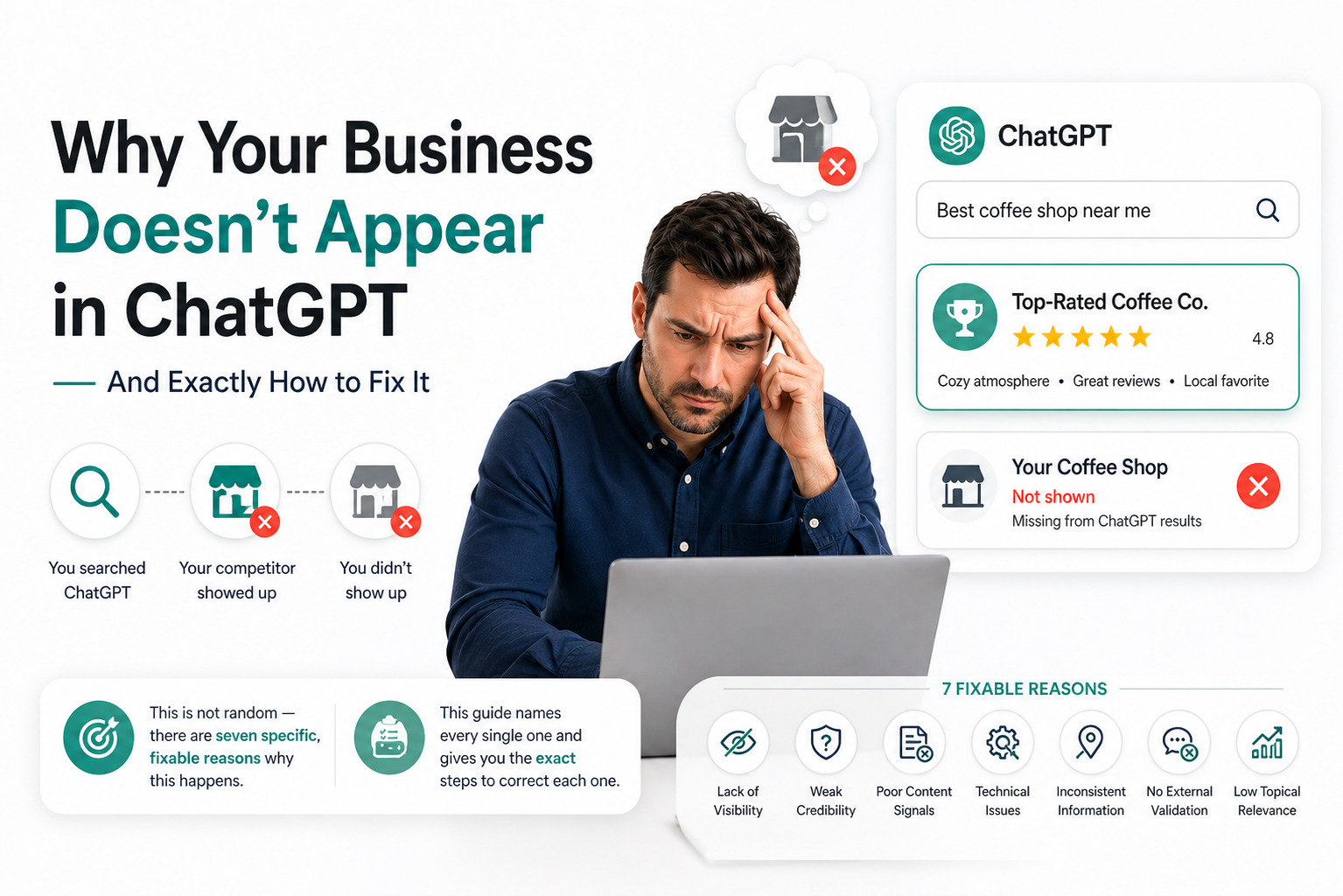
The Short Answer
Your business is not appearing in ChatGPT answers for one or more of seven specific reasons: your website is blocking AI crawlers, you have no credible third-party mentions, your content has no extractable answers, your schema markup is missing, you are not in Bing's index, your business identity is fragmented across platforms, or your competitor started building their AI presence before you. Every one of these is fixable. This guide tells you exactly how.
Before we get into the seven reasons, understand this: ChatGPT citations are not random. They follow predictable, researchable patterns. A 2025 University of Toronto study found that ChatGPT cited third-party sources 93.5 percent of the time for well-known brands and 95.1 percent for niche brands. Seer Interactive analysed 300,000 keywords and found a 0.65 correlation between Google page one ranking and ChatGPT citation. The system has logic. Once you understand the logic, you can fix your position in it.
ChatGPT's Crawler Is Blocked on Your Website
Go to yourdomain.com/robots.txt in your browser. Look for any of these lines: User-agent: GPTBot followed by Disallow: /, or a broad User-agent: * rule with Disallow: / that has no AI crawler exceptions. If you find them — this is your problem.
This is the most common silent citation blocker we find when auditing client websites. OpenAI's web crawler is called GPTBot. When ChatGPT Search performs live retrieval — searching the live web to find sources to cite — it uses GPTBot to read pages. If your robots.txt file blocks GPTBot, ChatGPT cannot read your content, cannot index it, and cannot cite it. Full stop.
The problem typically happens in one of three ways. First, a developer copied a restrictive robots.txt template that includes a blanket disallow for all bots. Second, your site runs a security plugin (common in WordPress — Wordfence, iThemes Security) that auto-blocks unfamiliar crawlers. Third, you deliberately blocked AI crawlers early on because of content scraping concerns, without realising it was also blocking citation eligibility.
Beyond GPTBot, you also need to check for PerplexityBot, Google-Extended, ClaudeBot and Anthropic-AI. Each platform uses its own crawler. A blocked GPTBot means no ChatGPT Search citations. A blocked PerplexityBot means no Perplexity citations. These are independent systems that all need access.
User-agent: GPTBot then Allow: /. Repeat for PerplexityBot, Google-Extended, ClaudeBot, Anthropic-AI, and Bytespider.yourdomain.com/robots.txt in your browser to confirm the allow rules are live.You Have No Third-Party Mentions — The #1 Killer
Search Google for "your business name" -site:yourdomain.com. Count the results. If you see fewer than 10 results from credible external sources — directories, review platforms, press articles, industry publications — you have a third-party mention deficiency. Also ask ChatGPT directly: "What can you tell me about [your business name]?" A vague or incorrect response indicates low entity recognition.
This is the single largest reason businesses do not appear in ChatGPT answers, and the one most businesses completely overlook. The University of Toronto's 2025 study found that 93.5 percent of citations for well-known brands and 95.1 percent for niche brands came from third-party earned sources — not from the brand's own website.
Think about how ChatGPT decides who to recommend. If someone asks "what is the best web design agency in Dubai?", ChatGPT does not read your website and trust what you say about yourself. It cross-references what Clutch says, what Google reviews say, what design blogs have written, what publications have covered. If the rest of the internet is silent about your business, ChatGPT has no corroboration that you exist — let alone that you are good.
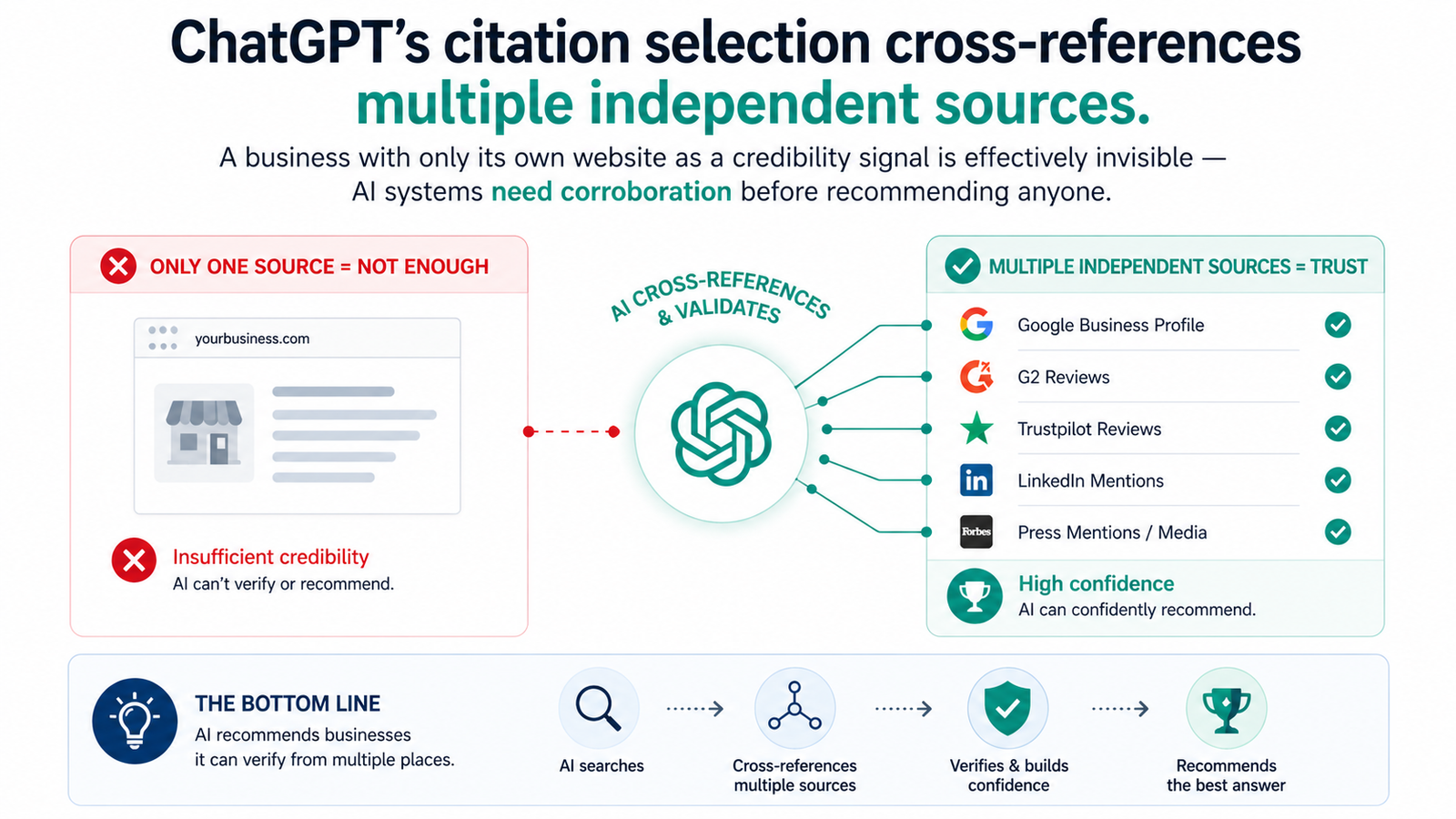
Your competitor who is showing up in ChatGPT likely has: a verified Clutch profile with reviews, a Trustpilot presence, mentions in industry publications, a LinkedIn company page with activity, and press coverage from at least one authoritative source. That gap is your answer.
Your Content Has No Extractable Answers
Read the opening paragraph of your main service page. Does it directly and specifically answer the most likely question a visitor has — in the first two sentences? Or does it begin with "We are a passionate team dedicated to…"? Now look at your H2 subheadings. Are they questions? Or labels like "Our Services," "What We Do," "About Our Process"? Label headings are invisible to AI citation systems.
AI systems like ChatGPT are, at their core, question-answering machines. When a user asks a question, ChatGPT searches for the clearest, most direct answer it can find. For your content to be cited, it needs to visibly, structurally contain the answer to a question someone would ask ChatGPT.
Most business websites are written for brand impression, not for answer extraction. They use flowery language, bury key information deep in paragraphs, and use headings that describe sections rather than answer questions. This content can be excellent for converting a human reader — but it is effectively invisible to AI citation systems, because there is no clear signal that says "here is the answer to [specific question]."
What AI Cannot Cite
- "We are a leading digital marketing agency with years of experience helping businesses grow their online presence..."
- H2: "Our Services" / H3: "Digital Marketing"
- Generic paragraphs with no specific data, no questions answered, no clear takeaways
- Long introductory sections about company history before any useful content
What AI Can Cite
- "GEO Optimization is the process of structuring website content and brand signals so AI systems like ChatGPT cite your business in their answers."
- H2: "What Does a GEO Optimization Agency Do?" / H2: "How Long Does It Take to Appear in ChatGPT?"
- Paragraphs containing specific statistics, direct answers, and clear expert conclusions
- FAQ sections with question-answer pairs matching real user queries
Your Schema Markup Is Missing or Wrong
Go to search.google.com/test/rich-results and enter your homepage URL and main service page URL. Check what schema types are detected. If you see no schema, or only basic types with errors, this is your problem. Also check: does your FAQ section have FAQPage schema? Do your blog posts have Article schema? Most do not.
Schema markup is structured data in JSON-LD format that gives AI systems machine-readable context about what your page contains. It does not change how your page looks to visitors. It changes whether AI systems can precisely identify, categorise and cite your content when answering relevant questions.
Without schema, an AI crawler reads your page as raw text and has to infer what type of content it is, what questions it answers and who created it. With schema, you explicitly tell it: "This is an FAQ section. Here are the questions and answers." This precision directly increases citation frequency and accuracy.
A study by Semrush found that pages with FAQPage schema receive significantly more AI Overview impressions than equivalent pages without it. Schema markup is one of the highest-leverage, lowest-effort GEO interventions available.
WordPress users: The Rank Math SEO plugin (free tier) adds FAQPage, Article and Organization schema with a GUI — no manual JSON-LD required. For advanced control, add JSON-LD directly in your theme's head section.
You're Not Indexed in Bing — ChatGPT's Live Database
Go to bing.com and search site:yourdomain.com. If Bing returns zero or very few results, you are not properly indexed. Also visit bing.com/webmasters — if you have never submitted your sitemap here, Bing may have never crawled your site.
This is one of the most overlooked technical reasons for missing ChatGPT citations, especially common among businesses that have always focused exclusively on Google. Most SEOs and business owners think only about Google Search Console. But ChatGPT Search uses Microsoft Bing's index as its primary live retrieval database. If you are not in Bing — properly, completely, with your key pages indexed — ChatGPT Search cannot find you to cite you.
Research from Ahrefs confirms that the vast majority of ChatGPT Search citations come from pages that rank in both Google and Bing. Bing has an estimated 1 billion monthly active users globally in 2026, and it now powers the live retrieval layer of the most widely used AI search tool on the planet. It deserves dedicated attention.
Your Business Entity Is Fragmented Across Platforms
Search for your business name on Google, Clutch, Yelp, LinkedIn, Google Maps and Facebook. Compare the business name, address and phone number shown on each. Are they identical — including spelling, spacing, punctuation and legal suffix ("Ltd", "LLC", "Limited")? Any variation counts as fragmentation.
AI knowledge systems build their understanding of a business entity by aggregating information from multiple sources. If your business name appears as "GrowingAI" on your website, "Growing AI" on LinkedIn, "Growing AI Ltd" on Clutch, and "GrowingAI Limited" on Google Business Profile — AI systems treat these as potentially four different entities. Instead of combining to strengthen one entity's authority, they split across four weaker signals.
This is the NAP consistency problem — Name, Address, Phone number. A BrightLocal 2025 study found that 68 percent of businesses have at least one significant NAP inconsistency across their online listings. For AI citation specifically, name consistency is the most critical variable — even minor differences in formatting fragment your entity signal.
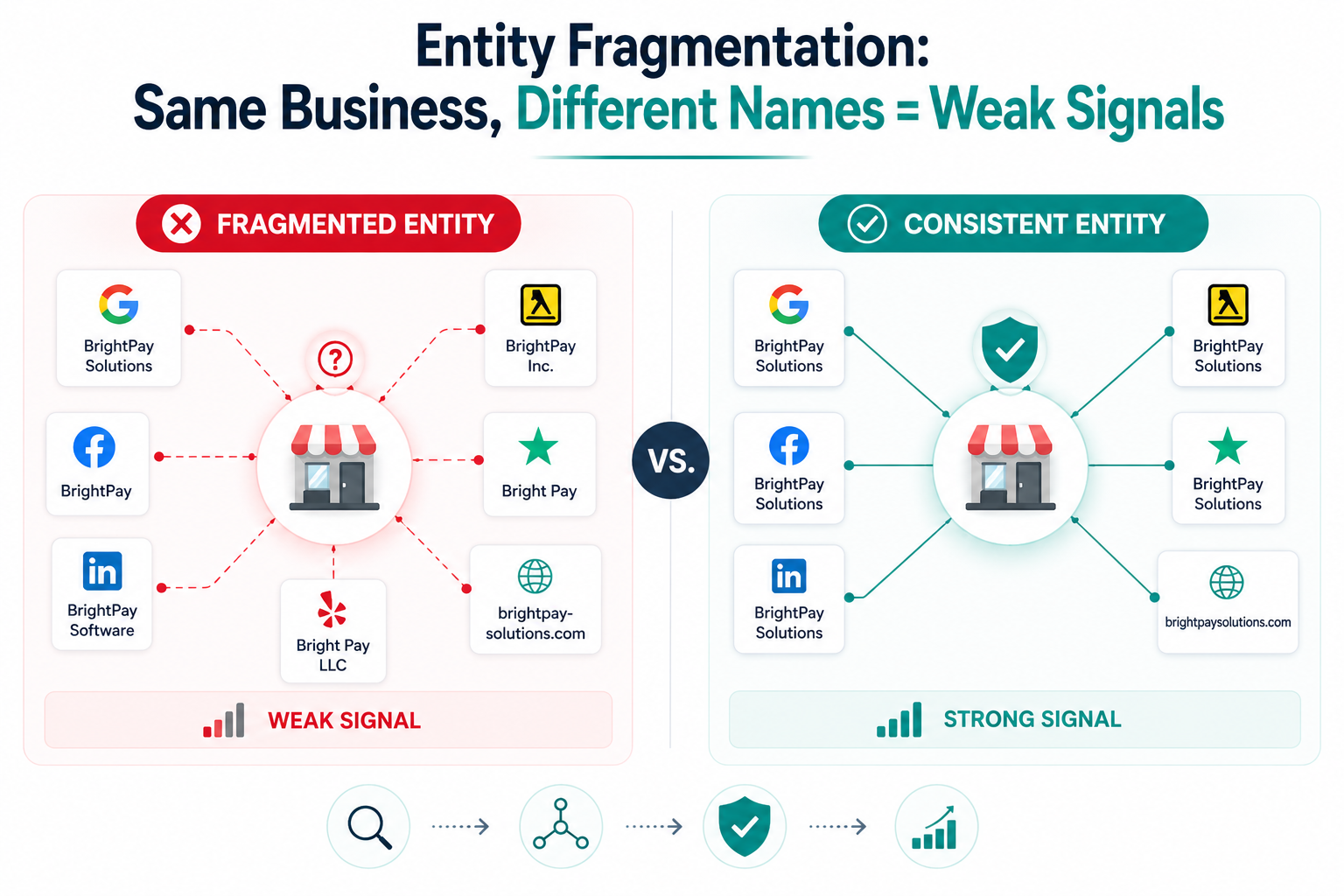
sameAs array to explicitly link all your platform profiles to your website. This directly tells AI systems these are all one entity.Your Competitor Started 6 Months Before You
Ask ChatGPT: "Who are the leading [your service] companies in [your location/industry]?" Note every competitor cited. Then analyse their Clutch profile (check review dates), their blog post publication dates, their LinkedIn post history and their Wayback Machine history at web.archive.org. If competitors started appearing 6 to 12 months ago with matching content and entity improvements, they got a head start — not a permanent advantage.
AI citation authority compounds. A business that began building its GEO presence in mid-2025 has accumulated six months of reviews, six months of content authority, six months of press mentions and entity recognition in training data. When you are starting today, you are starting with a gap to close — but the gap is closable.
The good news: this gap is much smaller than the equivalent gap in traditional SEO. In Google SEO, a 12-month head start in backlink building can represent thousands of links that take years to overcome. In GEO optimization, the gap is primarily one of entity recognition and content structure — both of which can be improved substantially within 90 days. A Princeton GEO research paper found that deliberate optimisation improved AI citation frequency by up to 40 percent.
The businesses seeing the fastest citation catch-up share one approach: they do not try to compete across all queries. They identify two or three specific sub-topics where the competitor's content is weakest and build the single most comprehensive, authoritative resource on those sub-topics. Topical depth beats broad coverage for AI citation.
The cost of more delay: Every month you wait, your competitor accumulates another 30 days of reviews, another article, another press mention. The gap does not stay the same — it grows while you are standing still. A free audit this week costs nothing and shows you exactly where the gaps are.
The Fix: What to Do This Week
Priority Action PlanYou now know exactly why your business is not appearing in ChatGPT. Here is a prioritised, day-by-day action sequence for your first week — sequenced by impact and speed of result, fastest wins first.
| Reason | How Common | Severity | Time to Fix | DIY Possible? |
|---|---|---|---|---|
| 1. Crawler Blocked | 28% of sites | CRITICAL | 20 minutes | Yes |
| 2. No Third-Party Mentions | 71% of sites | CRITICAL | 4–8 weeks | Partial |
| 3. No Extractable Answers | 84% of sites | CRITICAL | 1–2 weeks | Yes |
| 4. Schema Missing or Wrong | 79% of sites | HIGH | 2–4 hours | Yes |
| 5. Not in Bing Index | 43% of sites | HIGH | 30 minutes | Yes |
| 6. Fragmented Entity | 68% of sites | HIGH | 1–2 weeks | Yes |
| 7. Competitor Head Start | Always true | MEDIUM | 3–6 months | Partial |
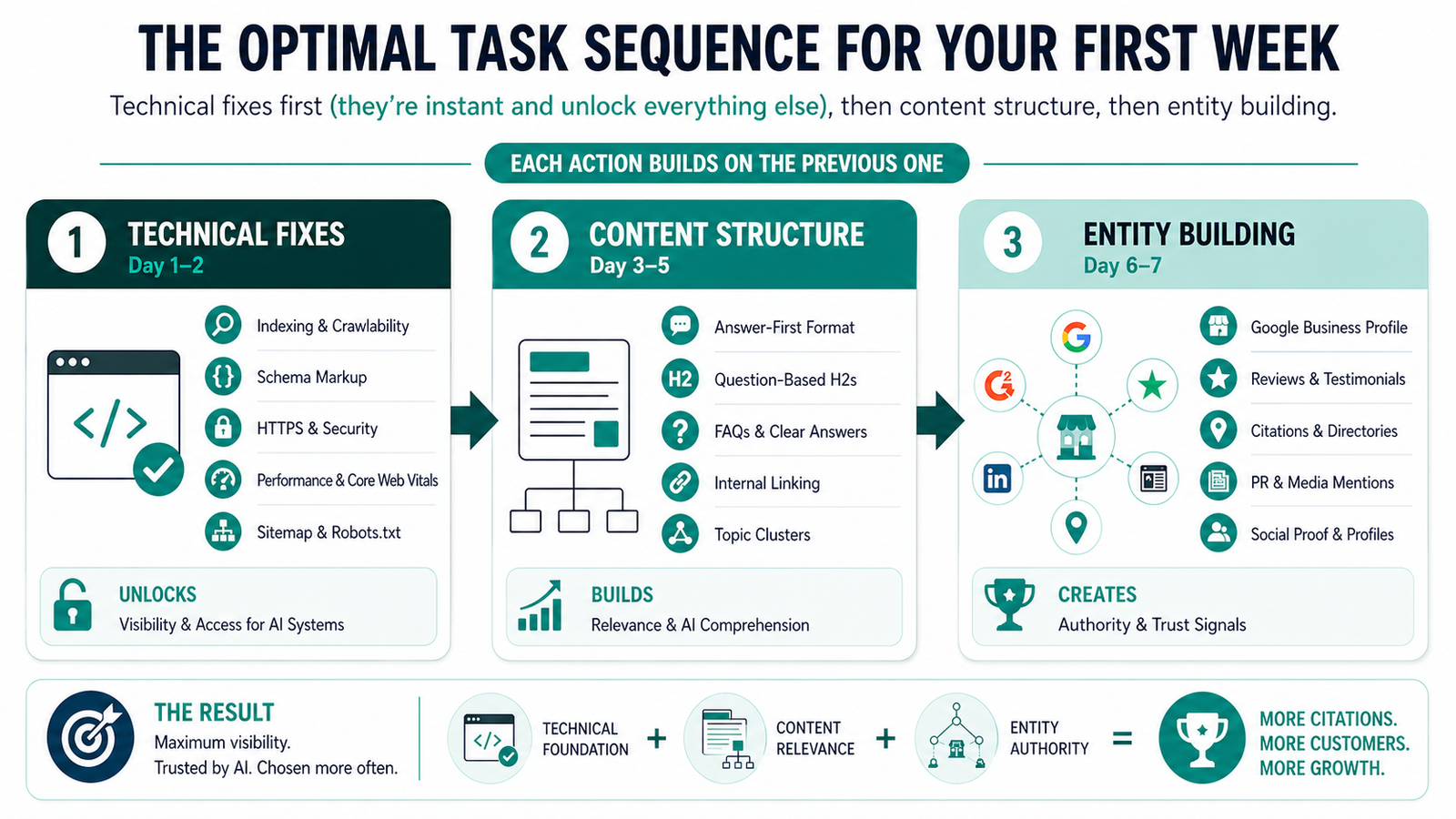
Open your robots.txt and add Allow rules for GPTBot, PerplexityBot, Google-Extended, ClaudeBot and Anthropic-AI. Verify the fix is live. This is the highest-priority action — without it, none of the other work can generate live retrieval citations.
Create a Bing Webmaster Tools account, verify your domain and submit your XML sitemap. Use the URL submission tool to manually submit your top 5 pages. This unlocks ChatGPT Search live retrieval for all your key pages.
Identify your three most commercially important pages. Rewrite the first paragraph of each to open with a direct, specific answer to the most likely visitor question. No preamble. Answer first, every time.
Write 6 Q&A pairs for each of the three pages you rewrote on Day 2. Add the FAQ sections to the pages. Implement FAQPage schema in JSON-LD format. Validate with Google's Rich Results Test.
Decide on your canonical business name. Check Google Business Profile, LinkedIn, Clutch and your top 5 directory listings. Correct every inconsistency. Add Organization schema with the sameAs array to your homepage.
Email your five most recent satisfied clients personally — not a mass email. Include a direct link to your Clutch, Google Business Profile or Trustpilot review page. A personal request converts at 3x the rate of an automated one.
Ask ChatGPT and Perplexity your 10 core queries. Record every result in a spreadsheet. This is your baseline. Set a weekly reminder to re-run the same queries. Progress you cannot see is progress you cannot manage.
Not Sure Which of These 7 Reasons Apply to You?
Book a free AI visibility audit. We check all seven issues against your actual website and give you a prioritised fix list — specific to your business, your industry and your competitors.
Takes 48 hours. We audit your site, test your ChatGPT presence and email you the full report. Hundreds of businesses audited across the UK, India, UAE, Australia and US.
Frequently Asked Questions
FAQ
My competitor has a worse website than me. Why does ChatGPT cite them and not me?
Website design quality has almost no influence on ChatGPT citation. What matters is content structure (answer-first writing, question headings, FAQs), entity authority (third-party mentions, reviews, directory listings), and technical access (AI crawlers allowed, schema markup, Bing indexing). Your competitor likely has more of these citation signals than you — even if their website looks less polished. A business with 30 Clutch reviews, press mentions and proper schema will consistently outperform a beautifully designed site with no third-party presence in AI citation.
How do I know which of the 7 reasons is causing my specific problem?
Work through the diagnostic test in each reason section — each one includes a specific check you can run in under five minutes. Start with Reason 1 (check your robots.txt) and Reason 5 (run site:yourdomain.com on Bing) as these are the most common and fastest to verify. Most businesses have at least three of the seven issues active simultaneously. If you want a complete picture without doing every check yourself, our free AI visibility audit covers all seven issues and gives you a prioritised fix list specific to your site.
How long will it take to start appearing in ChatGPT after fixing these issues?
Technical fixes (Reasons 1, 4 and 5) can produce results within 1 to 2 weeks — as soon as AI crawlers re-index your pages and Bing processes your sitemap. Content structure improvements (Reason 3) typically show citation results on Perplexity within 3 to 6 weeks and on ChatGPT Search within 4 to 8 weeks. Entity building (Reasons 2 and 6) takes longer — 6 to 12 weeks to accumulate meaningful third-party signal — but has the highest long-term impact. Fixing all seven issues simultaneously typically produces first citations on long-tail queries within 4 to 6 weeks.
Does fixing my Google SEO help with ChatGPT visibility?
Yes — significantly. Research shows that 71.7 percent of ChatGPT citations come from pages with organic search presence, and there is a strong correlation between Google page-one ranking and ChatGPT citation. Google SEO builds the domain authority that underpins your eligibility for AI retrieval. However, traditional SEO alone does not deliver GEO-specific results — you also need content structure optimisation, schema markup, entity building and the technical fixes covered in this guide. Think of strong Google SEO as the foundation and GEO optimisation as the layer built on top of it.
Can I do all of this myself or do I need an agency?
The technical fixes (Reasons 1, 4 and 5) can be completed by any business owner or web developer with basic technical knowledge — they are documented in this guide with step-by-step instructions. Content restructuring (Reason 3) requires time and writing skill but no technical expertise. Entity building (Reason 2) requires consistent outreach effort over several months. Where agencies add significant value is in speed, expertise and press outreach work — particularly authority link building, which is time-intensive and relationship-dependent. Our GEO Optimization service handles all seven issues simultaneously.
What does a free AI visibility audit actually cover?
Our free AI visibility audit tests your website against all seven issues in this guide: robots.txt crawler access for GPTBot and PerplexityBot, third-party mention volume and quality, content structure assessment on your key pages, schema markup presence and validity, Bing indexing status, NAP consistency across major platforms, and a competitive citation analysis comparing your AI search presence against your top three competitors. You receive a written report with prioritised recommendations within 48 hours. There is no obligation or sales pressure. Request yours here.
Does this work for service businesses outside the US and UK?
Yes — the seven reasons in this guide apply to every business, in every country, that wants to appear in ChatGPT answers. We have audited businesses across India, UAE, Australia, Canada and Europe and found the same patterns repeated regardless of geography. The fixes are identical. The only localisation consideration is which regional directories to prioritise for entity building — for example, JustDial and IndiaMart for India, Bayut Business for the UAE — which we cover in detail during our free audit.
What is the fastest single fix I can make to improve my ChatGPT visibility today?
Check your robots.txt file right now — visit yourdomain.com/robots.txt in your browser and look for any rule blocking GPTBot. If GPTBot is blocked, fixing that single issue in 20 minutes is the fastest possible improvement to your ChatGPT Search citation eligibility. If GPTBot is already allowed, the second fastest fix is submitting your sitemap to Bing Webmaster Tools — ChatGPT Search uses Bing's index for live retrieval, and if Bing has not indexed your pages, ChatGPT cannot cite them regardless of how good your content is.