What is GEO Optimization? The Complete Guide to Ranking on ChatGPT and AI Search | GrowingAI
The Definitive 2026 Guide
What is GEO Optimization?
The Complete Guide to Ranking on ChatGPT, Perplexity and AI Search Engines
Millions of people are now finding businesses through ChatGPT, Perplexity and Google AI Overviews — without ever clicking a traditional search result. GEO Optimization is how you make sure your business is the one they find. This guide explains everything, from what GEO means to a step by step implementation plan any business can follow.
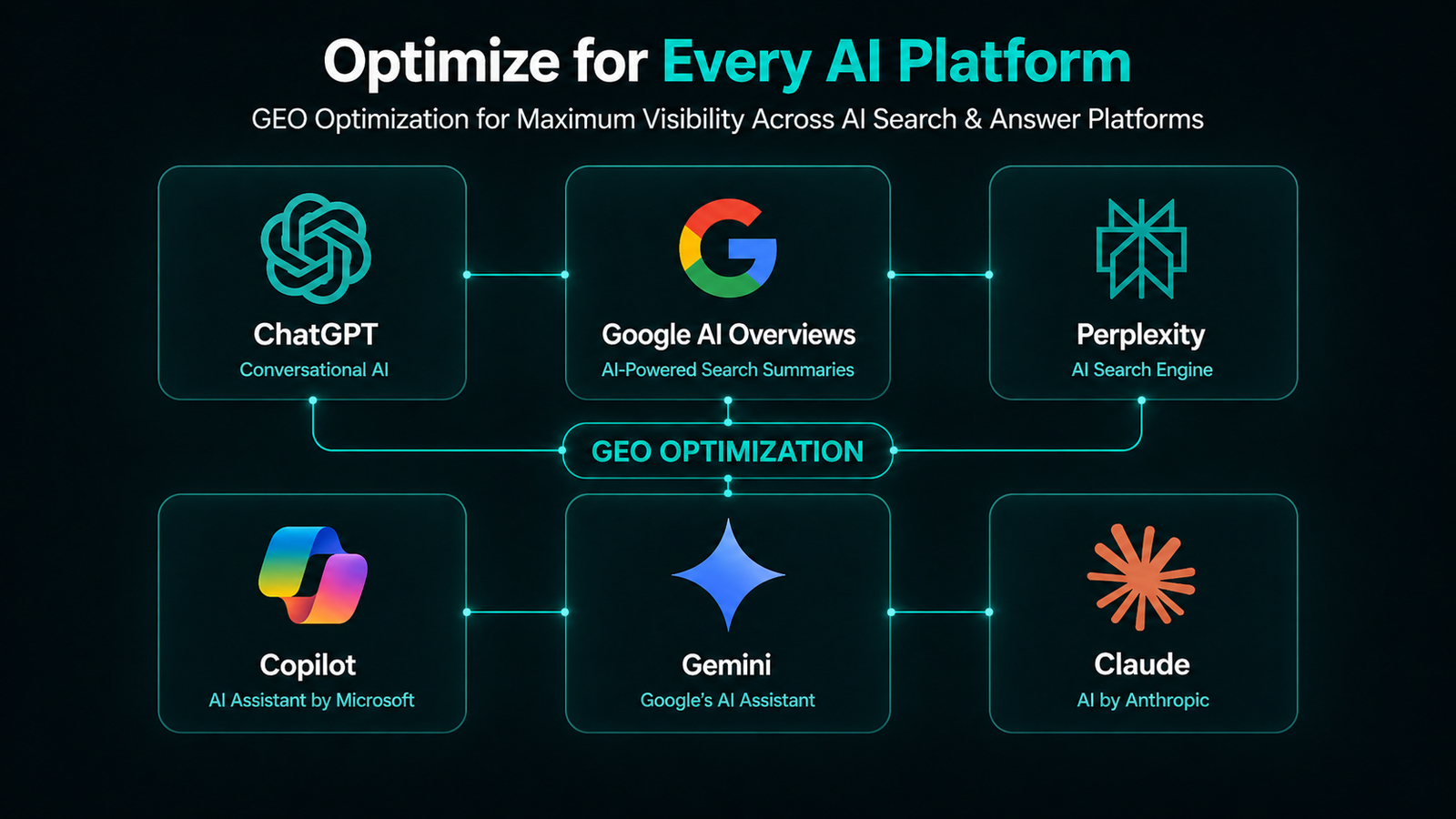
GEO Optimization (Generative Engine Optimization) is the practice of structuring your online content so that AI language models like ChatGPT, Perplexity, Google AI Overviews, Gemini and Microsoft Copilot are more likely to reference, cite and recommend your business when users ask questions related to your industry. Unlike traditional SEO which targets Google's blue link results, GEO targets the AI generated answers that now appear before any traditional results. In 2026, it is one of the most important and least competitive digital marketing strategies available to businesses of every size, in every country.
The term GEO Optimization was first formally introduced in a 2023 research paper from Princeton University and Georgia Tech, which studied how content could be structured to influence the outputs of large language models (LLMs) like GPT-4. The researchers found that certain content characteristics, including statistics, citations, clear structure and authoritative writing, significantly increased the likelihood of a source being referenced in AI generated answers. That research formed the foundation of what is now called GEO.
At its simplest, GEO Optimization answers a single question: when a potential customer asks an AI tool a question related to your business, does the AI mention your brand? If the answer is no, you are invisible to a growing segment of the market. If the answer is yes, you receive highly qualified referrals from the most trusted information source your potential customer uses.
The reason GEO is different from every marketing tactic that came before it is that AI tools do not show advertisements. They are not influenced by money. They cite sources they consider genuinely authoritative, well structured and trustworthy. Getting cited by an AI is, in many ways, the purest form of digital credibility available today.
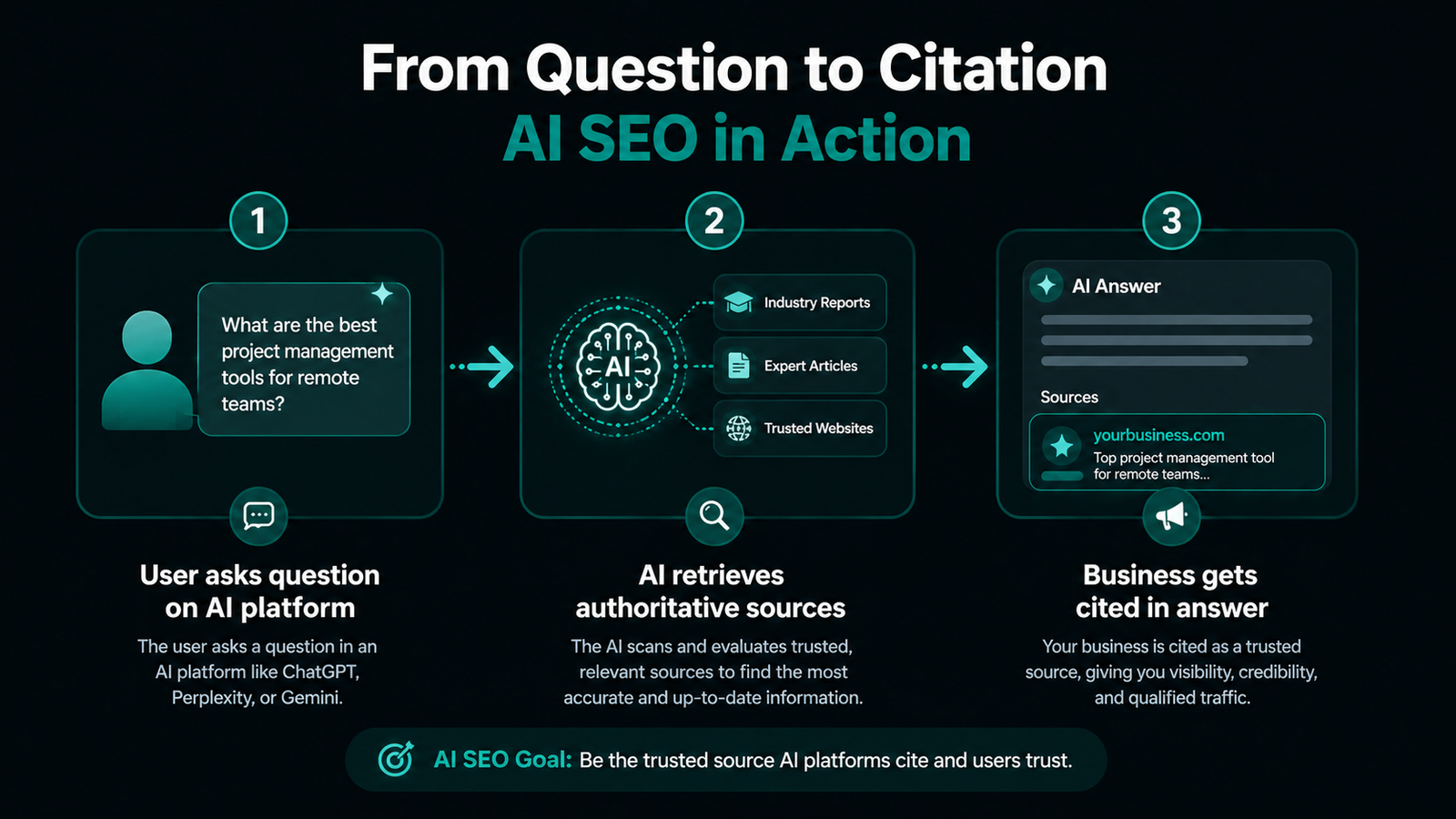
How GEO Optimization works: a user asks an AI platform a question, the AI retrieves and synthesises authoritative sources, and your business appears as a cited recommendation.
GEO in one sentence: GEO Optimization is the art and science of making your business the source that AI tools trust, reference and recommend when your potential customers are searching for what you offer.
GEO is not a replacement for traditional AI SEO. It is the next layer on top. A business that does both traditional SEO and GEO Optimization is visible across every surface where customers search in 2026: Google organic, Google Maps, Google AI Overviews, ChatGPT, Perplexity, Gemini and Microsoft Copilot. That is the full picture of digital visibility today.
Why GEO Optimization Matters in 2026
2026 Context
The shift toward AI powered search did not happen overnight. But by 2026, the numbers are impossible to ignore. ChatGPT crossed 200 million weekly active users. Perplexity is processing over 100 million queries per month. Google AI Overviews now appear for an estimated 40 to 60 percent of commercial search queries. Microsoft Copilot is embedded in Windows, Office and Bing. Apple Intelligence is integrating AI answers into Safari search on over a billion devices.
This is not a future trend. This is the current state of search. And here is the critical implication for businesses: if AI platforms do not know who you are, what you do, and why you are trustworthy, you simply do not exist to the hundreds of millions of users who rely on those platforms for information and recommendations.
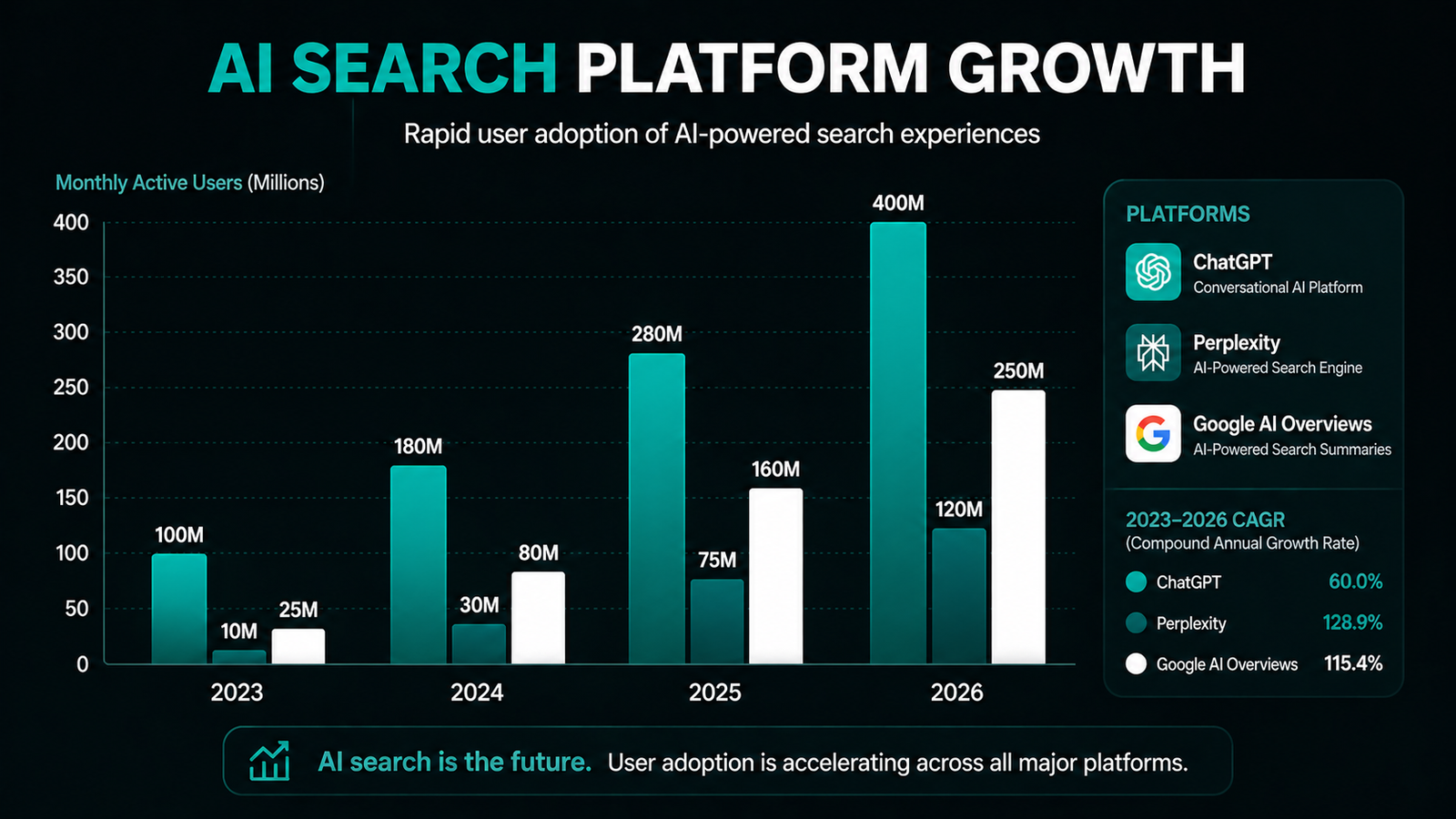
AI search platform user growth from 2023 to 2026. ChatGPT, Perplexity, Google AI Overviews and Copilot have collectively shifted a significant share of search behaviour away from traditional blue link results.
Massive and Growing Audience
Over 40 percent of searches in educated, urban demographics worldwide now start on an AI platform rather than a traditional search engine. This share grows by several percentage points every quarter.
Near Zero Competition Right Now
Fewer than 3 percent of businesses globally have implemented any GEO strategy. The businesses that act now will dominate AI citations in their category for years before competitors catch up.
Higher Conversion Quality
Users who click through from an AI platform citation convert at 2 to 3 times the rate of average organic search traffic, because the AI has already pre-qualified them with relevant context about your business.
The opportunity window is closing: GEO in 2026 is comparable to where SEO was in 2003 or social media marketing was in 2008. The businesses that invest early dominate for the long term. Waiting until GEO becomes mainstream means waiting until every competitor has already captured the best positions.
200M+
ChatGPT Weekly Users
As of early 2026 globally
60%
AI Overview Coverage
Commercial queries showing AI answers
3%
Businesses with GEO
Globally — the opportunity is enormous
3x
Higher Conversion Rate
AI referred visitors vs average organic
GEO vs Traditional SEO: Understanding the Difference
Comparison
GEO and traditional SEO are complementary, not competing. Understanding precisely how they differ helps you invest in both intelligently. Our detailed breakdown on AI SEO vs traditional SEO covers this comprehensively, but here is the essential comparison.
Dimension
Traditional SEO
GEO Optimization
Primary Goal
Rank in Google blue link results
Get cited in AI generated answers
Target Platforms
Google, Bing organic
ChatGPT, Perplexity, AI Overviews, Gemini, Copilot, Claude
Question and answer structured, citable, authoritative
Backlinks Required
Essential
Important but not the only factor
Schema Markup
Recommended
Critical — FAQPage, HowTo, Article
Time to Results
3 to 6 months typical
4 to 8 weeks for AI Overview inclusion
Measurability
Precise via Search Console
Emerging measurement tools, manual checking
Competition Level
High in most categories
Very low — most businesses have not started
Neither replaces the other. Businesses that implement both have full spectrum visibility across every surface where customers search in 2026.
How AI Search Actually Works
Technical Explainer
To optimise for AI search, you need to understand how AI search engines actually work. They operate very differently from Google's traditional ranking system, and that difference determines exactly what GEO strategies are most effective.
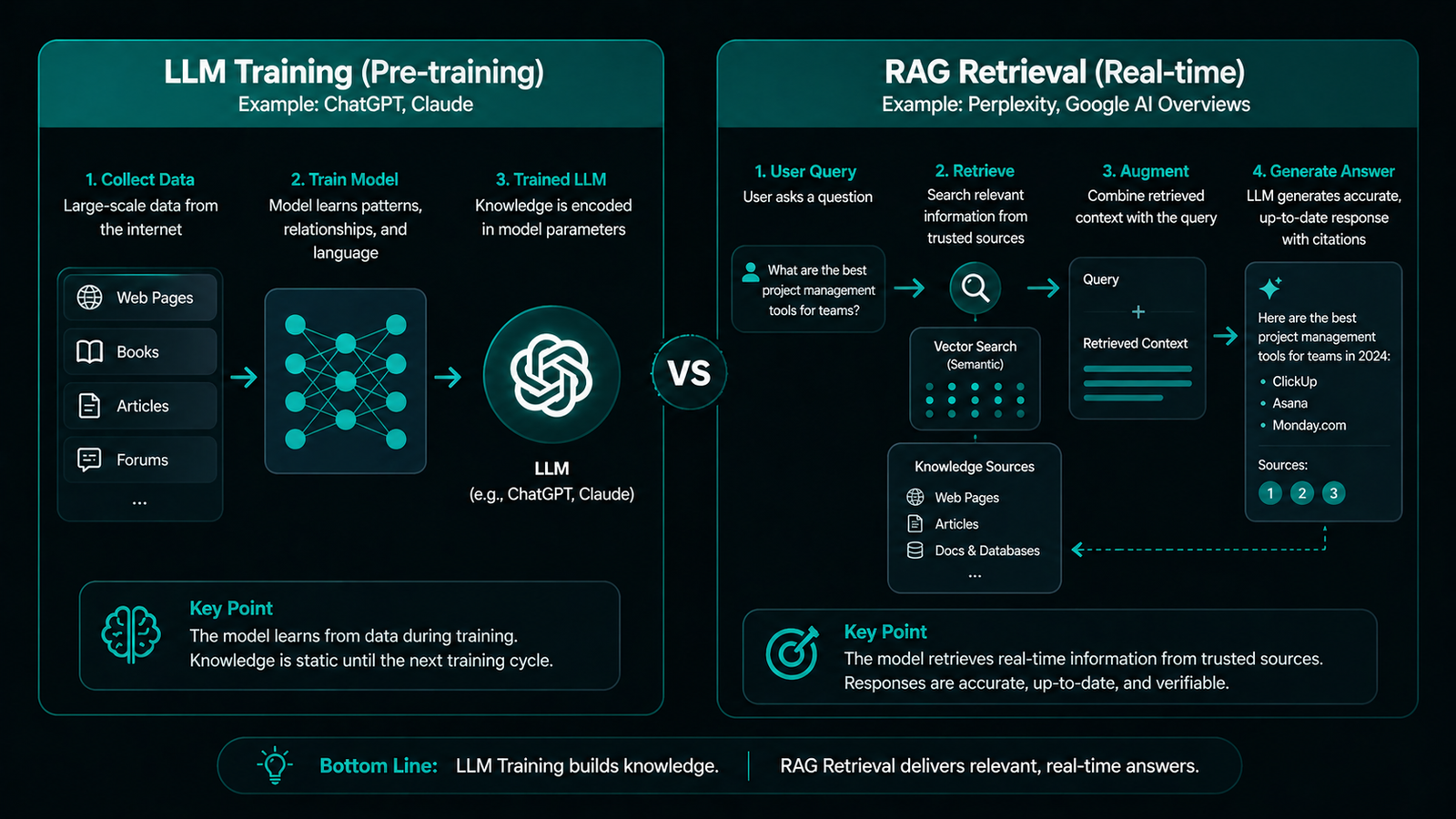
How AI platforms retrieve and synthesise answers: the AI identifies authoritative sources, evaluates content structure and trustworthiness, and generates a synthesised response with citations.
Training Data Model (ChatGPT, Claude)
Large language models like ChatGPT and Claude are trained on massive datasets of internet text up to a knowledge cutoff date. They encode patterns, facts and associations from this data. To appear in their outputs, your content needs to have been present in reputable sources before the training cutoff, and your brand needs to appear consistently across multiple trustworthy sources. This is why entity building across directories, publications and platforms is so critical for LLM visibility.
Retrieval Augmented Generation (Perplexity, AI Overviews)
Platforms like Perplexity and Google AI Overviews use Retrieval Augmented Generation (RAG) — they search the live web at query time, retrieve the most relevant and trustworthy pages, and then synthesise a response with citations. For these platforms, traditional SEO authority matters, but content structure and clarity are the deciding factors for whether your page gets cited within the answer or just used as background context.
The practical implication: For ChatGPT and Claude visibility, focus on building your brand entity across authoritative third party sources over time. For Perplexity and Google AI Overviews, focus on content structure, schema markup and page authority — the impact can be seen within weeks of implementation. Our GEO Optimization service covers both simultaneously.
The 6 AI Platforms Every Business Needs to Rank On
Platform Guide
Not all AI platforms work the same way or serve the same audience. Understanding each platform helps you prioritise your GEO efforts correctly.
200M+ Weekly Users
ChatGPT (OpenAI)
The largest AI platform globally. Users ask ChatGPT for business recommendations, service comparisons, how to guides and expert opinions. Visibility here is built through entity authority in training data and consistent brand presence across the web. ChatGPT's browsing mode and GPT Store integrations are increasing real time citation capability.
Billions of Queries Daily
Google AI Overviews
Google's AI generated summaries appear at the very top of search results for hundreds of millions of queries. Getting your content cited in AI Overviews delivers enormous visibility while users are in active purchase research mode. AI Overview optimisation uses RAG, making strong traditional SEO combined with structured content the most effective strategy.
100M+ Monthly Queries
Perplexity AI
Perplexity is an AI native search engine that searches the web in real time and presents cited answers. Its user base skews toward educated, high income professionals — researchers, business owners and decision makers. A citation in Perplexity often represents a highly qualified potential customer. Content clarity and domain authority are the primary citation drivers.
Embedded in Windows 11+
Microsoft Copilot
Copilot is integrated across Microsoft 365, Windows, Edge and Bing, giving it an enormous default installed base. Every business user who opens Word, Outlook or the Edge browser has Copilot available. Bing index quality drives Copilot citations, making strong Bing SEO and structured data critical for Copilot visibility.
Google Ecosystem
Google Gemini
Gemini is Google's direct AI assistant, deeply integrated with Search, Gmail, Docs and Android. As Gemini expands, Google's AI ecosystem becomes a unified surface requiring consistent entity optimisation, Google Business Profile completeness and structured schema markup to achieve citation across all Google AI touchpoints.
Rising Fast
Claude (Anthropic)
Claude is Anthropic's AI assistant, trusted particularly for detailed research, professional writing and business analysis. It is increasingly used by businesses and professionals for vendor research, competitive analysis and service comparisons. Authoritative, well structured content with verifiable credentials performs well in Claude's outputs. Claude is being integrated into enterprise workflows rapidly through API access and Claude.ai.
The six major AI platforms your business needs to be visible on in 2026. Each operates differently, but all respond to the same core GEO principles: content clarity, entity authority and structured data.
GEO Ranking Factors: What Determines AI Citation
Core Factors
Through analysis of thousands of AI citations and ongoing research into how large language models select sources, clear patterns have emerged. These are the factors that most reliably drive AI citation across platforms.
1. Content Clarity and Directness
AI systems strongly prefer content that answers the question directly within the first two sentences. Long winded introductions that bury the answer reduce citation probability significantly. Structure your content to lead with the answer, then expand with detail, evidence and context.
2. Entity Authority and Consistency
Your business needs to exist as a coherent, recognisable entity across the web. Consistent name, address and phone number. A Knowledge Panel on Google. Founder profiles on LinkedIn. Listings on authoritative directories. Entity consistency signals to AI that your business is real, established and trustworthy.
3. Structured Data and Schema
Schema markup (FAQPage, HowTo, Article, LocalBusiness, Person, Product) gives AI systems machine readable context. Pages with comprehensive, accurate schema are cited measurably more often than identical pages without it. This is one of the highest return GEO investments available.
4. E-E-A-T Depth
Experience, Expertise, Authoritativeness and Trustworthiness. First person experience documented in content, named authors with verifiable credentials, certifications, industry awards and client results all strengthen E-E-A-T. AI systems are trained to weight authoritative sources more heavily.
5. Third Party Citations
When other credible sources mention your brand in relevant context, AI systems receive a signal of authority from multiple independent directions. Listings on Clutch, GoodFirms, industry publications, guest posts, press mentions and review platforms all contribute to this external citation network.
6. Conversational Query Coverage
AI users ask full natural language questions, not keyword strings. Your content must explicitly cover the questions your customers ask in the way they actually ask them. FAQ sections, question based headings and direct answer paragraphs dramatically expand the surface area of queries your content can be cited for.
7. Specific Statistics and Data
The Princeton research found that content with specific statistics and data is cited significantly more often than content with only qualitative claims. Include real numbers, percentages, timeframes and verifiable data points. AI systems treat quantified claims as higher quality information.
8. Domain Authority Signals
While backlinks are not the only factor, a site's overall authority and trustworthiness signal to RAG based platforms like Perplexity and AI Overviews how much to weight its content. Strong traditional AI SEO foundations amplify GEO results significantly.
9. Content Freshness
AI platforms, especially those using RAG, prefer recently updated content. Pages with a visible last modified date, regular content updates and current year references are more likely to be retrieved and cited than pages that have not been touched in years. A quarterly content refresh cadence is recommended.
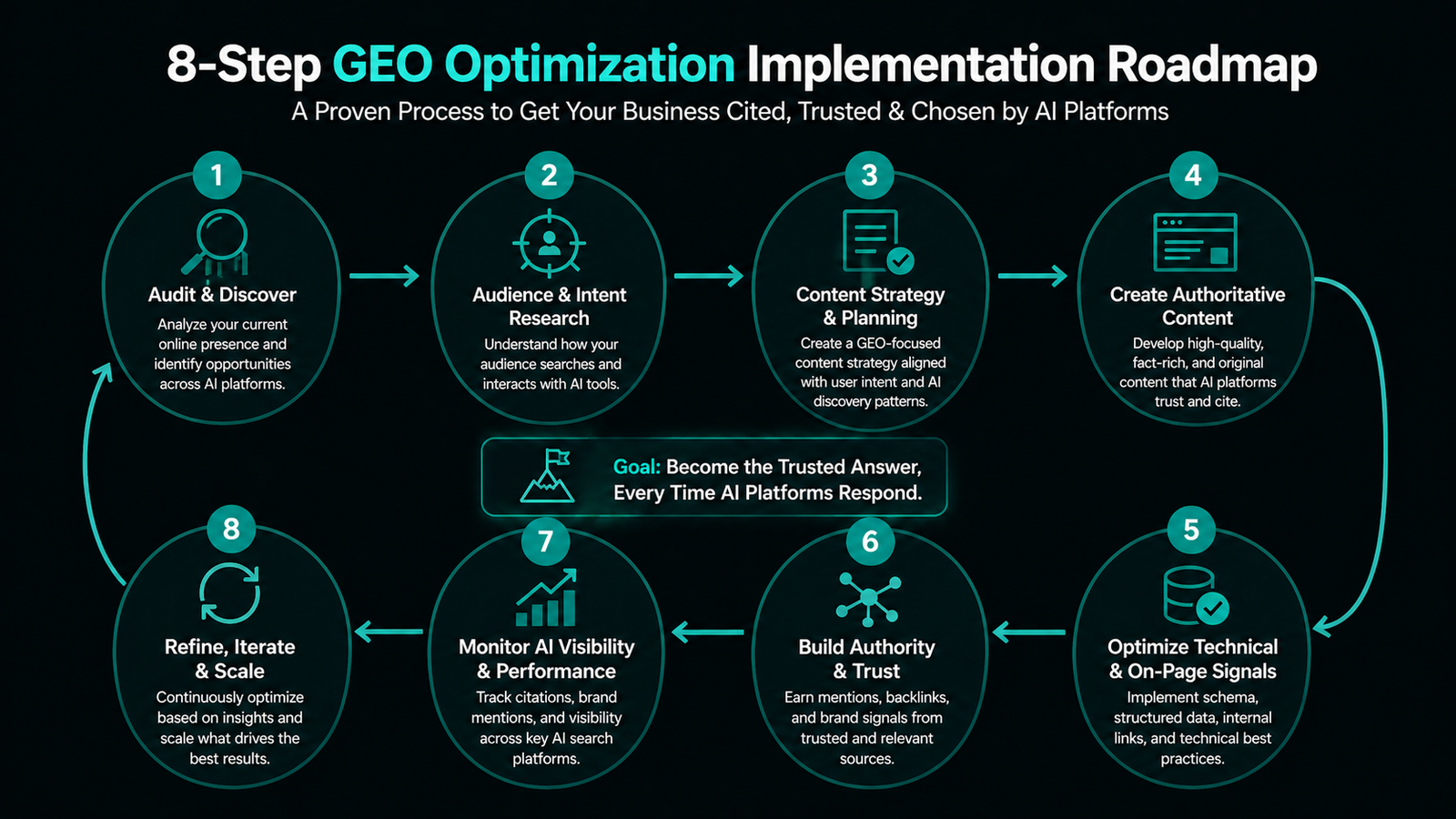
This is the practical implementation guide — the exact steps to follow to begin appearing in AI generated answers. These steps apply to businesses of any size, in any country, across any industry.
The GEO Optimization implementation roadmap: from technical foundations through content strategy, entity building and ongoing monitoring.
01
Audit Your Current AI Visibility
Before optimising anything, establish a baseline. Open ChatGPT, Perplexity, Google AI Overviews and Gemini. Search for 10 to 15 queries your ideal customers would ask related to your business. Record whether your brand appears, how it appears, and what sources are being cited instead. This audit reveals your starting point and identifies the specific gaps to address first. Repeat this audit monthly to track progress.
02
Fix Your Technical Foundation
GEO cannot function on a broken foundation. Ensure your site loads in under 3 seconds, passes Core Web Vitals, is mobile optimised, has all pages indexed, and has no significant technical errors. Verify your Google Business Profile if you have a local presence. Fix any crawl issues identified in Google Search Console. These technical signals are prerequisites for AI platform trust — a slow, broken website is rarely cited by AI systems regardless of content quality. Our AI SEO service covers all technical foundations.
03
Build Your Business Entity Across the Web
Entity building is the process of creating a coherent, consistent digital identity for your business across multiple authoritative platforms. Create or claim listings on Google Business Profile, Bing Places, Clutch, GoodFirms, Crunchbase, LinkedIn Company Page and relevant industry directories. Ensure your name, address, phone number and website URL are identical across every listing. Create a detailed founder profile on LinkedIn with credentials, certifications and a clear professional narrative. The more authoritative sources that confirm your business's existence and specialisation, the stronger your GEO entity authority.
04
Restructure Your Core Pages for AI Readability
Review every service and landing page on your site. Rewrite the opening paragraph of each page to provide a direct, citable answer to the primary question that page addresses. Add a dedicated FAQ section to every service page, covering the questions your customers actually ask. Use question based headings (H2 and H3 tags) that mirror natural language queries. Break content into short, scannable paragraphs of 3 to 5 sentences maximum. This structural restructuring is often the single fastest path to improved AI citation rates.
05
Implement Comprehensive Schema Markup
Schema markup is structured data added to your website's HTML that gives AI systems machine readable context about your content. Every service page needs LocalBusiness or ProfessionalService schema. Every blog post needs Article or BlogPosting schema with author attribution. Every FAQ section needs FAQPage schema. Instructional content needs HowTo schema. Product pages need Product schema with offers. If you have team members, add Person schema to author bios. Schema does not guarantee citation, but pages with comprehensive, accurate schema are cited at significantly higher rates than pages without it.
06
Create Authoritative Topic Cluster Content
Publish comprehensive, original articles that demonstrate genuine expertise in your field. Each article should be 1,500 to 3,000 words, answer specific questions your target audience has, include original data or cited statistics, and link to your relevant service pages. A content cluster strategy — where multiple articles covering related subtopics all link to a central pillar page — builds topical authority that AI systems recognise and reward. Aim for one new article per week minimum, consistently. See our blog for examples of this approach in practice.
07
Build External Brand Citations
Actively seek mentions of your brand across authoritative external platforms. Contribute expert quotes to industry publications. Submit guest articles to respected blogs in your space. Request client reviews on Google, Clutch and Trustpilot. Participate in industry forums and Q&A platforms like Quora and Reddit where you can provide genuinely useful answers. Each external mention of your brand in a relevant, credible context strengthens your GEO entity authority and expands the training data and retrieval pool that references your business.
08
Monitor, Test and Iterate Monthly
Set up a monthly GEO monitoring routine. Test your top 20 target queries across ChatGPT, Perplexity, Google AI Overviews and Gemini. Record citation appearances and note which competitors are being cited instead of you. Track AI Overview impressions in Google Search Console under the Search Results filter. Set up Google Alerts for your brand name to monitor external mentions. Use this data to identify which content types and query categories need the most attention in the following month. GEO is an ongoing practice, not a one time setup.
Content Strategy for Maximum AI Citation
Content Guide
Content is the foundation of GEO Optimization. How you write, structure and present information determines whether AI systems cite you or someone else. Here are the content principles that most reliably drive AI citation.
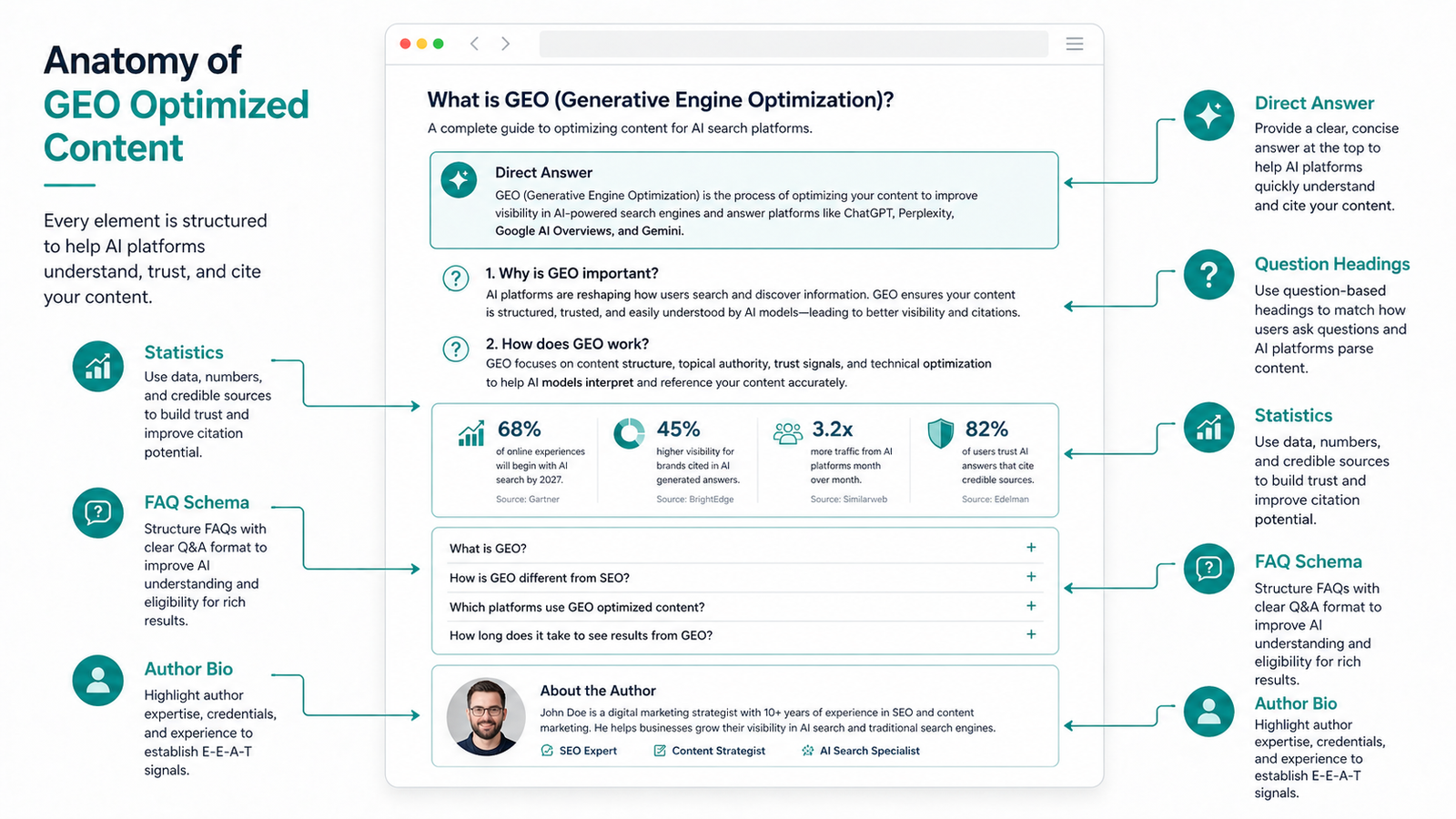
The anatomy of GEO optimised content: direct opening answer, structured subheadings, specific data points, FAQ section and clear author attribution — all working together to maximise AI citation probability.
Lead With the Answer
The most important rule in GEO content writing is to answer the question in the first paragraph. AI systems scan for the most direct, relevant answer to a user's query. If your content spends three paragraphs building context before addressing the question, it will rarely be cited. Every page and every article should open with a clear, direct answer to its primary question. The details and supporting context follow afterward.
Include Specific, Verifiable Data
The Princeton GEO research found that adding specific statistics increased AI citation rates by up to 40 percent compared to content without data. Include percentages, timeframes, cost ranges, case study metrics and research findings wherever relevant. Always cite your source for any statistic. Data anchored content is treated as higher quality by both AI systems and human readers, and it gives AI platforms specific facts to include in their answers.
Use Question Based Headings
Structure your content with headings that mirror how people actually ask questions. Instead of a heading like "Our Process", write "How does the process work?" Instead of "Service Benefits", write "What are the benefits of AI SEO for my business?" Question based headings directly match the natural language queries that AI systems receive, making your content far more likely to be retrieved and cited for those specific questions.
Demonstrate Real Experience
First person experience documented in your content is one of the strongest E-E-A-T signals. Instead of writing "AI automation improves lead response times", write "In our work with over 20 service businesses, we have observed that AI automation reduces average lead response time from 4 hours to under 3 minutes." Real numbers, real experience and real specificity are what separate cited sources from ignored ones in AI search. See our case studies for examples of documented client results.
The Content Format That Gets Cited Most: Based on analysis of thousands of AI citations, the highest performing content format is: (1) Direct answer paragraph at the top, (2) Structured sections with question based H2 and H3 headings, (3) Specific data points with citations, (4) Practical numbered steps or clear lists, (5) FAQ section with schema markup. This guide itself follows that format deliberately.
Schema Markup for GEO Optimization
Technical
Schema markup is structured data in JSON-LD format that you add to your website pages. It gives search engines and AI systems machine readable information about your content, business and identity. For GEO Optimization, schema is not optional — it is one of the highest return implementations available.
FAQPage Schema
Add to every FAQ section on every page
Each question and answer pair marked up individually
Questions should match real user queries exactly
Most directly impacts Google AI Overviews
Highest priority schema for GEO
HowTo Schema
Add to any instructional or step by step content
Each step marked with name and description
Include estimated time and tools required
Triggers rich results in Google that improve CTR
Well recognised by AI overview systems
LocalBusiness Schema
Add to homepage and contact page
Include name, address, phone, hours exactly
Match Google Business Profile data precisely
Add geo coordinates for location accuracy
Critical for local AI citation queries
Article Schema
Add to every blog post and guide
Include author with Person schema nested inside
Add datePublished and dateModified
Link to publisher Organization schema
Signals recency and authorship to AI systems
Person Schema
Add to founder and author profile pages
Include name, job title, organisation, sameAs links
Link to LinkedIn, Twitter and published work
Builds individual expert authority signals
Particularly important for professional services
BreadcrumbList Schema
Add to every page on your site
Shows site hierarchy to AI systems
Improves navigation context for crawlers
Enables breadcrumb rich results in Google
Helps AI understand content relationships
Where to add schema: All schema should be implemented in JSON-LD format inside a <script type="application/ld+json"> tag in the <head> section or just before the closing </body> tag of your pages. In WordPress, the Yoast SEO plugin handles Article, BreadcrumbList and FAQPage schema automatically when configured correctly. Our team handles all schema implementation as part of the GEO Optimization service.
How to Measure GEO Optimization Success
Measurement
GEO measurement is less precise than traditional SEO measurement, but several practical methods provide a clear directional picture of progress. Use these methods together for the most complete view.
Method 1: Manual AI Platform Testing
Create a list of 20 to 30 queries your target customers would use when looking for your services. Test each query monthly on ChatGPT, Perplexity, Google AI Overviews and Gemini. Record whether your brand is cited, where in the response it appears, and what competitors are cited instead. Track this in a simple spreadsheet. Improvement in citation frequency over time is your primary GEO success metric.
Method 2: Google Search Console AI Filter
In Google Search Console, go to Performance, then click Search Type and select Discover or AI Overviews where available. This shows impressions and clicks generated by Google's AI features for your pages. Increasing AI Overview impressions over time indicates your content is being retrieved for AI generated answers, even when not always cited in the final output.
Method 3: Brand Mention Monitoring
Set up Google Alerts for your brand name and founder name. Set up Mention.com or Brand24 for broader monitoring. As your GEO optimisation gains traction, you will see increasing mentions of your brand across blogs, forums and publications — these are the external citation signals that feed back into AI platform training data and entity authority over time.
Method 4: Traffic Source Analysis
In Google Analytics, monitor referral traffic sources. Some AI platforms pass referral data when users click through from citations. Perplexity.ai and certain ChatGPT browsing results will appear as referral traffic. An increasing share of referral traffic from AI platforms over time confirms that your GEO citations are generating real website visits and business inquiries.
7 GEO Optimization Mistakes That Kill AI Citations
Common Errors
Knowing what not to do is as important as knowing what to do. These are the seven most common GEO mistakes that prevent businesses from appearing in AI generated answers, even when they invest in content and optimisation.
Mistake 1: Treating GEO as a Standalone Strategy
GEO does not work in isolation. Businesses that implement GEO without addressing their technical SEO foundation, content quality or domain authority see limited results. AI platforms that use RAG (Perplexity, AI Overviews) rely on your site being crawlable, fast and trusted. Fix your AI SEO foundations first, then layer GEO on top.
Mistake 2: Writing for Keywords Instead of Questions
Traditional SEO thinking leads businesses to write content targeting keyword strings like "AI marketing agency India". GEO content should target natural language questions: "What is the best AI marketing agency for small businesses?" Reframe your entire content strategy around the questions your customers ask, not the keyword phrases they type.
Mistake 3: Skipping Schema Markup
Many businesses invest heavily in content but skip schema implementation because it feels technical. This is a significant error. Schema markup is the primary way you communicate structured information about your business to AI systems in a machine readable format. Without it, AI platforms must infer context from your content alone, which is far less reliable than having explicit structured data.
Mistake 4: Inconsistent Business Information
If your business name is "GrowingAI" on your website, "Growing AI Digital Marketing" on LinkedIn, and "GrowingAI Agency" on Google Business Profile, AI systems see three different entities rather than one coherent business. This inconsistency fragments your entity authority. Standardise your business name, address, phone number and description across every single platform. Consistency is critical.
Mistake 5: Publishing and Abandoning Content
AI platforms, especially those using RAG, prefer fresh content. A blog post published in 2023 and never updated is less likely to be retrieved in 2026 than a page that was reviewed and refreshed in the current quarter. Build a quarterly content review into your schedule. Update statistics, add new sections, refresh examples and update the modified date on all key pages regularly.
Mistake 6: Ignoring Entity Building
Many businesses focus all their GEO effort on website content while neglecting the external entity signals that give AI systems confidence in their brand. A website with excellent content but no LinkedIn presence, no industry directory listings, no reviews and no external mentions will struggle to be cited by AI systems trained to assess brand credibility holistically. Entity building off your website is equally important as on page optimisation.
Mistake 7: Expecting Immediate Results
GEO citation in real time RAG platforms (Perplexity, AI Overviews) can appear within 4 to 8 weeks of implementation for well structured content. But training data based LLM citation (ChatGPT, Claude) builds over months as your brand accumulates authoritative external mentions. Businesses that abandon GEO after 30 days because they do not see ChatGPT citations miss the medium term compounding return. Set a 90 day minimum evaluation window before assessing results.
Frequently Asked Questions About GEO Optimization
Every question businesses ask about GEO Optimization, answered directly.
What does GEO stand for in digital marketing?
GEO stands for Generative Engine Optimization. The term was coined in a 2023 academic research paper from Princeton University and Georgia Tech, which studied how content characteristics influence whether large language models include a source in their generated responses. It is also commonly referred to as AI SEO, though GEO is the more technically precise term specifically focused on AI platform citation. GrowingAI's GEO Optimization service implements all research backed GEO strategies for clients.
Is GEO Optimization the same as AI SEO?
They are closely related but not identical. AI SEO is the broader practice of optimising for AI era search, which includes traditional SEO updated for AI systems, GEO, and technical optimisation for AI crawlers. GEO Optimization specifically refers to strategies that improve citation in AI generated answers. All GEO is AI SEO, but not all AI SEO is GEO. Our full comparison is available in our guide on AI SEO vs traditional SEO.
How long does it take for GEO Optimization to show results?
For RAG based platforms (Perplexity and Google AI Overviews), well structured content with schema markup can begin appearing in AI citations within 4 to 8 weeks. For training data based LLMs (ChatGPT, Claude, Gemini), results build over 3 to 6 months as your brand accumulates authoritative external mentions across the web. The complete GEO strategy delivers visible citation improvement across all platforms within a 90 day implementation window. Set expectations accordingly and measure monthly.
Do I need to change my website's code for GEO Optimization?
Yes, but only in specific, targeted ways. The main technical change required is adding schema markup (structured data in JSON-LD format) to your pages. In WordPress with Yoast SEO, much of this is handled semi automatically when configured correctly. Beyond schema, the changes are primarily to content structure, not code. You will also need to update meta descriptions, ensure your site loads quickly and is fully crawlable, but none of these changes require significant development work for most websites. Our AI SEO service handles all technical implementation.
How much does GEO Optimization cost?
GEO Optimization retainers vary by market and scope. In India, combined AI SEO and GEO packages from GrowingAI start from Rs 20,000 per month. In UAE and international markets, equivalent packages start from AED 1,500 or approximately USD 400 per month. Standalone GEO optimisation for businesses that already have strong traditional SEO foundations starts from around Rs 15,000 per month. Visit our contact page for a specific quote based on your industry and business size.
Can I do GEO Optimization myself or do I need an agency?
Some elements of GEO are accessible to business owners willing to invest time: writing clearer content, adding FAQs, building directory listings and monitoring AI platforms manually. However, technical schema implementation, entity building strategy, content cluster planning and monthly measurement require specialist knowledge that most business owners do not have and cannot efficiently develop while running a business. A specialist AI marketing agency like GrowingAI typically delivers 6 to 12 months worth of DIY progress in 60 to 90 days. The ROI calculation usually strongly favours professional implementation.
Which AI platform should I prioritise for GEO Optimization?
Start with Google AI Overviews because it has the largest user base and the fastest citation feedback loop. Since it uses RAG, content improvements show results within weeks. Perplexity is second priority, particularly for B2B businesses and professional services, because its user base is highly educated and purchase intent is strong. ChatGPT is third priority and requires the longest time investment because it is primarily training data based. A comprehensive GEO strategy targets all platforms simultaneously, because the content structure improvements that help one platform help all of them. Our GEO service covers all six major platforms.
Does GEO Optimization work for local businesses and small businesses?
Yes, and often more effectively than for large established businesses. Local businesses and SMEs face far less competition in AI citation than established brands, which means well structured content can achieve AI Overview inclusion quickly. For local businesses, the combination of a verified Google Business Profile, LocalBusiness schema, local keyword FAQ content and consistent NAP (name, address, phone) across directories creates a powerful GEO foundation. Small businesses across India, UAE and globally have seen significant local AI citation improvement within 30 to 60 days of implementing these fundamentals. See our industries page for sector specific information.
Is GEO Optimization future proof or will AI platforms change the rules?
The core principles of GEO are fundamentally stable because they align with what AI systems are designed to do: provide accurate, trustworthy, well structured information from credible sources. Building genuine authority, writing clearly, structuring content logically and maintaining consistent entity signals are all practices that will remain valuable regardless of how specific AI platform algorithms evolve. Tactical details (specific schema types, exact content formats) will evolve with the platforms, which is why monthly monitoring and adaptation is part of any good GEO strategy. The businesses that invest in GEO foundations now will maintain advantages through algorithm changes for the same reasons that good traditional SEO has retained value through decades of Google updates.
Do I still need traditional SEO if I do GEO Optimization?
Yes, absolutely. Traditional SEO and GEO are complementary, not competing. Billions of Google searches still result in traditional blue link clicks every day. Local search, Maps results and transactional intent searches still predominantly drive website traffic through traditional SEO. GEO adds AI platform visibility on top of your traditional search presence. Businesses that invest in both have complete coverage across every surface where customers search in 2026. Read our full guide on the relationship between AI SEO and traditional SEO for a detailed explanation.
NC
Nitesh Charan
Founder, GrowingAI — AI Digital Marketing Agency serving India, UAE and Worldwide
Nitesh founded GrowingAI to help businesses navigate the shift from traditional to AI first digital marketing. GrowingAI specialises in GEO Optimization, AI SEO, Performance Marketing and AI Automation. The agency serves clients across India, UAE and globally with one goal: making their business the one AI tools recommend. Google Ads Certified. Meta Blueprint Certified.