Free AI Marketing Audit for India & UAE Businesses | Book Now →
GROWINGAI
Chat on WhatsApp
AI Automation for Small Business: The Complete 2026 Guide | GrowingAI
Complete Business Guide 2026

AI Automation for Small Business: The Complete 2026 Guide

Small businesses using AI automation in 2026 are saving 20 to 35 hours per week, responding to leads in under 90 seconds and running marketing campaigns that previously needed a full team. This guide tells you exactly what to automate first, which tools to use and what it realistically costs.

By Nitesh Charan, GrowingAI
Updated May 2026
16 min read
Global Guide
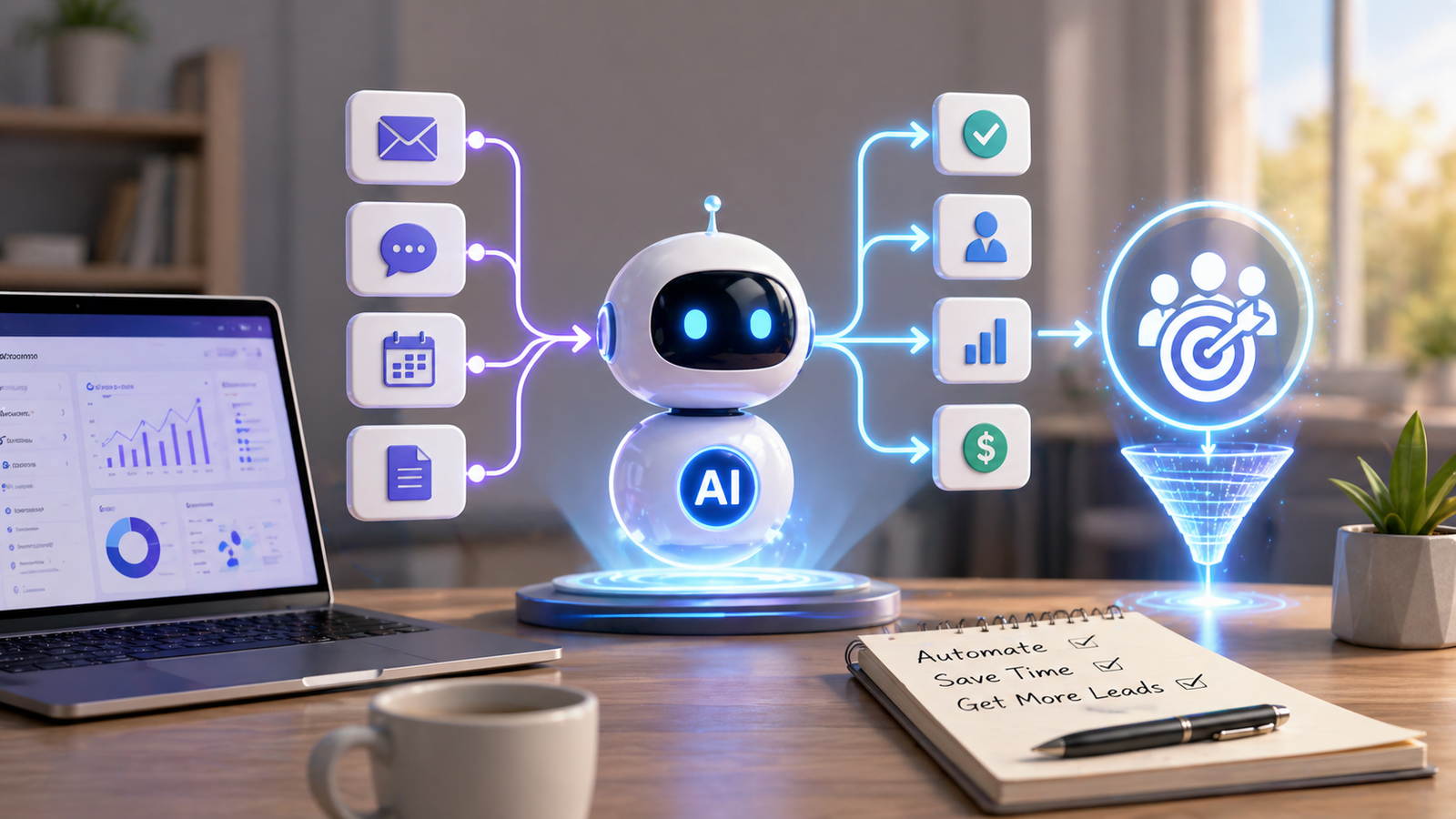
AI automation for small business 2026 — automated workflows saving time and generating leads

Quick Answer: What is AI Automation for Small Business?

AI automation for small business means using artificial intelligence software to handle repetitive tasks automatically — without human involvement. This includes responding to customer enquiries, qualifying leads, sending follow up messages, booking appointments, updating your CRM, posting on social media and generating reports. In 2026, AI automation tools start from as little as $50 per month and can genuinely replace 20 to 35 hours of manual work per week. The businesses getting the highest return are those that automate lead response, customer follow-up and routine admin first — then expand from there.

What is AI Automation for Small Business

Foundation

AI automation for small business refers to software systems that use artificial intelligence to carry out business tasks automatically, without requiring a human to perform them manually each time. Unlike basic automation (which simply moves data from one place to another), AI automation can understand context, make decisions, generate content, interpret customer intent and respond appropriately — behaviour that previously required human judgement.

In 2026, AI automation is accessible to businesses of every size. What once required a development team and enterprise budget can now be built using no-code platforms like Make.com, n8n and GoHighLevel — configured by an agency or a technically capable business owner within days rather than months. The barrier to entry has collapsed. The question is no longer whether AI automation is feasible for small businesses. The question is which processes to automate first and how to sequence that investment for maximum return.
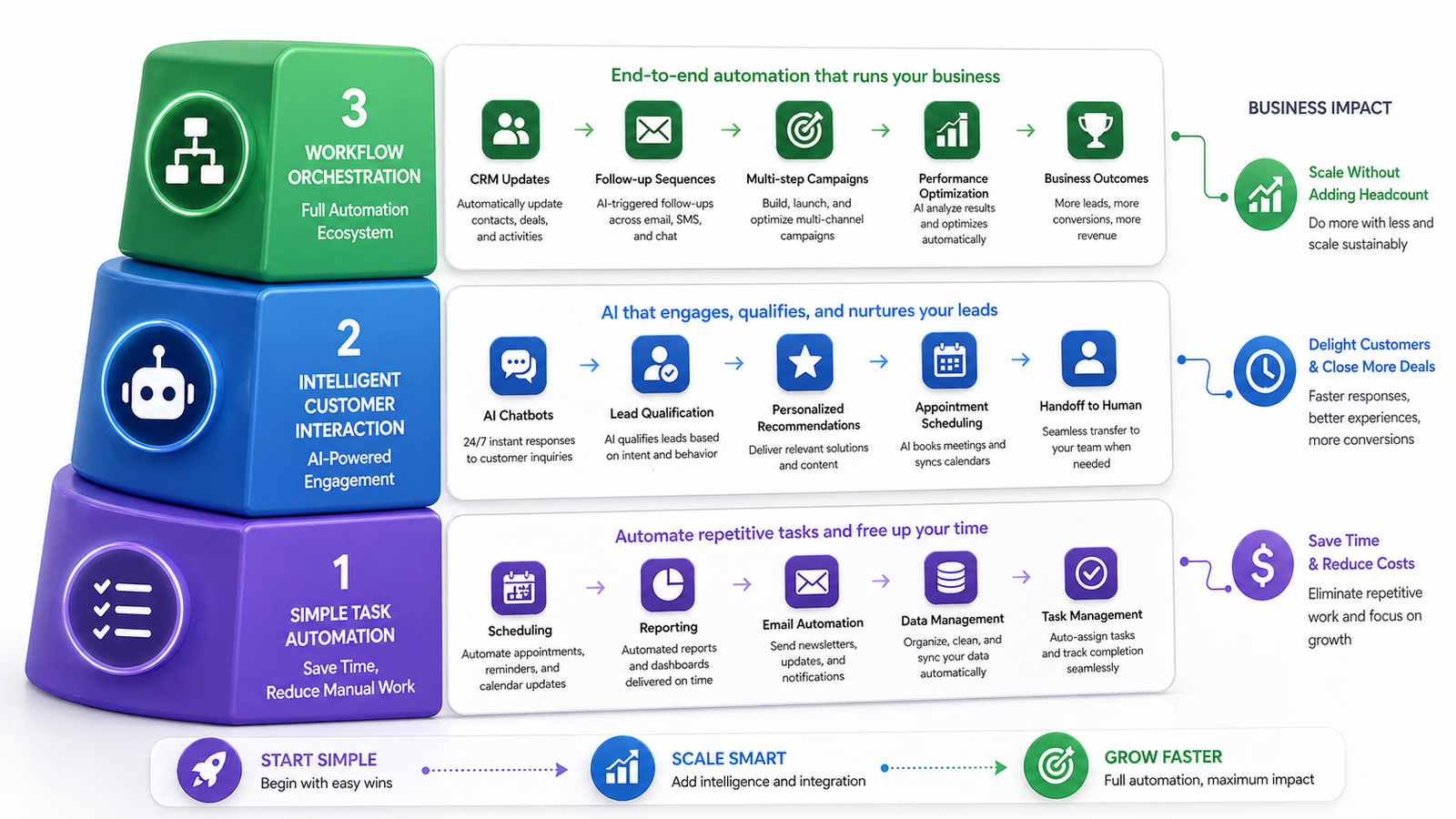
AI automation for small business overview — what processes can be automated and how AI systems connect to business workflows
An overview of AI automation layers for small business: from simple task automation (scheduling, reporting) through intelligent customer interaction (AI chatbots, lead qualification) to full workflow orchestration (CRM updates, follow-up sequences, multi-step campaign management).

Basic Task Automation

Scheduled social media posts, automatic invoice generation, data entry between systems, appointment reminders and report generation. Rule based, predictable, repeatable. This is the entry level and where most small businesses start.

Intelligent AI Automation

AI chatbots that understand natural language, lead qualification that asks the right questions dynamically, content generation that follows your brand voice, and email responses that are contextually relevant to each customer. This is where AI adds genuine intelligence beyond rules.

Full Workflow Orchestration

Multi-step automated workflows where a single trigger (a new lead enquiry) initiates a sequence of AI driven actions: qualifying the lead, updating the CRM, sending a personalised response, notifying the sales team and scheduling a follow-up — all without human involvement.

The 2026 reality: A small business with 3 to 10 employees that implements AI automation properly can operate with the efficiency of a team twice its size. The competitive advantage is not theoretical — it is already being realised by small businesses in every sector, from real estate agencies to export firms to clinics to coaching institutes. Businesses not automating in 2026 are paying a growing competitive tax in wasted time and missed opportunities.

Key Benefits of AI Automation for Small Business

Proven Outcomes

These are not theoretical benefits — they are outcomes documented across businesses that have implemented AI automation correctly. The specific numbers vary by industry and implementation quality, but the directional improvement is consistent.

20 to 35 Hours Saved Per Week

The average small business owner and their team spend 20 to 35 hours per week on tasks that AI can handle: responding to routine enquiries, sending follow-up messages, updating records, scheduling posts, generating standard reports and booking appointments. Automating these tasks does not just save time — it frees the owner to focus on strategy, client relationships and growth activities that actually require human expertise.

Lead Response in Under 90 Seconds

Research consistently shows that the probability of converting a lead drops by over 80 percent if you do not respond within 5 minutes. The average small business responds to leads in 4 to 8 hours. AI automation responds in under 90 seconds, around the clock. For businesses where speed of response determines conversion — real estate, education, legal, healthcare, finance — this single improvement frequently delivers full ROI on the automation investment within 30 to 60 days.

24/7 Customer Service Without Staff

AI automation enables a small business to provide customer service around the clock without hiring night shift staff or paying overtime. International businesses, in particular, benefit enormously — a UK customer enquiring at 11pm gets an immediate, helpful response even if the business team is in India or UAE and asleep. This 24/7 availability has a measurable impact on customer satisfaction scores and repeat business rates.

Fewer Errors and Consistent Quality

Human teams make data entry errors, forget to send follow-up emails and occasionally miss appointments. AI automation systems do not. Once configured correctly, they execute the same process with the same quality every single time. For businesses where consistency matters — legal documentation, financial reporting, client onboarding — the error reduction alone can be quantifiably valuable, reducing rework time and client complaints.

Scale Without Proportional Headcount

Traditional business growth requires proportional headcount growth — more customers means more staff means more overhead. AI automation breaks this equation. A business that handles 50 enquiries per day with AI automation can handle 200 enquiries per day with the same system and the same team size, simply by scaling the automation capacity. This scalability is particularly powerful for seasonal businesses where enquiry volume fluctuates significantly.

Better Data and Decision Making

AI automation systems generate structured, trackable data as a natural byproduct. Every lead interaction, every customer conversation, every appointment booking and every follow-up is logged automatically. This creates a data foundation that enables better business decisions — which marketing channels generate the best leads, which follow-up messages have the highest conversion rates, which times of day see the most enquiries, and which customer segments have the highest lifetime value.
35hrs
Saved Per Week
Average time saved by small businesses using AI automation
90s
Lead Response Time
AI responds vs 4 to 8 hour human average
80%
Conversion Drop Without Fast Response
Probability loss after 5 minutes without response
3x
Output Capacity
Same team size, 3x volume handled with AI

What to Automate First — Prioritised for Small Business

Priority List

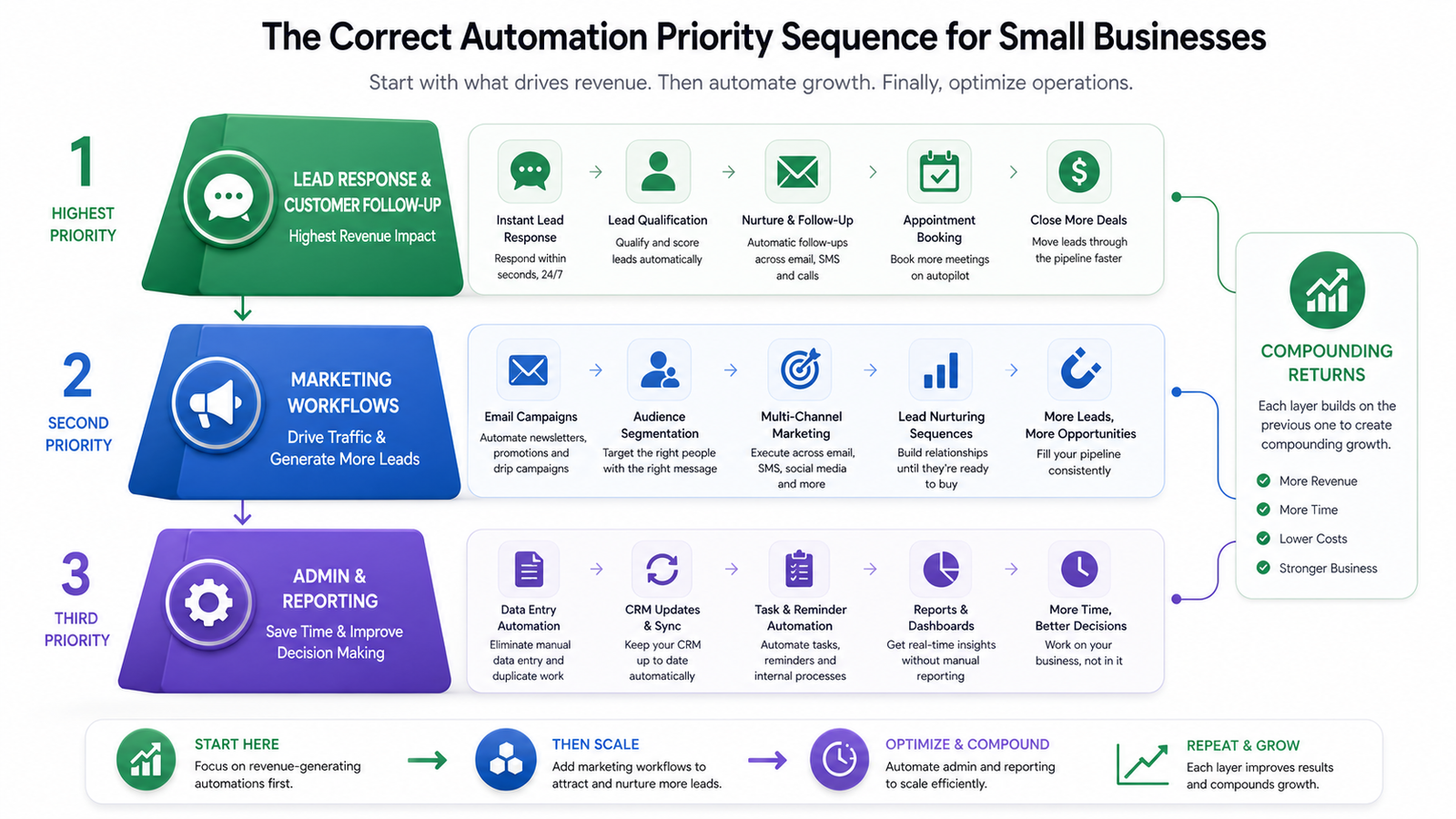
The most common mistake small businesses make with AI automation is trying to automate everything at once. Start with the processes that have the highest volume, the most repetition and the biggest impact on revenue if handled slowly or inconsistently. Here is the correct sequence.

What to automate first in small business — priority order from lead response to marketing to admin tasks
The correct automation priority sequence for small businesses: start with lead response and customer follow-up (highest revenue impact), then marketing workflows, then admin and reporting. Each layer builds on the previous one and delivers compounding returns.
Priority 1 — Highest ROI
Lead Response and Initial Qualification

When a new enquiry arrives via your website form, WhatsApp, Instagram DM or any other channel — AI responds immediately, asks the right qualifying questions (budget, timeline, specific need) and either books a call or routes the lead to the right team member with a full qualification summary. This is consistently the highest return automation for any business that receives 10 or more enquiries per day.

Saves 2 to 4 hours daily for most small businesses
Priority 2 — High ROI
Lead Follow-Up Sequences

Most leads do not convert on the first interaction. AI automation sends a structured sequence of personalised follow-up messages over 7 to 14 days — via WhatsApp, email or SMS — to every lead that did not immediately book or buy. These sequences run automatically without any manual input. Businesses typically see 20 to 40 percent of their "lost" leads convert through automated follow-up sequences that would previously have never been contacted again.

Recovers 20 to 40 percent of leads previously abandoned
Priority 3 — High ROI
Appointment Booking and Reminders

AI reads your live calendar, offers available slots to prospects and confirms bookings automatically. It sends a confirmation immediately, a reminder 24 hours before and a final reminder 1 hour before the appointment. For businesses where appointments drive revenue — clinics, law firms, financial advisors, coaches, salons, interior designers — reducing no-shows by even 25 percent can significantly improve monthly revenue without acquiring a single new customer.

Reduces no-shows by 25 to 40 percent on average
Priority 4 — Medium ROI
CRM Updates and Data Management

Every lead interaction, customer conversation, appointment booking and purchase updates your CRM automatically. No more manual data entry. No more leads lost in WhatsApp conversations that were never transferred to a spreadsheet. Clean, complete, current data in your CRM enables better decisions, better follow-up and better understanding of your customer lifecycle — all without anyone spending time on data administration.

Saves 5 to 8 hours of admin per week
Priority 5 — Medium ROI
Social Media and Content Scheduling

AI generates content ideas based on your industry, drafts posts in your brand voice, schedules them across platforms (Instagram, LinkedIn, Facebook, Google Business Profile) at optimal posting times and tracks engagement — all automatically. For small businesses without a dedicated social media manager, this automation maintains a consistent online presence that would otherwise require daily manual attention or expensive agency fees.

Replaces 4 to 6 hours of weekly social media management
Priority 6 — Admin Efficiency
Invoicing, Reporting and Admin

Automatic invoice generation when a project is completed or a payment milestone is reached. Weekly or monthly performance reports delivered to your inbox without anyone compiling them. Stock alerts when inventory falls below threshold. Expense categorisation from receipts. These admin automations individually save modest time but collectively free up significant capacity — and they eliminate the cognitive load of remembering to do routine administrative tasks.

Saves 3 to 5 hours of admin per week

Best AI Automation Tools for Small Business in 2026

Tool Guide

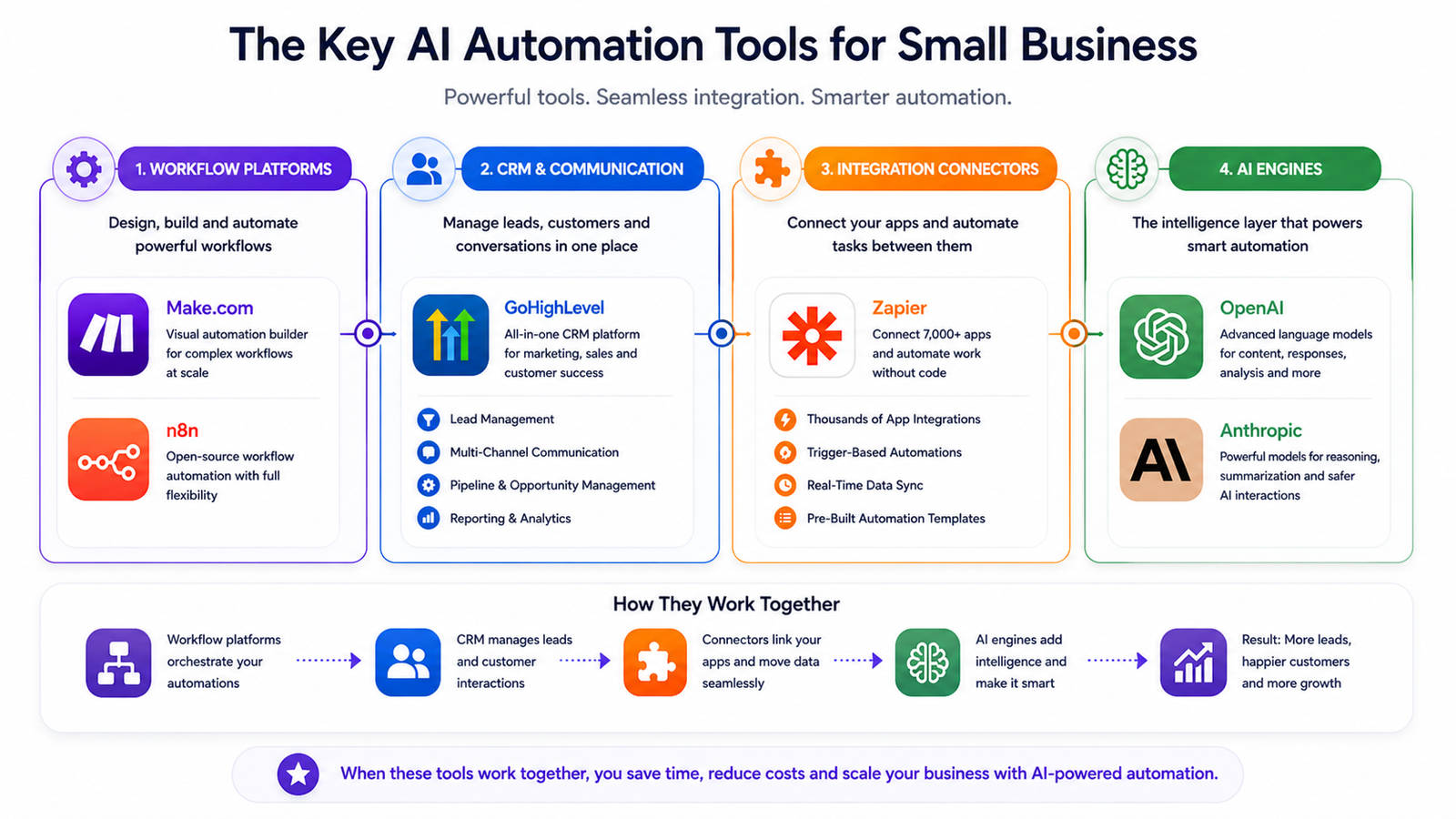
The AI automation tool landscape has consolidated significantly by 2026. These are the platforms small businesses are actually using with the best results, organised by function.

Best AI automation tools for small business 2026 — Make.com n8n GoHighLevel Zapier overview comparison
The key AI automation tools for small business in 2026: workflow platforms (Make.com, n8n), CRM and communication (GoHighLevel), integration connectors (Zapier) and AI engines (OpenAI, Anthropic) that power the intelligence layer of any automation system.
Workflow Automation Platform
Make.com (formerly Integromat)

The most popular visual workflow builder for small business AI automation. Connects over 1,500 apps without code. Build multi-step automations that trigger from WhatsApp, email, form submissions, CRM events or any other input. Includes native AI modules that allow you to incorporate GPT-4 or other LLMs into any workflow step. Ideal for businesses wanting power without technical complexity.

Free plan available. Paid from $9/month. Most small businesses use the $16 to $29/month plan.
Open Source Workflow Platform
n8n

An open source workflow automation platform similar to Make.com but with more flexibility for custom integrations and the ability to self-host for data privacy. Particularly popular for businesses with developers on the team or agencies building client automation systems. Has excellent AI node support and can connect to virtually any system with an API. GrowingAI builds many client automations on n8n.

Free self-hosted. Cloud from $20/month. No per-execution pricing at scale — better value for high volume automations.
All-in-One CRM and Automation
GoHighLevel

The most comprehensive all-in-one platform for small business automation. Combines CRM, email marketing, SMS, WhatsApp messaging, landing pages, appointment booking, review management and workflow automation in a single platform. Particularly well suited for service businesses, marketing agencies and businesses managing large numbers of leads. Eliminates the need for multiple separate tools by consolidating everything in one system.

From $97/month. Agencies can white-label it for clients from $297/month.
Integration Connector
Zapier

The most widely used integration tool, connecting over 6,000 apps. Best for simple, two-step automations (when X happens in App A, do Y in App B). Less suited to complex multi-step AI workflows than Make.com, but excellent for quickly connecting business tools without technical expertise. Best used for simple triggers and notifications rather than sophisticated AI workflows.

Free plan for simple automations. Paid from $19.99/month. Gets expensive at scale.
AI Language Engine
OpenAI API (GPT-4 / GPT-4o)

The intelligence layer that powers the AI components of most automation systems. Used via API within Make.com, n8n or GoHighLevel workflows to generate text responses, analyse customer messages, extract structured data from conversations and make context aware decisions. GPT-4o in 2026 is fast, cost-effective and powerful enough for virtually all small business automation use cases. Most businesses use $5 to $50 of API credits per month.

Pay per use. Approximately $0.01 to $0.03 per 1,000 tokens. Very low cost at small business scale.
WhatsApp AI Automation
Wati / Interakt / 360dialog

WhatsApp Business API solution providers that connect your WhatsApp number to automation systems. Required for businesses wanting to automate WhatsApp lead response, broadcast campaigns and AI chatbot deployment on WhatsApp. Each platform has different pricing and feature sets — Wati is best for simplicity, 360dialog for technical flexibility and Interakt for Indian SME pricing. See our complete guide on WhatsApp AI agents for business.

From $40/month plus Meta API conversation fees (approximately $0.011 per conversation in India).

The recommended stack for most small businesses in 2026: GoHighLevel for CRM and communications + Make.com or n8n for advanced workflows + OpenAI API for AI intelligence + WhatsApp BSP for WhatsApp automation. This combination covers 95 percent of what small businesses need to automate, without requiring custom software development. Our AI automation service builds and manages this stack for clients.

How to Get Started With AI Automation: Step by Step

Action Guide

Here is the exact sequence we recommend to small businesses starting their AI automation journey. This sequence is designed to deliver early ROI that funds the next phase of automation investment.

01

Audit Where Your Time Actually Goes

Before automating anything, spend one week tracking exactly where your team's time goes. Use a simple spreadsheet — task, time spent, frequency per week. You will almost certainly discover that 60 to 70 percent of your team's time goes on tasks that are repetitive, rule-driven and do not require genuine human judgement. This audit reveals your highest value automation targets and gives you a baseline to measure ROI against. Do not skip this step — businesses that automate without an audit often start with the wrong processes and get poor early results.

02

Map Your Lead Journey From First Contact to Close

Draw the exact journey a lead takes from first contacting you to becoming a paying customer. Include every human touchpoint, every manual action, every wait period and every decision point. This journey map reveals which steps cause the most delay, which steps are most repetitive and which steps have the highest drop-off rate. The highest value automation opportunities are at the beginning of this journey (lead response) and at the follow-up stages (where most businesses lose leads through inaction).

03

Start With Lead Response Automation — Get Wins Fast

Your first automation should be lead response. Set up an AI system that responds to every new enquiry within 60 to 90 seconds, across every channel you receive enquiries on (website form, WhatsApp, email, Instagram DM). The AI collects basic qualification information and either books a call or sends a personalised response with the next step. This single automation typically delivers clear, measurable ROI within 30 days — more leads engaged, more calls booked, more conversions — which gives you the proof of concept needed to expand into additional automations.

04

Set Up Your CRM and Connect Everything to It

Choose a CRM system (GoHighLevel, HubSpot, Zoho or a custom option) and configure it as the central hub of your automation system. Every lead, every conversation, every deal stage update and every customer interaction should flow into and out of your CRM. A CRM that is manually maintained is always incomplete. A CRM connected to your automations is always current. This foundation enables every subsequent automation to operate with accurate, complete data — which is what makes the difference between an AI system that gives useful responses and one that gives generic, unhelpful ones.

05

Build Follow-Up Sequences for Unconverted Leads

Create automated follow-up sequences that run for 7 to 14 days after a lead's initial contact if they have not converted. Each message in the sequence should add value — a relevant resource, a case study, an answer to a common objection, a limited time offer or simply a personalised check-in. These sequences run completely automatically, recovering 20 to 40 percent of leads that would otherwise have been abandoned. In most businesses, this automation alone recovers its cost multiple times over within the first month.

06

Automate Appointment Booking and Reminders

Connect your calendar to your lead response system so the AI can offer real available slots and confirm bookings without human involvement. Set up automatic reminders at 24 hours and 1 hour before each appointment. If your business has consultations, sales calls, service visits, medical appointments or any other scheduled interactions, this automation directly reduces no-shows, saves receptionist or admin time and creates a better customer experience than the manual booking process it replaces.

07

Measure, Optimise and Expand

After 30 days with your initial automations running, review the data. How many leads were responded to? How many calls were booked? How many follow-up sequences converted leads? What was the no-show rate before and after appointment reminders? This data tells you exactly what the automation delivered in the first month. Use it to optimise the scripts and sequences, then plan the next phase of automation expansion — social media, reporting, content generation or more complex workflow orchestration. Our team provides this monthly review as part of the AI automation service.

AI Automation for Lead Generation in Small Business

Lead Growth

AI automation does not just handle the leads you already receive — it actively generates more of them when connected to your marketing and visibility strategy. Here is how the two work together.

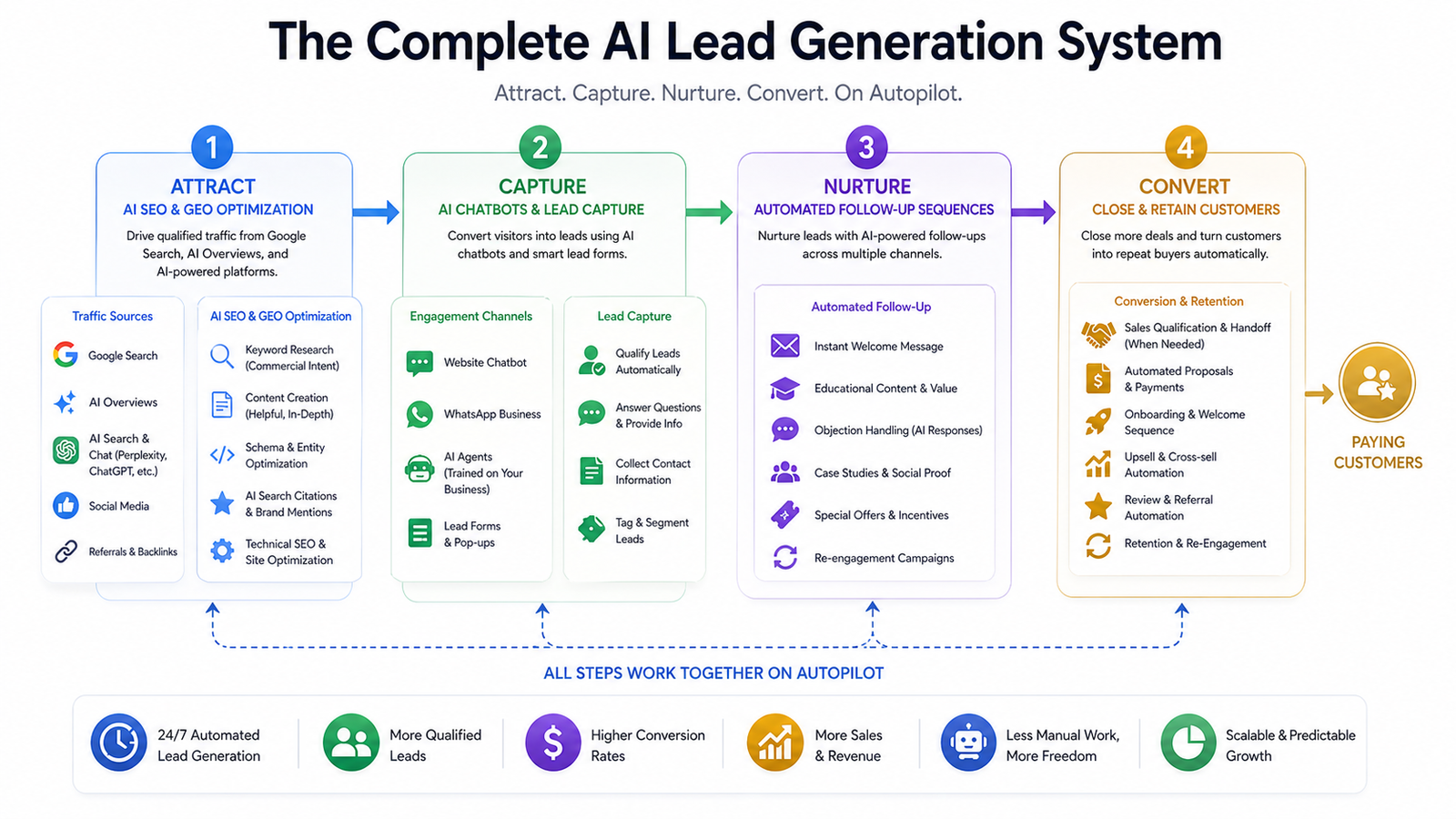
AI automation for lead generation — how AI SEO, GEO and automation work together to attract qualify and convert leads
The complete AI lead generation system: AI SEO and GEO Optimization drives qualified traffic to your website and AI search citations, WhatsApp and website chatbots capture those visitors as leads, and automated follow-up sequences convert them to paying customers — all working together without human involvement at each step.

Attract: AI SEO and GEO Visibility

The foundation of automated lead generation is visibility. If people cannot find your business when searching on Google or asking ChatGPT, there are no leads to automate. Our AI SEO service and Google AI Overviews strategy ensure your business is visible when your ideal customers are actively looking for what you offer. This is the traffic that feeds your automation funnel.

  • Rank on Google for buyer intent keywords
  • Get cited in Google AI Overviews
  • Appear in ChatGPT and Perplexity answers
  • Optimise Google Business Profile for local search

Capture: AI Chatbots and Forms

When a visitor lands on your website or messages you on WhatsApp, AI chatbots engage them immediately, answer their questions and capture their contact details and requirements — turning website visitors into qualified leads automatically, even outside business hours.

  • Website AI chatbot engages visitors 24/7
  • WhatsApp AI qualifies leads on the app they already use
  • Smart forms ask the right questions at the right time
  • Lead data flows directly to CRM — no manual input

Nurture: Automated Follow-Up

Most leads do not buy on first contact. Automated nurture sequences send personalised, valuable content to every lead over 7 to 30 days, building trust and maintaining top-of-mind presence until they are ready to buy.

  • Email sequences with relevant case studies and insights
  • WhatsApp follow-ups at optimal intervals
  • Behaviour triggered messages based on lead actions
  • Automatic re-engagement for dormant leads after 30 to 60 days

Convert: Sales Automation

When a lead is ready to convert, automation handles the logistics — booking the final call, sending the proposal, processing the payment and onboarding the new client — reducing friction at every step of the close.

  • Automatic proposal generation from lead qualification data
  • One-click payment links sent via WhatsApp or email
  • Automated client onboarding sequences post-purchase
  • Satisfaction surveys and review requests post-delivery

How Much Does AI Automation Cost for a Small Business

Pricing Guide

AI automation costs have fallen dramatically in 2026. A system that would have cost $50,000 to build in 2022 can be deployed for $500 to $2,000 today. Here is a realistic breakdown of what you should expect to invest at different levels of automation.

Automation Level What It Includes Monthly Cost Range Best For
Starter Lead response automation, basic CRM setup, email follow-up sequences $100 to $250 / Rs 8,000 to Rs 20,000 Businesses with under 20 leads per day
Business Full lead qualification, WhatsApp AI, appointment booking, CRM integration, follow-up sequences $300 to $600 / Rs 25,000 to Rs 50,000 Service businesses, 20 to 100 leads per day
Growth Everything in Business plus social media automation, reporting, multi-channel campaigns, content generation $600 to $1,500 / Rs 50,000 to Rs 1,25,000 Established SMEs wanting full marketing automation
Enterprise Custom AI workflows, multiple department automations, ERP integration, AI calling agents, dedicated team $1,500+ / Rs 1,25,000+ Larger SMEs, multi-location businesses

Important distinction: There is a difference between platform costs (the monthly subscription to tools like GoHighLevel, Make.com and WhatsApp BSP) and agency setup and management fees. The table above covers the total monthly investment including both. A one-time setup fee of $500 to $2,000 is typical when working with a specialist agency — this is the investment required to build, test and configure your automation system before the ongoing monthly management begins.

Calculating Your AI Automation ROI

ROI Guide

ROI from AI automation comes from two sources: cost savings (time your team no longer spends on manual tasks) and revenue gains (more leads converted, more sales closed through faster response and better follow-up). Here is how to calculate both for your business.

Before AI Automation
4 hrs
Average time to respond to a new lead enquiry
60%
Of leads never followed up after first contact
25 hrs
Per week on repetitive admin and follow-up tasks
After AI Automation
90 secs
AI responds to every lead instantly, 24/7
100%
Of leads receive structured follow-up sequences automatically
2 hrs
Per week team time on admin — AI handles the rest
6 wks
Typical payback period for small business AI automation investment For businesses receiving 20 or more enquiries per day, the increased conversions from faster lead response and automated follow-up typically cover the full automation investment cost within 4 to 8 weeks. Beyond that, the ROI compounds month on month.

Simple ROI Calculation for Your Business

Use this framework to estimate your automation ROI before investing:

  • Time savings: Hours saved per week × your hourly cost × 4 weeks = monthly time value
  • Lead recovery: Average leads per month × 30% recovery rate × your average deal value × your close rate = monthly revenue gain
  • Reduced no-shows: Monthly appointments × 25% no-show reduction × your average appointment value = monthly revenue recovered
  • Total monthly ROI: (Time savings + Lead recovery + No-show reduction) minus automation monthly cost

For most service businesses receiving 20 or more enquiries per day, this calculation returns a positive monthly ROI within the first month, with the setup cost recovered within 4 to 8 weeks.

7 Mistakes Small Businesses Make With AI Automation

Avoid These
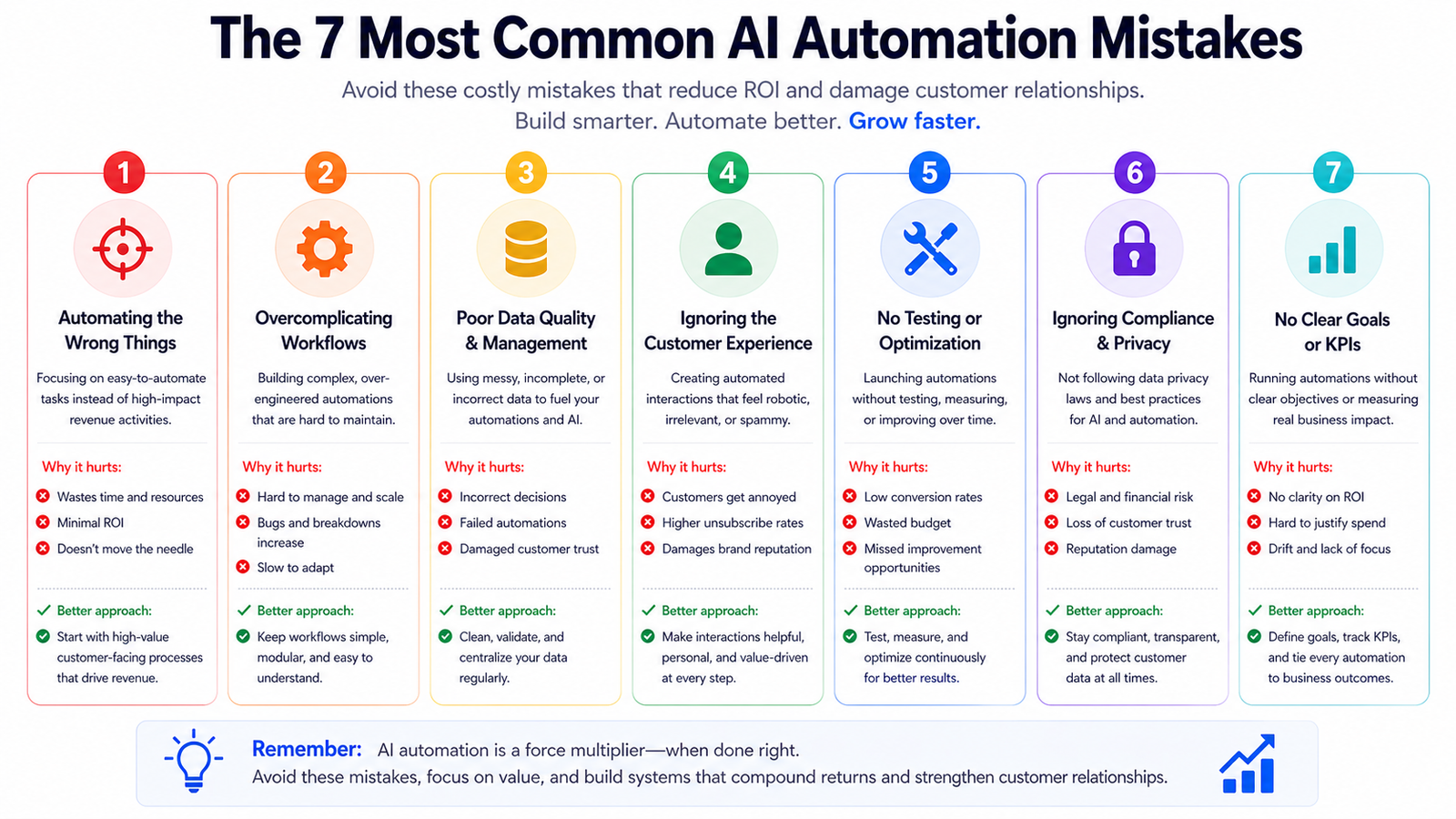
7 AI automation mistakes small businesses make in 2026 — common errors that reduce ROI and damage customer experience
The 7 most common AI automation mistakes that reduce ROI and damage customer relationships. Understanding these mistakes before implementing is the difference between a system that compounds returns and one that creates new problems.

Mistake 1: Automating Too Much Too Fast

Trying to automate 10 processes simultaneously before any of them are working correctly is the most common mistake. Start with lead response automation only. Get it working correctly. Measure the results. Then add the next automation. A small business that adds one well built automation per month will, after 6 months, have a more robust and effective system than one that tried to build everything at once and ended up with multiple partially working systems.

Mistake 2: Using Generic Scripts Without Business Training

An AI chatbot or email sequence that uses generic templates rather than your specific business information, services, pricing and tone will give generic responses that do not convert. Every automation system must be trained on your specific business — your services in detail, your common customer questions, your pricing ranges, your geographic coverage and your brand voice. Generic templates are a starting point for testing, never a final customer-facing implementation.

Mistake 3: No Human Escalation Path

AI automation systems must know when to hand over to a human. Complex negotiations, complaints, high-value deals requiring personal attention and situations requiring genuine empathy all need human involvement. A system with no escalation path will handle these situations poorly and potentially damage client relationships. Define clear escalation triggers before launching any customer facing AI system.

Mistake 4: Not Measuring Before and After

Without baseline measurements before you automate, you cannot prove ROI or identify what needs improvement after implementation. Before starting automation, record: average lead response time, lead to appointment conversion rate, follow-up email open and reply rates, average no-show rate and weekly admin hours. These numbers become your before-state that you compare to post-automation performance each month.

Mistake 5: Sending Too Many Automated Messages

Automated follow-up sequences that message leads every day for 30 days are not effective — they are annoying. The optimal frequency depends on your industry, but 2 to 3 messages in the first week, then tapering to weekly and then bi-weekly over 30 days is a reasonable framework for most service businesses. More is not better. Each message must add value — a resource, a relevant insight, an answer to a common question — not just repeat the same call to action.

Mistake 6: Ignoring Data Privacy Compliance

Collecting customer data through automated systems without proper consent, privacy policy disclosure and data handling procedures creates legal exposure — especially for businesses serving customers in the EU (GDPR), UK (UK GDPR), India (DPDPA) or any other jurisdiction with data protection regulation. Ensure your automation system includes proper opt-in collection, privacy policy links in all communications and appropriate data retention policies before deploying any customer-facing automation.

Mistake 7: Building on Free Tools That Cannot Scale

Free tiers of automation tools have strict limits on the number of automations, executions per month and integrations available. Building your business-critical lead response system on a free plan that caps at 100 executions per month creates a reliability problem as you grow. Invest in the appropriate paid plan from the start. The cost difference between free and starter paid plans is typically $15 to $30 per month — a fraction of the value a properly running automation delivers.

Frequently Asked Questions About AI Automation for Small Business

Every question small business owners ask before implementing AI automation, answered directly.

What is AI automation for small business?

AI automation for small business means using AI powered software to handle repetitive tasks automatically — without human involvement. This includes responding to leads, qualifying customers, booking appointments, sending follow-up messages, updating CRM records and generating reports. Unlike basic rule-based automation, AI automation can understand natural language, make contextual decisions and adapt its responses based on the specific situation. In 2026, this technology is accessible to businesses of any size starting from $50 to $100 per month.

Can a very small business (1 to 5 people) use AI automation?

Yes — and very small businesses often benefit the most from AI automation, because they have the fewest resources to handle repetitive tasks manually. A solo consultant or a 3-person team can use AI to respond to leads 24/7, send follow-up sequences, book appointments and manage social media — effectively operating with the capacity of a much larger team. Start with lead response automation (the highest return for smallest teams) and add capabilities progressively as your revenue grows from the initial automation investment.

How much does AI automation cost for a small business?

AI automation for small business costs vary from $100 to $600 per month for most service businesses, depending on the complexity of what is automated. This typically includes platform subscription costs (Make.com or GoHighLevel), AI API costs (usually $5 to $50 per month) and WhatsApp BSP fees if applicable. Agency setup fees for a specialist to build and configure the system range from $500 to $2,000 one-time. In India, equivalent packages start from Rs 8,000 per month. In UAE, from AED 400 per month. Most businesses with 20 or more daily enquiries see full ROI within 6 to 8 weeks. Contact us at GrowingAI for a precise quote for your business.

How long does it take to set up AI automation for a small business?

A starter AI automation system (lead response, basic CRM integration, email follow-up) can be live in 1 to 2 weeks. A full business automation system (WhatsApp AI, appointment booking, CRM integration, social media, follow-up sequences) typically takes 3 to 4 weeks from brief to launch. More complex systems with custom integrations or multiple departments can take 6 to 8 weeks. GrowingAI's standard implementation timeline for small business clients is 2 to 3 weeks for the most commonly requested automation package.

Do I need technical knowledge to use AI automation?

No. Once your AI automation system is configured by a specialist agency, day-to-day operation requires no technical knowledge. You interact with dashboards, review reports and update information through simple interfaces. When you want to change a service description, update pricing or add a new FAQ answer, you simply provide the updated information to your agency or enter it into a knowledge base interface. The technical complexity is entirely handled during the build phase — not by you during ongoing operation.

What results can I realistically expect from AI automation?

Realistic results for small businesses in the first 90 days: lead response time drops from hours to under 90 seconds, 20 to 40 percent of previously abandoned leads convert through automated follow-up, appointment no-show rates reduce by 25 to 35 percent, and the business owner and team recover 15 to 30 hours per week previously spent on manual follow-up and admin. Revenue impact is typically 10 to 30 percent improvement in lead-to-customer conversion rate within the first 60 days. See our case studies for specific client outcomes.

Does AI automation work for businesses in any country?

Yes. AI automation tools work globally and support multiple languages automatically. The core platforms (Make.com, GoHighLevel, n8n) are used by businesses in over 100 countries. WhatsApp automation is particularly effective in markets where WhatsApp is the dominant communication channel — India, UAE, Southeast Asia, Africa, Latin America and much of Europe. GrowingAI serves clients in India, UAE and internationally, implementing automation systems customised for the communication preferences and business practices of each market.

Which industries benefit most from AI automation?

Every service business with high enquiry volume benefits significantly. The highest ROI implementations are in: real estate (lead qualification at scale), education and coaching (student enquiry and enrolment), healthcare (appointment booking and reminders), professional services (intake, scheduling and follow-up), hospitality (reservations and upsell), export and manufacturing (international buyer qualification), e-commerce (order support and reorder sequences) and marketing agencies (client reporting and campaign management). Visit our industries page for sector-specific automation approaches.

Is AI automation safe for my customer data?

AI automation systems can be built to be fully compliant with data protection regulations including GDPR, UK GDPR and India's DPDPA. This requires proper opt-in consent collection, privacy policy disclosure in all communications, appropriate data retention periods and secure data handling practices. GrowingAI builds all automation systems with data privacy compliance as a default, not an afterthought. Customer data collected through our automation systems is stored only in your chosen CRM and never shared with third parties beyond the configured integration points.

Should I hire an agency or do AI automation myself?

For most small business owners, using a specialist agency delivers faster results at lower effective cost than doing it yourself. Learning Make.com, GoHighLevel, WhatsApp API setup and AI prompt engineering while running a business typically takes 3 to 6 months and produces inferior initial results compared to an experienced team deploying the same system in 2 to 3 weeks. That said, if you have a technical co-founder or a team member willing to own automation, and you have 3 to 6 months to invest in learning, DIY is viable. Agencies like GrowingAI are best for businesses that want results quickly without the learning curve.

Ready to Automate Your Small Business With AI?

GrowingAI builds complete AI automation systems for small businesses worldwide. From lead response to CRM to follow-up sequences — we handle the full implementation in 2 to 3 weeks.

Free Automation Audit
Live in 2 to 3 Weeks
Full CRM and WhatsApp Integration
India, UAE and Worldwide
Ongoing Optimisation Included

WHAT TYPE OF BUSINESS DO YOU RUN?

Helps us give you the most relevant audit for your specific industry.

Real Estate
Builders, developers, agents
Healthcare
Clinics, hospitals, doctors
E-Commerce
Online store, D2C brand
Education
Institute, coaching, EdTech
Manufacturing
Factory, exporter, supplier
Professional Services
Legal, finance, consulting
Hospitality
Hotel, restaurant, travel
Other
Tell us in next step

WHAT'S YOUR BIGGEST CHALLENGE?

Select the most urgent problem you want to solve.

Not getting enough leads online
Website exists but enquiry rate is very low
Competitors outranking me on Google
Not on page 1 for my target searches
Poor ad ROI — burning budget
Ads running but leads are expensive or low quality
Not visible on ChatGPT & AI platforms
Business doesn't appear in AI search results
No automated lead follow-up
Leads come in but response is too slow

WHERE SHOULD WE SEND YOUR AUDIT?

We'll prepare a personalised report within 24 hours.

DETAILS RECEIVED!

Personalised audit being prepared for your business

Initial Assessment
Preparing your analysis...
Your Audit Will Cover
Website SEO score + Core Web Vitals
AI platform visibility (ChatGPT, Perplexity, Gemini)
Top 3 competitor gap analysis
Personalised observations and recommendations

Response within 24 hours. Urgent? Call/WhatsApp: +91 6377767206

Scroll to Top