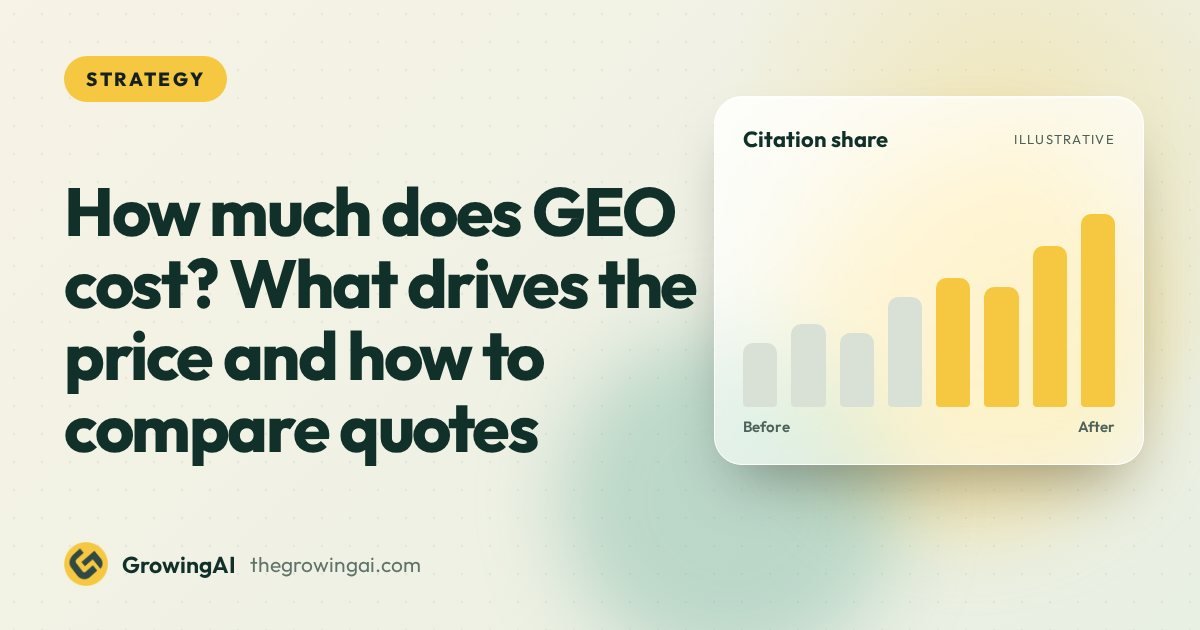
- No honest universal GEO price exists, because scope varies too much. Be wary of anyone who quotes one without looking at your site.
- Price follows scope: site size, priority pages, platform access, languages, markets, authority work and reporting depth.
- Compare quotes on who implements, what is delivered, what is measured, how many prompts, contract length and cancellation.
What does GEO cost, in plain terms?
GEO costs anywhere from a small fixed project to a standing monthly programme, and the honest answer to "how much" is that it depends on scope. Generative engine optimization is the work of getting your brand named and cited in AI answers from ChatGPT, Google AI Overviews and AI Mode, Perplexity, Gemini, Claude and Microsoft Copilot. A five page site in one language and a multi market catalogue in three languages are not the same job, so they do not share a price.
You will find articles that publish average GEO prices. We have not verified any third party price averages, so we do not repeat them here. The market is young, providers define the work differently, and a single average hides more than it shows. What we can do is explain what moves the price, so you can judge any quote on its own terms.
If you are still getting oriented, what generative engine optimization is covers the basics, and GEO vs AEO vs SEO explains how the labels relate.
Why there are no honest universal numbers
Three things make a universal price misleading. First, the deliverables differ. One provider sells a report. Another edits your pages. Another runs a monthly programme of content and outreach. Putting a single number on all three is like asking the price of "a building".
Second, results are not guaranteed by anyone, so price cannot be tied to a known outcome. AI engines change often, their answers vary from one run to the next, and no provider controls them. Third, your starting point matters. A site that blocks AI crawlers by accident needs different work from a site that is open but thin on clear answers.
What moves the price
Whatever model you choose, the same seven factors push a quote up or down. Ask any provider how each one affects their number.
| Factor | Why it changes the cost |
|---|---|
| Site size | More templates and sections mean more to audit, fix and keep consistent. A small brochure site is quick. A large catalogue or knowledge base is not. |
| Number of priority pages | Rewriting a page so it gives direct answers, matches real questions and carries correct schema takes real hours. Ten pages and a hundred pages are very different projects. |
| Platform and access | WordPress, WooCommerce, Shopify, custom code and headless builds each have their own limits. Admin access, a staging site or a Git repo makes implementation faster than screenshots and email chains. |
| Languages | Each language needs its own answers, headings and entity signals. Translation alone is not enough. See GEO for multilingual sites. |
| Markets | Selling in the UAE, the USA and the United Kingdom means different buyer prompts, sources and competitors in each place. |
| Authority work | Getting mentioned on third party sites, communities and publications takes time and outreach. It is separate from fixing your own site. See GEO authority building. |
| Reporting depth | Tracking five engines across many prompts, repeated over time, costs more than a one time before and after check. |
Most of these are about how much work there is. A provider who cannot say which factors drive their price probably has not scoped your site.
The three common ways to buy GEO
Most offers fall into one of three models. Each fits a different situation.
1. A one time implementation project
You pay a fixed fee, the provider audits and fixes your site, and the project ends. The benefit is a known cost and a known end date. The limit is that GEO does not stop mattering when the project does, so you need a plan for what comes next. Our own GEO Pilot is this model, and we describe it in detail below.
2. A monthly retainer
You pay each month for continuing work: new and updated content, monitoring, authority building and reporting. This suits brands that want steady progress and have the budget for it. The risk is paying for activity that is not tied to anything you can check. A good retainer states what is delivered each month.
3. Tools only, where you do the work
You subscribe to software that measures how often AI engines mention you, then fix things yourself or with your own team. This is the cheapest in cash and the most expensive in time. It works when you have a capable in house person. It disappoints when the report arrives and nobody has the time or skill to act on it. Types of AI visibility tools explains what these tools do and do not do.
| Model | Best for | Watch out for |
|---|---|---|
| One time implementation | Getting the technical and page level foundations right once, with a known cost | Needs a plan for ongoing work afterwards |
| Monthly retainer | Brands that want continuing content, monitoring and authority work | Vague monthly deliverables and long contracts |
| Tools only | Teams with in house skill and time to fix what the tool finds | A dashboard full of problems and nobody to fix them |
One time project
Fixed fee, known end date
- Best for foundations done once
- Needs a plan for afterwards
Monthly retainer
Continuing work each month
- Best for steady content and outreach
- Watch for vague deliverables
Tools only
You do the work
- Cheapest in cash
- Costly in time if nobody acts
What the GEO Pilot costs and what it includes
We will be specific, because vague pricing helps no one. The GEO Pilot is a fixed $999 (USD), one time, delivered inside 30 days. We do the implementation ourselves. You give us access (an admin login, a staging site or a Git repo) and you approve the changes.
- Week 1. A baseline across five AI engines on up to 20 buyer prompts, an AI crawler access check, and a technical and entity audit.
- Week 2. Technical fixes: crawler access and robots rules, sitemap, canonicals, structured data, and llms.txt if it is useful for your site.
- Week 3. Up to 10 priority pages rewritten and restructured to be answer ready, with direct answers, headings that match real questions, FAQs and schema.
- Week 4. The same prompts tested again, then a report with before and after results and a 90 day roadmap.
The scope is one domain and one language. It does not include a new site build, ongoing digital PR, link building or paid media. It works on any platform: WordPress, WooCommerce, Shopify, custom code or headless. We make no promises about rankings, citations or traffic, because nobody can.
Ongoing work after the Pilot is quoted, based on what the baseline and the roadmap show. We do not publish monthly prices here because they depend on the factors above. You can see how engagements are laid out on the pricing page, and you can get a quote when you are ready.
How to compare quotes: questions to ask any provider
Put the same questions to every provider, including us. The answers matter more than the number at the bottom.
- Who implements the changes? Do they edit your site, or do they send a list for your team to work through? Both can be fair, but the price should reflect which one it is.
- What exactly is delivered? Ask for a written list: audits, pages changed, technical fixes, reports. "Optimisation" is not a deliverable.
- What is measured, and how? Ask which engines are tested, how often, and how they separate a real change from normal variation in AI answers.
- How many prompts are tracked? A handful of prompts tells you little. A clear, buyer based set tells you more. See how to research buyer prompts.
- How long is the contract? Short and fixed is easy to judge. Long commitments need a very good reason.
- How do I cancel, and what do I keep? You should own the page changes, the reports and the prompt list if you leave.
- What access do you need? Reasonable access is normal. Ask how changes are approved and how they can be reversed.
Ask each provider to show how they would test your prompts before and after the work. If the answer is a screenshot of a single lucky result, keep looking.
Red flags in GEO quotes
- Promised citations or rankings. No provider controls what ChatGPT, Gemini or Perplexity say. A promise of results is either a misunderstanding or a sales line.
- Secret methods. Good GEO is mostly clear structure, accurate facts, open crawler access and credible third party mentions. If a provider will not explain what they change, you cannot check it.
- Long lock ins. A 12 month contract signed before any baseline is a lot of trust in an unproven plan.
- No baseline. If nobody measures where you start, nobody can show what changed.
- Reports with no actions. A score without fixes leaves the hard part with you.
- One price for every client. A flat number that ignores your site, markets and languages was not scoped for you.
Green flags and red flags
- ✓A written scope list
- ✓A baseline before any work
- ✓A short, fixed term
- Promised citations or rankings
- Secret methods you cannot check
- A long lock in before a baseline
- Reports with no actions
When GEO is not worth buying
GEO is not right for every business at every moment. Be cautious about buying it when:
- Your buyers do not use AI tools to research what you sell, and you have not seen any sign that they do.
- Your site is down often, slow to load or blocks crawlers for reasons you cannot change. Fix the basics first.
- You have no clear offer, no proof and no pages that explain what you do. There is little for an engine to cite.
- You need revenue next month. Visibility in AI answers builds over weeks and months and is not a quick channel.
- You expect a guarantee. If a guarantee is the condition, GEO is the wrong purchase.
If you run a small business and are unsure, is GEO worth it for a small business goes deeper. You can also test where you stand before spending anything, using the free AI Visibility Checker and the AI Crawler Access Checker.
The costs people forget to budget for
The fee on the proposal is rarely the whole cost. Before you compare quotes, list the other items, because they differ a lot between models and can matter as much as the fee.
| Hidden cost | Where it shows up | How to plan for it |
|---|---|---|
| Your team's time | Approving changes, answering questions, giving access, reviewing drafts | Name one decision maker and agree a response time, such as two working days. |
| Subject matter input | Pages need real facts, prices, process steps and exclusions that only you know | Set aside an hour or two for an interview. Vague input gives vague pages. |
| Platform limits | Some themes, plugins or hosts make structured data, redirects or robots rules hard to change | Ask early what can be changed on your platform and whether staging access exists. |
| Content you do not yet have | Pricing explanations, case details, comparison pages, original data | Decide who writes them and how they are checked for accuracy. |
| Tool subscriptions | Monitoring software, schema tools, analytics add ons | Ask which are needed and whether they are included or billed separately. |
| Ongoing upkeep | Facts change, engines change, pages go stale | Plan a review each quarter, even if it is only a retest and a short list of fixes. |
Notice that three of the six cost your time, not cash. Time is the cost most buyers underestimate, and it is the main reason a cheap tool or a vague retainer stalls. A done for you project reduces your time cost but does not remove it, because you still have to give access and approve changes.
In house, freelancer, agency or tool: how the models compare
Beyond the three buying models above, you can also build the capability yourself. This table compares the options on the dimensions that tend to decide the matter. It does not rank them, because the right choice depends on your skills and capacity.
| Option | Cash cost | Time cost to you | Strength | Risk |
|---|---|---|---|---|
| Do it yourself with free tools | Lowest | High | You learn the subject and the work is cheap | Gaps in technical skills and slow progress |
| Tool subscription plus in house person | Moderate | High | Continuing visibility data and control | Reports without time to act |
| Freelancer | Varies | Moderate | Flexibility and direct contact | Single point of failure, uneven range of skills |
| Agency, one time project | Fixed and known | Low to moderate | Defined scope, implementation included, a clear end | Needs a plan for after the project |
| Agency, monthly retainer | Ongoing | Low to moderate | Continuing content, monitoring and outreach | Vague deliverables and long contracts |
None of these removes the need to measure. Whichever you pick, keep your own dated record of prompts and answers, so you can check any claim made to you.
What a sensible first year budget looks like in stages
Rather than fix a number, plan your spend in stages, each with a gate. This keeps risk small and lets evidence decide the next step.
- Stage 0, free baseline. Run the free checks and your own prompt test. Cost: your time. Gate: do you see a real gap in your category?
- Stage 1, foundations. Fix crawler access, technical issues and the priority pages. This is the work a fixed scope pilot covers. Gate: did the retest show movement on some prompts, and is the roadmap clear?
- Stage 2, targeted extension. Add pages, languages or markets where the baseline showed the most gain. Quote based on the roadmap. Gate: are enquiries or AI referrals changing?
- Stage 3, authority work. Invest in third party coverage, community presence and original data where it fits your market. This is the slowest and most variable. Gate: do mentions and citations hold across repeated runs?
- Stage 4, steady upkeep. Quarterly reviews, fact updates and retests. Keep it small and regular.
You can stop at any gate. The point is that you never commit to a large spend before you have seen the previous stage's evidence. For a view of what stage 1 looks like week by week, read what 30 days of implementation looks like.
Stages with a gate between each
- 1Stage 0Free baseline. Gate: is there a real gap?
- 2Stage 1Foundations. Gate: did the retest move?
- 3Stage 2Targeted extension. Gate: are enquiries changing?
- 4Stage 3Authority work. Gate: do mentions hold across runs?
- 5Stage 4Steady upkeep with quarterly reviews
Example, hypothetical: three businesses, three different scopes
Example, hypothetical: this shows how the factors above produce different scopes. We give no prices, because the point is the logic.
| Business | Site and markets | Likely scope | Why |
|---|---|---|---|
| A solo consultant in the UK | Six page WordPress site, English only | Small. Access check, a few pages, schema, a baseline | Few pages and one market make the work short. |
| A UAE clinic group | Forty pages, English and Arabic, several locations | Larger. Per language pages, location facts, directory consistency | Two languages and many locations multiply the page and entity work. See GEO for multilingual sites. |
| A US ecommerce brand | Shopify store with hundreds of products | Larger and more technical. Product data, feed accuracy, category pages | Catalogue scale needs templates and rules. See ecommerce GEO. |
You can see that the first could fit a bounded pilot, and the others would need a pilot to prove the approach and then a quoted extension. That is a normal path. A fair provider tells you which case you are in after looking at your site, not before.
What to put in a written GEO agreement
Whatever you buy, ask for these items in writing. They protect both sides and take little time to agree.
- Scope list. Named deliverables, such as number of pages, audits, fixes and reports. Avoid "optimisation" as a line item.
- Exclusions. What is not included, for example a site rebuild, link building, paid media or extra languages.
- Access and approvals. What access is needed, who approves changes and how a change is reversed.
- Measurement method. Which engines, how many prompts, how often runs are repeated and how results are recorded.
- No guarantee clause. A plain statement that placement, rankings and traffic are not promised. If a provider refuses to say this, ask why.
- Ownership. You keep the content, the prompt list and the reports.
- Term and exit. Length, notice period and what happens to work in progress.
If you want a second opinion on a proposal, contact us. We will tell you honestly which parts we think are reasonable, including when a proposal is better suited to your situation than ours.
Free steps that cost nothing and reduce any quote
Doing these before you ask for quotes both improves your results and lets a provider scope accurately, which tends to lower the price.
- Run the AI visibility checker and keep the output.
- Check bot access with the AI crawler access checker and fix anything obviously wrong.
- Write your ten most important buyer prompts and note who is named for each.
- Gather admin access details and decide who can approve changes.
- List your top ten pages and the single question each should answer.
- Collect any claims you can prove: years in business, certifications, case outcomes, with documents.
What to do next
Start with evidence, not a price list. Run the free checks, write down ten questions your buyers really ask, and see whether AI engines name you for any of them. Then decide whether you need a one time fix, a continuing programme or a tools first approach.
If you want the foundations done for you at a fixed cost, the GEO Pilot is $999, one time, inside 30 days. If you want to see what a 30 day project looks like week by week, read what 30 days of implementation looks like.