- GEO means improving the odds that AI tools such as ChatGPT, Google AI Overviews and Perplexity name or cite your brand when they answer a question.
- It builds on normal SEO. Access, clear pages and consistent facts matter first. No one can guarantee a mention, because answers change by user, place and day.
- Start by recording what AI engines say about you today. Without a dated baseline you cannot tell if any change worked.
GEO in one paragraph
Generative engine optimization, or GEO, is the practice of shaping your website and your wider web presence so that AI answer engines can find you, understand you and name you in their responses. A generative engine is any tool that writes an answer instead of listing links. ChatGPT search, Google AI Overviews, Google AI Mode, Perplexity, Gemini, Claude and Microsoft Copilot all fit that description.
The goal is different from classic SEO. In SEO you want a click from a ranked list. In GEO you want your brand to appear inside the answer, ideally as a named recommendation with a link. Often the buyer reads the answer and never visits a results page at all.
If you want the service view rather than the explainer, see our page on generative engine optimization. This guide stays on the basics: where the term came from, how engines build answers, what you can control and what nobody can promise.
Where the term comes from: a 2023 research paper
The phrase was formalised in a paper titled GEO: Generative Engine Optimization, posted to arXiv in November 2023 by researchers from Princeton University, Georgia Tech, the Allen Institute for AI and IIT Delhi. It was later presented at the KDD 2024 conference. The authors built a benchmark of queries, tested several ways of rewriting web content, and measured how often a source appeared in generated answers.
They reported that some content changes, such as adding quotations, statistics and cited sources, raised a measure of source visibility by up to about 40 percent in their tests. Read that carefully. It was a controlled study on a research benchmark, not a live test across ChatGPT or Google. It shows that content form can influence which sources a model uses. It does not give you a percentage to expect on your own site.
The 2023 research paper
How AI engines build an answer, in three steps
Each product works a little differently, and none publishes its full ranking logic. The broad pattern is public, though, and it explains what you can influence.
- Interpret the question. The engine works out intent. Google has described AI Mode as breaking a question into related sub questions and searching for each, a technique it calls query fan out.
- Retrieve sources. Many engines fetch fresh web pages through a search index or their own crawler. Some answers rely only on what the model learned in training and fetch nothing.
- Write the answer. The model combines what it retrieved and what it learned, then may attach links to the sources it used.
That gives you two levers. You can make sure retrieval can reach your pages, and you can make your pages the clearest, most checkable source for the question. A third lever works over a longer time: being described consistently across the web, so that training data and retrieval agree about who you are.
Which crawlers and engines matter, and who documents them
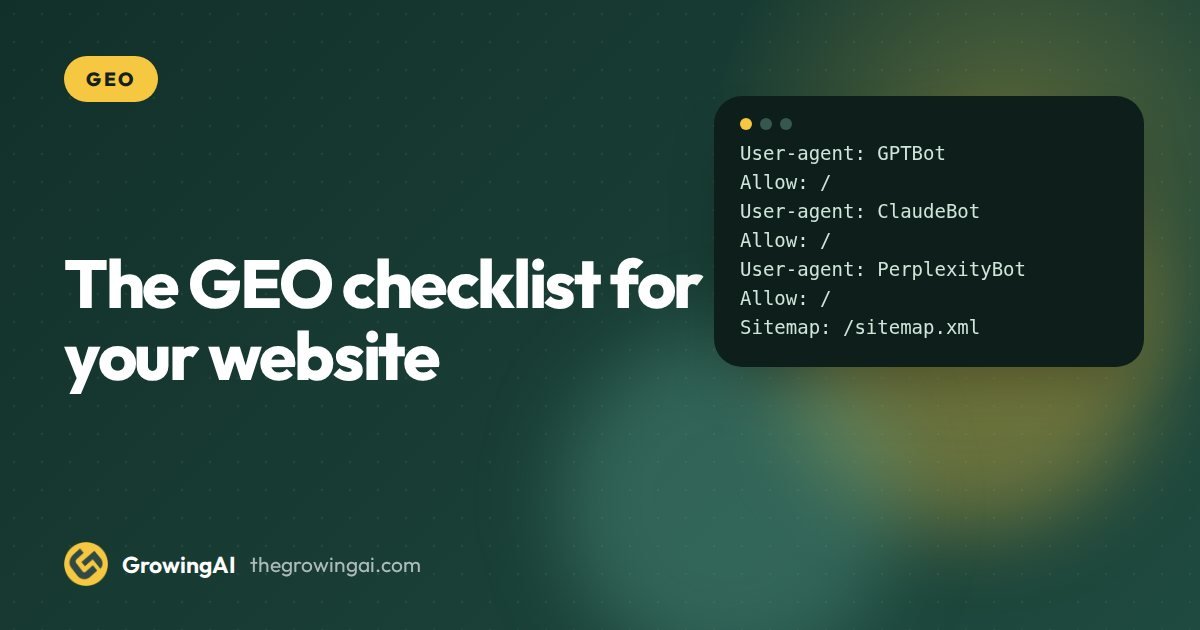
Before any content work, check that the right bots can reach you. The table lists the engines most buyers use and the access facts each company has published. We checked these against each company's own documentation in October 2026. Policies change, so verify before you edit a live robots.txt file.
| Engine | Bots it documents | What it means for you |
|---|---|---|
 ChatGPT (OpenAI) ChatGPT (OpenAI) | OAI-SearchBot for search, GPTBot for training, ChatGPT-User for user actions | Blocking GPTBot does not stop search inclusion. OAI-SearchBot is the one tied to search results. |
 Perplexity Perplexity | PerplexityBot, Perplexity-User | Check that neither is blocked by a firewall or a blanket rule. |
 Claude (Anthropic) Claude (Anthropic) | ClaudeBot, Claude-User, Claude-SearchBot | Separate bots for training, user requests and search. Decide each on purpose. |
 Google AI Overviews and AI Mode Google AI Overviews and AI Mode | Googlebot and normal Search rules | Google says there are no extra technical requirements beyond being indexed and snippet eligible. |
Our guide to AI crawlers and robots.txt goes through the choices line by line, and the free robots.txt generator builds a file you can review.
What you can control, ranked by how well it is supported
We sort GEO work into three groups. The first group is solid because it rests on vendor documentation. The second is sensible practice with mixed evidence. The third is unproven, and we treat it that way.
Well supported
- Crawlability and indexing. A page that bots cannot fetch cannot be retrieved or cited. This is the cheapest fix and the most often missed.
- Clear, direct answers on the page. Engines quote text they can lift cleanly. A heading that asks the question and a first sentence that answers it help both people and machines.
- Accurate facts. Names, services, locations and prices that match across your site and your profiles reduce wrong or mixed up answers.
Sensible, mixed evidence
- Mentions on other trusted sites. Many answers cite review sites, directories, publications and forums. Being described there likely helps, but how much varies by engine and topic.
- Structured data. Schema helps machines read a page. Google states it needs no special markup for AI features, so treat schema as good hygiene rather than a switch.
- Freshness. Dated, updated pages suit questions where recency matters. For slow moving topics it matters less.
Unproven
- llms.txt. It is a community proposal for a Markdown guide to your site. It is not a confirmed ranking or citation factor at any major engine. Read our view on llms.txt before spending time on it.
- Prompt tricks and hidden text. Instructions aimed at models inside page text are unreliable and can look like manipulation. We do not use them.
Well supported
Rests on vendor documentation
- Crawlability and indexing
- Clear, direct answers
- Accurate, consistent facts
Mixed evidence
Sensible practice
- Mentions on trusted sites
- Structured data
- Freshness
Unproven
Treat with care
- llms.txt
- Prompt tricks
- Hidden text
What a GEO dashboard shows, and what it does not
Measurement is the hard part. Because answers vary, a sound report runs a fixed list of prompts on a fixed schedule, records the full answer each time, and counts mentions, citations and position. The example below shows the shape of that report.
| Google AI Overviews | 64 | pos 3.1 | |
| ChatGPT | 55 | pos 2.4 | |
| Perplexity | 60 | pos 2.2 | |
 Gemini Gemini | 49 | pos 3.0 | |
 Copilot Copilot | 41 | pos 3.6 |
This is sample data to show the layout. It is not a client result. Two cautions apply to any real version. First, a single run is noise, so you need repeated runs to see a trend. Second, a score is a summary. Read the underlying answers, because a mention inside a negative sentence is not a win.
GEO versus SEO and AEO in one glance
People mix these terms up. The short version: SEO earns rankings and clicks, AEO structures content so a direct answer can be extracted, and GEO aims to get your brand named in generated answers. They overlap heavily. We compare them in detail in GEO vs AEO vs SEO.
Key terms every GEO conversation uses
GEO talk is full of borrowed words. If you know six of them, you can follow almost any article, vendor pitch or report. We define them here in plain language so the rest of this guide, and anything you read elsewhere, is easier to judge.
| Term | Plain meaning | Why it matters to you |
|---|---|---|
| Retrieval | The step where an engine fetches pages or passages to help answer a question | If your page is never retrieved, it cannot be used or cited |
| Grounding | Tying an answer to retrieved sources instead of relying on memory alone | Grounded answers often show links, which is where citations come from |
| Citation | A visible link or source note attached to an answer | A citation can send a visit and signals the engine used your page |
| Mention | Your brand name appearing in the answer text, with or without a link | A buyer can act on a mention even if no one clicks |
| Entity | A thing a system can recognise as distinct: a company, person, product or place | Engines recommend entities they can identify clearly |
| Query fan out | Splitting one question into several related searches before answering | Your page may be chosen for a sub question, not the headline one |
| Share of voice | How often you appear compared with named competitors across a fixed prompt set | It is the most useful summary, if the prompt list is honest |
A mention and a citation are not the same thing, and a good report keeps them apart. A brand can be named with no link, and a link can appear with the brand never named in the sentence. We go deeper in our post on brand mentions versus citations in AI answers.
What is the difference between an AI answer and a normal search result?
A normal search result is a list. You pick, you click, you judge for yourself. An AI answer is a written statement, often a few short paragraphs, and the engine has already done some of the judging. That changes what a buyer sees first and what they remember afterwards.
- The shortlist is shorter. A results page may show ten links. An AI answer may name three companies, or only one.
- The wording is the engine's. It summarises you in its own sentences, so a vague or inconsistent source can produce a vague or wrong description.
- Follow up is built in. The buyer can ask a second question without leaving, such as who is cheapest or who has local experience. Your pages need to hold up under that second question.
- Clicks are optional. A buyer may get what they need from the answer. Your brand name inside it is then the entire touchpoint.
None of this removes the value of a good ranking. It adds a second place where buyers form an opinion about you, and that place has its own rules.
What makes a page easy for an AI engine to use?
A page that engines can use well has a clear job, a clear answer and clear proof. Think of the page as something a careful assistant would be glad to quote: easy to find, easy to read, safe to repeat. These are the traits we check on every page during a GEO Pilot.
- One main question per page. A page that tries to answer six unrelated things gives no clean passage to lift.
- A heading that matches how buyers ask. Use the buyer's wording, not your internal service name.
- A direct answer in the first one or two sentences. Detail follows. The opening should still make sense if it is quoted alone.
- Specifics with dates. Ranges, steps, conditions and limits. A claim with a date can be checked, and a checkable claim is safer to repeat.
- A table or list where the content is a comparison or a process. Structure removes guesswork about which value belongs to which option.
- A named author or company, and a visible update date. These help a reader judge freshness and responsibility.
- Text in the HTML. Do not hide the answer behind scripts, tabs that load later, or images of text.
A worked example, hypothetical: a Dubai accounting firm
Example, hypothetical: a small accounting firm in Dubai wants to be named when a business owner asks an AI tool for help with corporate tax registration. This is an illustration of the method, not a client and not a result.
- Baseline. The firm writes 20 prompts, such as how to register for corporate tax in the UAE, what a tax agent does, and which firms help small companies. It runs them in four engines and saves every answer with the date. Result in this example: the firm is named in none of them, and the answers cite two government pages, a directory and three competitor sites.
- Access check. The firm finds that its security plugin returns errors to unknown bots. It adjusts the rule so search crawlers can fetch its pages, and confirms the pages are indexable.
- Rewrite. It rebuilds three pages around real client questions, each with a direct answer, a short checklist and a visible update date. It states who the service is for and who should look elsewhere.
- Facts. It makes the firm name, services, office area and phone number identical on its site, Google Business Profile and the two directories the engines cited.
- Retest. After the engines have had time to recrawl, it runs the same prompts again and compares the saved text.
What happens next is not known in advance. The firm might be named in some answers, in none, or only for narrow questions. The point of the method is that it can tell the difference, and it stops the firm from claiming a win it cannot show.
Common misunderstandings about GEO
GEO is a trick to make a model say your name
It is not. Engines are built to answer buyers, not to serve brands. The honest approach is to be the clearest, most consistent and most checkable source for a question you can truly answer. If you cannot truly answer it, better wording will not fix that.
GEO replaces SEO
It sits on top of it. Google's own documentation says its AI features use pages that are indexed and eligible for snippets, which is ordinary search work. Our post on what stays the same between GEO and SEO lists the overlap.
One tool or score tells you where you stand
Tools differ in prompts, engines, locations and how often they sample. A score from one tool is not comparable to a score from another. Use any score as a pointer, then read the saved answers. Our overview of types of AI visibility tools explains the differences.
Bigger brands always win
Established brands have an advantage, because more text exists about them. Narrow questions are different. A specific service in a specific city, answered clearly and backed by consistent facts, is a realistic target for a smaller company. We cannot promise it, but it is where we would aim first.
Should you do GEO yourself or hire help?
Both are reasonable. The right choice depends on your time, your access to the website and how technical the fixes are.
| If this describes you | Lean towards | Reason |
|---|---|---|
| You can edit your site, have a few hours a week and a short question list | Doing it yourself with the 30 day plan above | The first steps need judgement about your business more than special tools |
| Your site is on a complex setup, or you cannot easily change robots rules, schema or templates | Done for you help | Access and markup fixes need someone with site level control |
| You need a before and after you can show a board or client | A structured audit with saved prompts | Evidence matters more than opinion when others must sign off |
| Your buyers rarely use AI tools yet | Standard SEO first, light GEO tracking | Effort should follow where buyers actually look |
Our GEO Pilot is the fixed price option for the done for you route: $999, one time, delivered inside 30 days. We implement the fixes on your site with your approval, and we make no promise of rankings, citations or traffic. If you want to gauge your starting point first, the free AI visibility checker is a quick first look.
Do it yourself or hire help
Questions to ask any GEO provider
Because the field is young, vendors vary widely. A short list of questions separates careful work from guesswork.
- Which engines do you test, on which dates, and how many prompts?
- Can I see the saved answers, not only a score?
- Who changes my website, and who approves the changes?
- What do you do if nothing moves after the first round?
- What is not included, and what do you refuse to promise?
- How do you handle a bot that I want blocked for business reasons?
A confident answer to each is a good sign. A promise of a guaranteed mention is a reason to walk away.
Where GEO fits in a wider marketing plan
GEO is one channel among several. It tends to reward the same habits as good marketing in general: knowing who you serve, saying plainly what you do, and being easy to verify. If you already publish useful pages and keep your profiles accurate, GEO work builds on that. If you do not, start there. Our guide to whether GEO is worth it for a small business helps you decide how much to invest, and the GEO checklist for your website turns the ideas in this article into tasks you can tick off.
A 30 day starter plan you can run yourself
- Week 1, record a baseline. Write 20 questions a buyer would ask. Run each in ChatGPT, Google AI Mode, Perplexity and Gemini. Save the answers with the date. Note who is named and which links appear.
- Week 1, check access. Read your robots.txt and your firewall rules. Confirm search bots from the table above can fetch your key pages and that those pages are indexable.
- Week 2, fix facts. List your company name, services, locations and contact details. Make them identical on your site, Google Business Profile and main directories.
- Week 3, rewrite three pages. Pick the pages that match your best questions. Put a direct answer under each heading, add a table or list where it fits, and add a visible date.
- Week 4, rerun the baseline. Repeat the same prompts. Compare. Keep only the changes you can connect to a result, and be willing to find that nothing moved yet.
A starter plan you can run yourself
- 1Week 1Record a baseline: 20 questions, saved with the date
- 2Week 1Check access: robots.txt and firewall rules
- 3Week 2Fix facts: same name, services and contacts everywhere
- 4Week 3Rewrite three pages with a direct answer under each heading
- 5Week 4Rerun the baseline and compare
Who gets the most from GEO
GEO pays off fastest where buyers ask AI tools for recommendations before they contact anyone. Typical examples are B2B software, IT services, clinics, real estate, professional services and local providers. If your buyers rarely use AI tools yet, normal SEO and a fast reply channel will likely return more for now.
Honest limits of GEO
- No guarantees. Anyone promising a place in ChatGPT answers is promising something outside their control.
- Answers vary. Two people can ask the same question and see different brands. Location, history and model version all play a part.
- Attribution is patchy. Some AI referrals show in analytics and some do not, so traffic numbers undercount influence.
- The field is young. Most published tests are small. Treat any claim, including ours, as a working view that needs rechecking.
If you want a baseline without the manual work, our LLM visibility audit runs the prompts across five engines and returns a plain report.