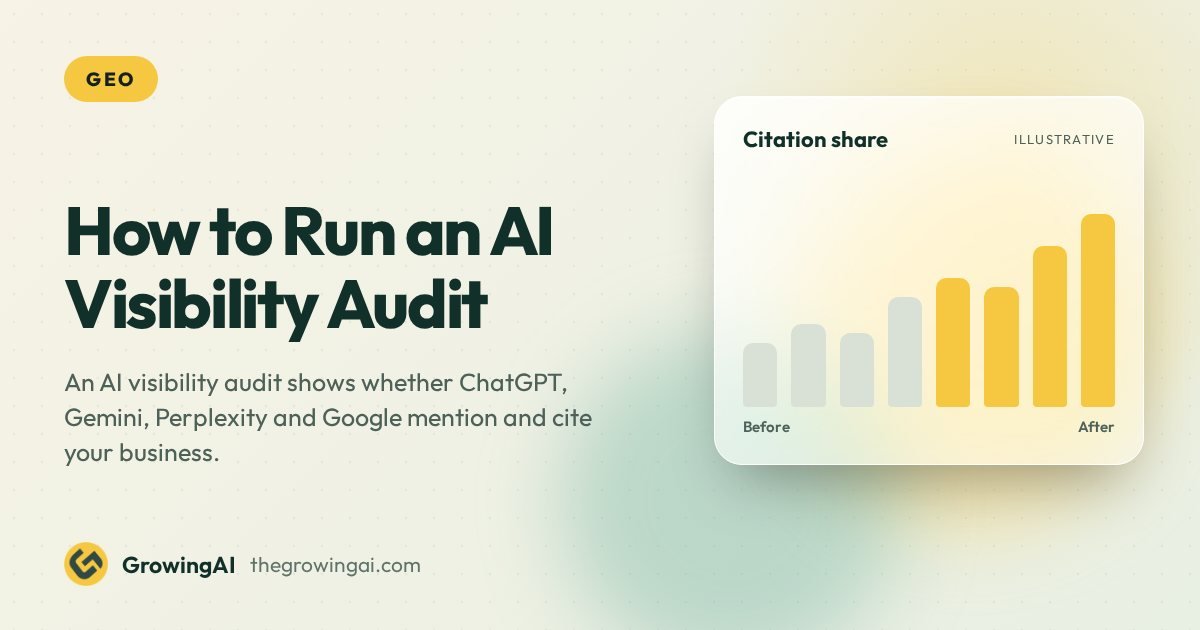
- An AI visibility audit tests a fixed set of buyer questions across several AI engines and records whether you are mentioned, cited and described correctly.
- Run the same prompts, in the same location and language, on a schedule. One screenshot proves nothing, because AI answers vary between runs.
- The output is a ranked fix list: access problems first, then missing content, then weak trust signals. Every finding should point to an action.
The short answer
An AI visibility audit is a repeatable check of whether AI search tools mention, cite and accurately describe your business when buyers ask questions in your category. You build a set of real prompts, run them across engines, record the results, and turn the gaps into a ranked fix list.
You can do a basic one yourself in an afternoon with a spreadsheet. This guide gives the method we use, in six steps, and is honest about what the method cannot tell you. If you would rather not do it by hand, there is a free option at the end.
What an AI visibility audit measures
Traditional rank tracking asks one question: what position is my page in? AI answers do not have positions. They have mentions, citations and descriptions, so the audit measures those instead.
| Measure | What it tells you | How to record it |
|---|---|---|
| Mention | Your brand is named in the answer | Yes or no per prompt and engine |
| Citation | Your page is linked as a source | Yes or no, plus which URL |
| Position in answer | Whether you are named first, among several, or last | Order among named brands |
| Accuracy | Whether the facts about you are right | Correct, partly wrong or wrong |
| Competitors named | Who else appears for the same prompt | List of brands |
| Sources used | Which sites the engine relies on in your category | List of domains |
| Sentiment | How you are described | Positive, neutral or negative note |
 Google AI Overviews Google AI Overviews | 64 | pos 3.1 | |
 ChatGPT ChatGPT | 55 | pos 2.4 | |
 Perplexity Perplexity | 60 | pos 2.2 | |
 Gemini Gemini | 49 | pos 3.0 | |
 Copilot Copilot | 41 | pos 3.6 |
The dashboard above is sample data showing how such measures can be summarised. It is not a client result. In your own audit, a simple spreadsheet is enough to start.
Step by step: run the audit
Step 1. Build your prompt set
Write 30 to 50 prompts that real buyers would type. Cover the full journey, not only the bottom of the funnel. Include discovery questions such as the best option for a need, comparison questions, cost questions, and local questions with your city or country.
- Category prompts: best AI SEO agency for a clinic in Dubai.
- Problem prompts: why is my business not showing in ChatGPT.
- Cost prompts: how much does GEO cost per month.
- Brand prompts: what is your company and is it any good.
Use plain wording, the way a person speaks. If you serve Arabic speakers, include prompts in Arabic as well. Our post on how UAE buyers use AI search shows how real queries differ by market.
Step 2. Pick the engines and fix the conditions
Test at least ChatGPT, Google AI Overviews and AI Mode, Gemini, Perplexity and Copilot. Use a logged out or clean session where possible, one location and one language. Note the date and the mode, such as whether web search was on. Changing conditions between runs makes results hard to compare.
Step 3. Run each prompt and record the answer
Paste each prompt, wait for the full answer, and record the measures from the table. Save the answer text and the sources, not only your yes or no. Because answers vary, run each prompt two or three times and note the range.
This is slow by hand: 40 prompts across five engines is 200 checks before repeats. That is why most teams start with a smaller set of 15 to 20 and expand later.
| Prompt | Engine | Visibility | Status |
|---|---|---|---|
| best geo agency for small business | ChatGPT | 82% | Cited |
| how much does geo cost per month | Google AI Mode | 64% | Mentioned |
| generative engine optimization services | Perplexity | 47% | Mentioned |
| llms.txt do i need it | ChatGPT | 31% | Not shown |
| ai visibility audit checklist | Gemini | 58% | Cited |
| geo vs aeo vs seo | Google AI Overviews | 22% | Not shown |
The prompt table above is sample data. It shows the layout we use to separate cited, mentioned and not shown results by engine.
Step 4. Analyse the sources
List every domain cited across your prompts and count how often each appears. You are looking for patterns. If a handful of directories, review platforms or industry publications dominate, those are places where being present matters. If your competitors are cited from pages you have no equivalent for, you have found a content gap.
The benchmark above is sample data. It shows how mentions can be compared across you and your competitors, so you can see who the engines prefer for your category.
Step 5. Check access and technical basics
Before blaming your content, rule out blockers. Can the search crawlers reach your pages? Check robots.txt, your firewall and your CDN, and read our guide on AI crawlers and robots.txt. Then check that key pages are indexed, load without JavaScript errors, and carry accurate structured data.
This step often turns up the cheapest wins. A site that blocks the very bots it wants citations from will not be fixed by writing more articles.
Step 6. Turn findings into a ranked fix list
Group what you found by cause and order by effort and likely impact. A useful order is below.
- Access problems. Blocked bots, noindex tags, broken pages.
- Accuracy problems. AI tools state wrong facts about you. Fix the source pages and profiles.
- Missing answers. Questions buyers ask that you do not answer clearly on any page.
- Weak trust signals. Few mentions on the sources the engines rely on.
- Measurement. Set the baseline and a monthly recheck.
A simple scoring template
You do not need a clever formula. For each prompt, give one point for a mention, one for a citation, and one for an accurate description. Divide your total by the number possible, per engine and overall. The number is only useful when compared with your own earlier run, not with other companies.
| Prompt | Engine | Mention | Citation | Accurate | Score |
|---|---|---|---|---|---|
| best ai seo agency for clinics | ChatGPT | Yes | No | Yes | 2 of 3 |
| how much does geo cost | Perplexity | Yes | Yes | Yes | 3 of 3 |
| llms.txt do i need it | Gemini | No | No | n/a | 0 of 3 |
The rows above are an example of the format, not real results.
How often to repeat it
Monthly is a sensible rhythm for most businesses. AI products change often and your own edits take time to be picked up, so weekly checks mostly record noise. Keep the prompt set mostly stable so you can compare, and add a few new prompts each quarter as your offers change.
- DoneAnswer blocks added to 6 service pages
- DoneAI crawlers allowed, sitemap cleaned
- NextThird party profiles to match entity facts
The report layout above is sample data. A monthly summary of prompts tracked, answers cited and pages fixed makes the trend easy to see.
Honest limits of any audit
- AI answers vary by run, user, location and mode. Results are samples, not absolute truths.
- Some engines do not show their sources reliably, so citation tracking can be incomplete.
- Your prompt set shapes the result. A biased set gives a flattering and useless audit.
- The audit shows what happens, not why. Causes need a separate investigation.
- No audit can promise a mention or a citation after you fix things.
Do it yourself or get help
If you have a small prompt set and time, the spreadsheet method works. If you have many services, several markets or two languages, the volume gets heavy and a tool or specialist saves real time. Our LLM visibility audit covers five AI engines, and the baseline is free. You get the prompt results, the sources, the technical findings and a ranked fix list.
For ongoing work after the audit, see our generative engine optimization service, and to see how we apply this in practice, read the Sudarshan Stoneix case study.
How to design a prompt set that does not flatter you
The prompt set decides what the audit can find. A set made of your own brand name and three flattering questions will tell you what you already believe. A good set is built from buyer language, grouped by purpose, and includes questions where you expect to lose.
| Prompt group | Buyer intent | Example pattern (hypothetical) | Share of the set |
|---|---|---|---|
| Discovery | Learning the category | What should I look for in an IT support contract for a small office? | 20 to 25 percent |
| Shortlist | Wants named options | Best IT support companies in Dubai for a 20 person office | 25 to 30 percent |
| Comparison | Choosing between options | Managed IT support or in house IT for a small company? | 15 to 20 percent |
| Cost and process | Budget and steps | How much does an annual maintenance contract for IT cost? | 15 to 20 percent |
| Trust and risk | Avoiding a bad choice | How do I check an IT company is reliable before signing? | 10 percent |
| Brand | Checking a name | What is Example Co and what does it do? | 5 to 10 percent |
The shares are a starting point from our own practice, not a published standard. Adjust them to your sales cycle. If most of your leads arrive already knowing your name, give brand prompts more weight. If you are new, discovery and shortlist prompts matter more.
Where real prompts come from
- Sales call notes and the first emails from new enquiries. Copy the wording, including mistakes.
- Questions staff answer every week.
- Search Console queries that are long and phrased as questions. They show how people already word things.
- The People Also Ask boxes and related questions on Google results for your category.
- Your Google Business Profile questions and review text, for local businesses.
- Competitor FAQ pages, as a prompt for topics, never as text to copy.
Our post on researching buyer prompts for GEO goes deeper on this step. Keep every prompt neutral. Do not put your brand name or a leading phrase in a discovery prompt, because the engine may simply echo it.
Why one answer is never the answer: sampling and repeats
The same prompt can produce different answers on different runs. Engines may also vary by location, language, account history and whether a web search runs. Google says its AI Overviews and AI Mode may issue multiple related searches across subtopics and data sources to build a response, which is one reason two runs can pull different pages. Our post on query fan out explains the mechanism.
So treat each run as a sample. Use a simple rule for the pilot version of your audit:
- Run each prompt three times per engine, on the same day, in fresh sessions.
- Record a mention only as consistent if it appears in at least two of three runs. Record one of three as occasional.
- Record the sources from every run, not just the best one.
- Write the date, engine, mode, location and language on every row.
Engine by engine: what to note while you test
Engines differ in how they show sources, and their features change often. As of October 2026 these are the points we write down, based on the vendors' own documentation where we checked it and on our direct observation otherwise.
| Engine | What to record | Documentation point |
|---|---|---|
| Google AI Overviews and AI Mode | Whether an AI answer appears; links shown; whether you are among them | Google says no special optimization or markup is required; a page must be indexed and eligible to show a snippet |
| ChatGPT | Whether web search was used; named brands; linked sources | OpenAI describes OAI-SearchBot as the crawler for ChatGPT search features |
| Perplexity | Numbered sources; which domains repeat | Perplexity describes PerplexityBot as surfacing and linking sites in search results |
 Claude Claude | Whether web search was used; links in the answer | Anthropic documents Claude-SearchBot as improving search result quality |
| Gemini and Copilot | Named brands; cited sources; differences from the Google and Bing results | Check each vendor's current help pages |
Notice what the table does not say. It does not claim that being crawled by a bot causes a mention. It only records where each engine says its search features get their pages, so you know which crawler access to check in step five.
The recording sheet: columns that make the audit usable
A sheet with too few columns hides the reasons. One with too many never gets filled in. These ten columns work for a first audit.
- Prompt ID and group
- Prompt text
- Engine and mode
- Date and location
- Run number
- Brand mentioned (consistent, occasional, none)
- Your URL cited (yes or no, which page)
- Other brands named
- Domains cited
- Accuracy note (what was wrong, with the correct fact)
Add a notes column for anything odd, such as an answer that confuses you with a similarly named company. Those confusions are among the most valuable findings, because they point to an entity problem that you can fix.
Reading the results: patterns and what each one means
Raw yes and no counts do not tell you what to do. The shape across engines and prompt groups does. Use the table to move from pattern to likely cause, and then to a check. These are hypotheses to test, not diagnoses.
| Pattern you see | Likely cause to check first | First action |
|---|---|---|
| Not mentioned anywhere, even for brand prompts | Crawler access, indexing or no clear entity | Check robots.txt, firewall and index status |
| Named for brand prompts, absent from shortlist prompts | Weak category pages or few third party mentions | Check whether pages state what you do and where |
| Mentioned but the facts are wrong | Old or conflicting information in your own pages or profiles | Find the source the engine cites and correct it |
| Competitors cited from pages you have no equivalent for | Content gap | Plan a page that answers that question better |
| Same few directories cited for every prompt | The engine trusts those sources in your niche | Check your presence and details there |
| Visible in one engine only | Different indexes and source preferences | Look at what that engine cites that others do not |
If your wrong facts trace to a third party site, see how to fix wrong information about your brand in AI.
Pair the prompt tests with real traffic data
Prompt testing shows what engines say. Analytics shows what people do. Use both. Google states that traffic from AI features is included in the overall search totals in Search Console, under the Web search type, so there is no separate AI filter to read. For other engines, look at referral sources in your analytics tool. Our post on AI search traffic in Google Analytics shows how to set that up.
Also ask new leads one question: how did you find us? Add a free text option that lets people write ChatGPT, Gemini or Perplexity. It is crude and it is valuable, because many AI influenced visits arrive with no referrer.
A lead who typed your brand name after an AI answer looks like direct or branded traffic. Do not expect analytics alone to show AI influence.
Example, hypothetical: a first audit for a Dubai IT services firm
Suppose a Dubai IT firm sells annual maintenance contracts. It builds 24 prompts across the six groups, runs each three times on five engines and records the sheet. Hypothetical findings might be: the firm is named for brand prompts everywhere; it is absent from shortlist prompts in two engines; one engine states an old office address; and robots.txt is fine but the CDN returns errors to one search bot.
The fix list follows the order in the earlier steps: remove the CDN block, correct the address on the site and profiles, add a page that answers the contract cost question with ranges, then rerun the same prompts after a month. This is an illustration of method. It is not a client result, and we do not suggest outcomes.
Severity scoring for findings
A long list of findings overwhelms. Give each finding a severity from the cause, not from how annoying it looks.
- Critical. Stops all discovery: blocked crawlers, noindex on key pages, pages that return errors.
- High. Misleads buyers: wrong prices, hours, services or location in AI answers.
- Medium. Missing coverage: no page that answers a common buyer question.
- Low. Polish: thin profiles, inconsistent wording, missing markup that would clarify but is not decisive.
Work from critical down. Do not start with low items because they are easy.
How the audit is run inside the GEO Pilot
In week 1 of the GEO Pilot, we run a baseline across five AI engines on up to 20 buyer prompts, check AI crawler access, and complete a technical and entity audit. In week 4 we test the same prompts again and hand over a before and after report with a 90 day roadmap. You can start with the free AI visibility checker if you want a quick look first, and the post on how to measure GEO performance explains how to track the work over time. We do not promise rankings, citations or traffic.